America seems to have taken a renewed interest in mobility. Maybe due to President Obama’s recent commitment to high speed rail—or perhaps the positive results seen in towns like Portland and Denver have caught our collective attention. Whatever the reason, from the top down, people are rethinking our automobile-oriented culture—and getting excited about the possibilities.
There’s also good reason to focus on transportation as a way of jump-starting economic development. Industry requires access to people. And people need to have easy access to centers of employment. Continually improving access makes further development possible. Interrupting access will have the opposite effect. Likewise, doing nothing or simply maintaining existing infrastructure for an extended period of time will also hinder development.
For 30+ years Rochester has relied on the infrastructure choices it made in the 1950’s, 60’s, and 70’s. At that time we made development choices that encouraged our population to emigrate from the downtown core. We scrapped our extensive streetcar system, choked off downtown with the construction of the inner-loop, and paved super highways to take us from the city to the NY State Thruway and beyond. Since then that’s exactly where our money, our workforce, and our future have gone—down I-490 and out of state.
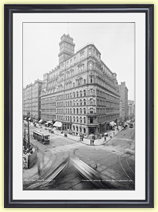
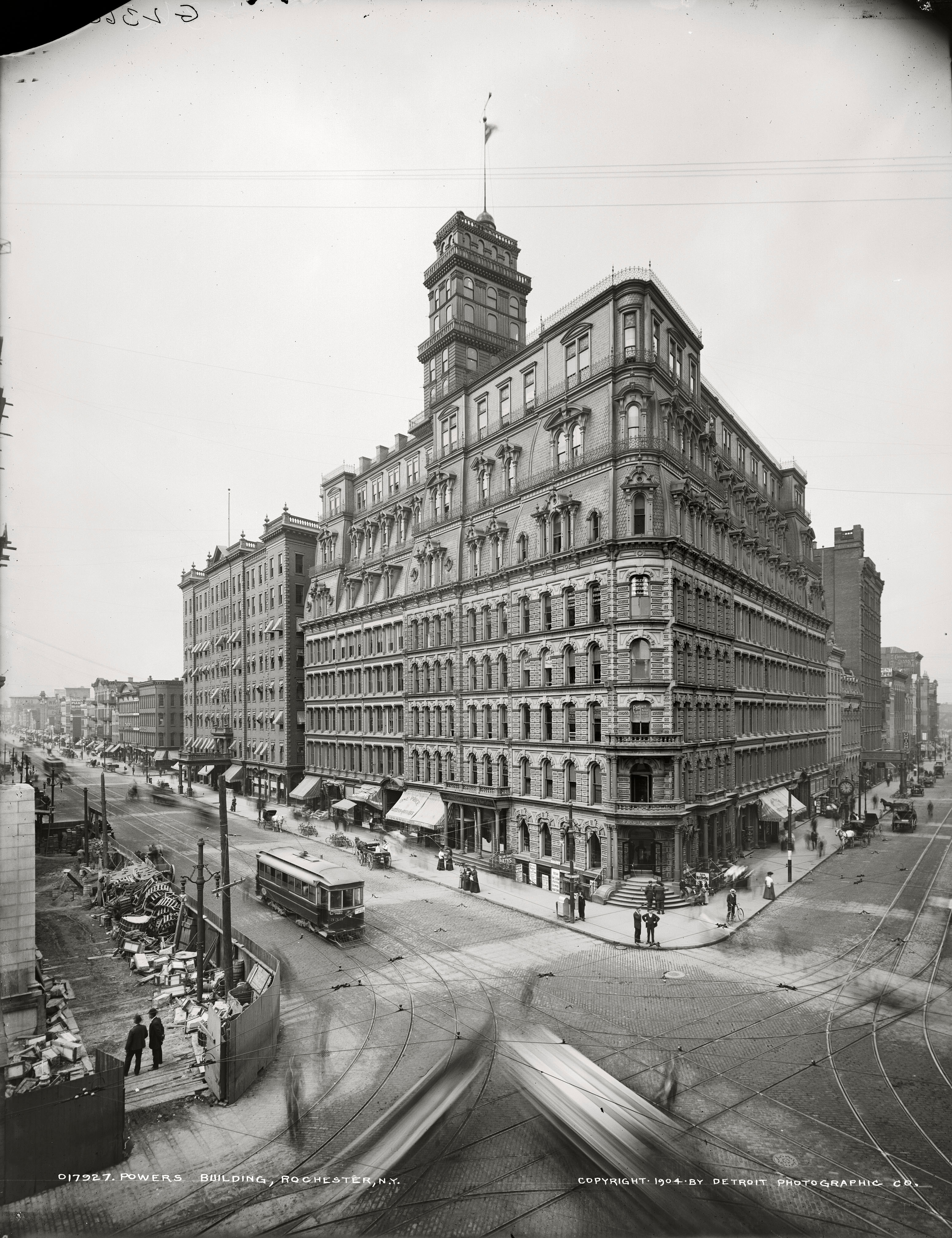
We found this old photo of the Powers Building and Rochester’s four corners recently on a vintage photos website called Shorpy.com . Not only is this a photo of one of Rochester’s most celebrated structures at one of the greatest times in the city’s history, but it’s incredibly detailed for such an old photo—right down to the logos painted on the office windows (click on the image to enlarge).
Hey, here’s a bit of fun for you… we hid the RochesterSubway.com logo somewhere in the photo. Let’s see which one of you can find it first. And while you’re searching for our hidden logo, here are a few other things you should take notice of…
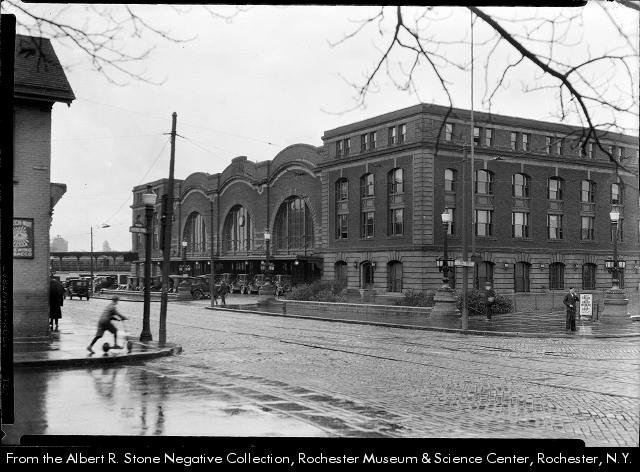
I’m a bit late on this but maybe this will be news to you. Some time last year, a notable infrastructure blog called The Infrastructurist, published a list of the top 10 greatest rail stations ever built. Standing shoulder to shoulder with some of the greatest examples of 20th Century American architecture is Rochester’s NY Central Station. What? You’ve never heard of it? That’s probably because it’s not with us anymore — may she rest in peace. The NY Central Station was demolished in 1965. In it’s place, the pretty little Amtrak Station you know and love today. In fact, all of the buildings on the Infrastructurist’s list are no longer.
“The organ [at Christ Church, Rochester NY] is a unique instrument, not only because of its lovely sound, but also because it is a nearly exact copy of a late Baroque organ built by Adam Gottlob Casparini of East Prussia in 1776. The original stands in the Holy Ghost Church in Vilnius, Lithuania. There is no other contemporary organ quite like the one at Christ Church.” These were the remarks of Guy Gugliotta, writer for the New York Times in a recent editorial entitled New Pipe Organ Sounds Echo of Age of Bach.
My brother-in-law who lives in Delaware spotted the article in the NY Times and immediately sent an email to tell me he found another reason to come and visit us in Rochester—to which I wittily replied, “Like you need another reason?” But he was truly impressed—as was I. Having walked past the Christ Church on East Avenue a zillion times before, I’m embarrassed to say I had no idea there was such a local treasure inside. So last week, my family and I decided to break tradition and attend a 10 o’clock Christmas Eve service just so we could witness the Craighead-Saunders Pipe Organ first hand. My brother-in-law was so jealous…
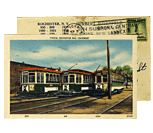
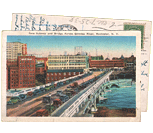
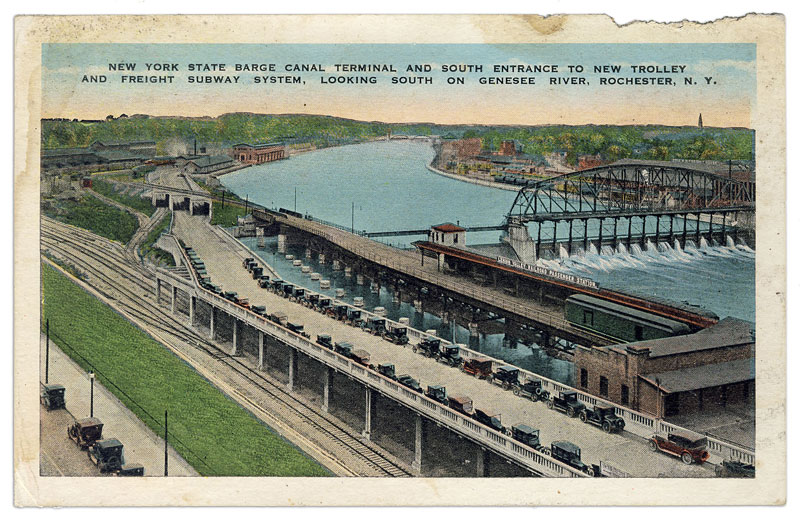
Recently we acquired this postcard (shown above) of the Rochester subway entrance at Court Street. And while I was reading up on the history of Rochester and the Erie Canal, I came across some pretty neat photos of downtown, the old canal, and later the construction of the Rochester Subway. These images say a thousand words so I’ll just start the slide show with this incredible panorama of Rochester from 1906…
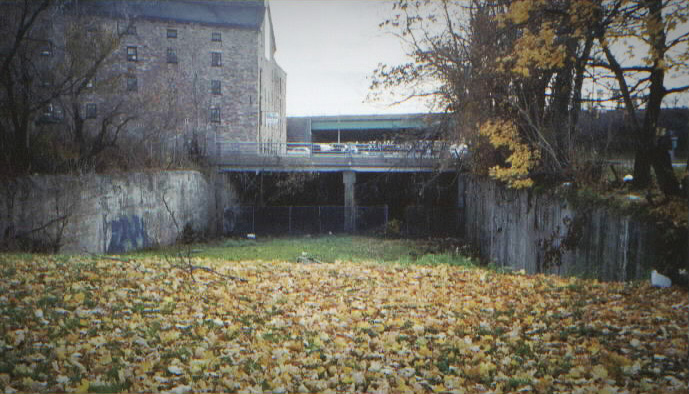
For decades it’s been an inconvenient truth for Rochester. The abandoned Erie Canal turned ghost subway tunnel has long been considered a ticking time-bomb. It’s widely known that the city has wanted to fill at least the west end of the tunnel for many years, citing critical safety deficiencies in the structure beneath the street surface. But, with Rochester’s ongoing economic struggles and estimates into the $10’s of millions, the project has been repeatedly delayed (or swept under the rug). Until now…
ROCHESTERSUBWAY.COM: It was recently brought to our attention that the City of Rochester is taking bids from contractors to repair and/or fill the abandoned subway tunnel under Broad Street. Can you confirm this? If so, what are the details of the job?
Tom Hack: The fill is going to take place from Brown Street to the RR portal next to Nick Tahoe’s (it involves about 1900 lf out of 4600 lf total). We are maintaining the RR portal behind Nick Tahoe’s as that will serve as a new access/maintenance road into the remaining sections of the tunnel.
ROCHESTERSUBWAY.COM: When are you hoping to start the work?
Tom Hack: We are scheduled to open bids on October 19, 2009. We hope to have “actual” construction operations underway in early December 2009, however the bulk of the tasks won’t hit their stride until April-May 2010.
ROCHESTERSUBWAY.COM: What range do you expect the bids to come in at? (in $$)
Tom Hack: We anticipate that bids for the work will be in the range of $14-16 Million (+/-).
ROCHESTERSUBWAY.COM: Is this project part of a larger initiative? i.e. Is this just Phase 1 in filling the rest of the tunnel, or maybe prep work for some larger project involving Broad Street?
Tom Hack: This project is a standalone project but obviously it does has ramifications toward other city proposed initiatives. Four issues that come into play are:
Parking within the confines of the remaining rehabilitated sections of the Tunnel
Phase III and IV of Rochester’s Historic Canal District Initiative does envision partial use of this space for the creation of the West end Basin, however the timing of this phase is 15-20 years out and obviously the dynamics and market conditions may dictate other uses.
Stabilization and general enhancement of the corridor. This project does strengthen, link and unify the visual attributes of the surrounding land uses and neighborhoods. This is an overall initiative of the City and indirectly the streetscape amenities that we will be installing does add value in that regard.
The project does advance the Rochester Heritage Trail. The Rochester Heritage trail is a designated walkway linking the City’s multitude of historic feature, dating when downtown was a port on the Erie Canal and the burgeoning center of commerce, industry and social activism. This is a self guided walk that identifies historic sites and tells the stories of Rochester’s people, places, and cultures as they impacted development of our nation. (Think Boston’s Freedom Trial)
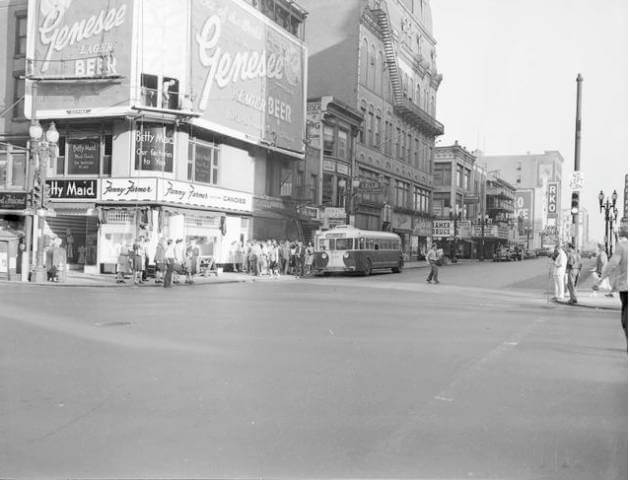
Last year sometime, Fred from Webster shared with us a few subway stories from when he was a kid. Fred contacted us again recently and this time shared a few old photos from the Main Street and Clinton area. When I get some time I’d like to go out and photograph these same locations today to see just how far we’ve come (or fallen). In the meantime take a look at these shots—and holler if you recognize any of these buildings…
A few weeks ago we showed you an amazing model railroad in Hamburg Germany called Miniature Wunderland. After we posted that story, let’s just say we were inspired.
In a recent post I implored our readers to send Maggie Brooks an email and request that she listen to Mayor Duffy’s concerns about the Renaissance Square project. It took a while but I actually did receive a response from Ms. Brooks. There no big surprises in it. As expected she defends the project citing the federal dollars, potential new jobs, and the 11 years it’s taken the project to get off the ground (11 years and still counting). But there are a few points that seem rather curious to me—one of which is a “full return on investment [for taxpayers] within seven years. Sure sounds dreamy. Here’s Maggies full response…
For a little more than 4 years I’ve worked in the High Falls district of Rochester. Last Thursday afternoon I took my lunch (which I usually eat over my computer keyboard) and I walked down Mill Street to Granite Mills Park. Of course you’ve never heard of it. It’s nothing more than a 50 foot square patch of concrete, a few trees, and 3 or 4 benches—not quite a full fledged “park” in the traditional sense. But on this sunny afternoon Granite Mills Park had transformed into a real urban plaza abuzz with music, laughter, people clapping, and even dancing.
A series of midday concerts presented by Hochstein Music School and WXXI called Hochstein at High Falls had kicked off with music provided by the Po Boy’s Brass Band. I don’t know if it was the glorious weather, the site of the surprisingly huge lunch-time crowd, or the sound of those trombones, but think I caught a glimpse of what the future might be like for that neighborhood by the falls…
The City Newspaper this week published an interview with Mayor Duffy, ‘It’s not too late to change’: Duffy on Ren Square . In it Duffy explains his recent coming out against the project as it is currently proposed. He cites recent changes in the business and development landscape downtown, new transportation stimulus funding, and sort of a personal awakening for his change of heart. Let’s show the Mayor we support him…
On Monday evening, June 8, 2009, the Rochester Regional Community Design Center will go before Rochester’s City Planning Commission and appeal the decision to allow a Fastrac gas station to be built on Main Street next to the Main/University Inner Loop on-ramp. Roger Brown, Creative Consultant at RRCDC explains, “Though we don’t agree with the Zoning Board’s decision to allow a gas station at that site … much of our case will be about the urban design of the building and how it needs to be designed according to the Center City Design Standards for Main Street.”
I’ll talk more about those “urban design standards” and how you can help. But first, there’s a virus spreading across America…
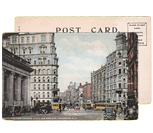
The intersection at State and Main Streets in downtown Rochester, known as the Four Corners, was once the epicenter of the city. I’m going to let these two photos do most of the talking for me in this article. The photo below is of the Four Corners, looking north toward State Street.
The postcard I’m holding in my hand is from the early 1900’s (maybe 1912-ish). Holding it up in front of the same location in 2009, it becomes a tiny window onto the past.
A few weeks ago I had the pleasure of being introduced to the Rochester Regional Community Design Center . The RRCDC is a group of design professionals, planners, and citizens who donate their time to the purpose of designing Rochester’s public spaces. They offer their design guidance and recommendations to the city through public lectures, design charrettes , and an open-to-the-public design gallery/resource library at their studio on East Main Street. For anyone remotely interested in how cities are planned or issues surrounding urban renewal as they apply to the city of Rochester, the RRCDC is a must-see.
If I said Rochester may one day have a rapid transportation system linking RIT to downtown Rochester and beyond, you might automatically think ‘light rail’. Think again. RochesterSubway.com recently discussed the future of Rochester’s transportation infrastructure with Richard Perrin, Executive Director of the Genesee Transportation Council and an AICP certified city planner.
NOTE: If you’ve got a question that we didn’t ask in our interview, please leave a comment at the end of this post and we’ll pass it along to Mr. Perrin who will do his best to answer it as time permits.
With the latest wave of federal stimulus , suddenly a storm of ideas and proposals are pouring down on downtown. In one corner, Governor David Paterson and Congresswoman Louise Slaughter are reigniting a movement in support of a new high-speed rail line from Niagara Falls to New York City. Slaughter wants to see Renaissance Square funds reallocated toward building a new train/bus station built where the old Amtrak station is now on Central Avenue . In the opposite corner, County Exec Maggie Brooks and Senator Charles Schumer are pushing ahead with demolition plans in preparation for Ren Square. Poor Mayor Duffy doesn’t know whether to take sides or run for cover.*
Okay, I haven’t put the time or effort into crafting my own “vision” for the old Midtown Tower, so I’m not going to be overly critical here. But I’m going to show you two concepts for Midtown that were sent to the city this week for review (and 1 wildcard concept). The first drawing (shown on the left) is from local developers Patrick Dutton and Shane Bartholf. It includes 158 for-sale condominiums with large window openings, common or public use of the former restaurant space on the 14th floor, and mixed-use office and retail on the first three floors. As you can see they’ve also added some shiny (albeit blurry) people to their drawing, as well as a lovely solar-flare effect to make the building look extra shiny…
Get Email Updates...
Stay up-to-date on Rochester-related stories, artifacts, and ideas that you won't find in the mainstream news.
Totally free, never spammy, and you can unsubscribe at any time.
After the Erie Canal was rerouted south of downtown Rochester, the Rochester
Industrial & Rapid Transit Railway (the “subway”) was built in
its place as a link between the five different railroads and interurban trolley
lines that served the Rochester area. As the industrial landscape of Rochester
changed, and highways replaced the railroads, the Rochester subway gradually
became a relic of a bygone era. In 1956 the subway was abandoned and much of
its route was converted into Interstate 490 — built to connect Rochester
with the New York State Thruway (I-90). Read more about the history of the Rochester Subway.
RochesterSubway.com exists to help spark
public dialogue around how we can better connect the neighborhoods of Rochester
NY, surrounding communities, and their cultural offerings. Rochester’s
future is written in her past. Let's rediscover it.