Every year, the roads witness countless motor vehicle accidents, with motorcyclists being some of the most vulnerable road users. As communities like Rochester experience bustling traffic and the pressure of busy roads, emphasizing safety becomes crucial. This article aims to highlight the importance of motorcyclist safety with insightful statistics and reflections on current road conditions.
The Staggering Statistics of Road Safety
As reported by the Insurance Institute for Highway Safety, a segment of motor vehicle accident fatalities involves bikers, accounting for 2% annually. It is known to many as one of the riskiest forms of transportation. This statistic illustrates the broader picture of road safety issues, which equally (if not moreso) affects motorcyclists. Safety precautions and improved awareness can drastically reduce these numbers and ensure a safer environment for all drivers.
The importance of structural integrity in vehicles underscores the need for preventive measures. In collisions, the windshield serves as a crucial component, providing nearly half the cabin’s strength in frontal crashes and up to 60% in rollovers, according to the Auto Glass Safety Council. Such data emphasizes the delicate nature of motorcycles, urging better protective gear and safety standards.
Rochester’s busy roads expose motorcyclists to an array of potential hazards. Commuters on these roads face unique challenges, including limited visibility and higher risks during peak traffic hours. Therefore, enhancing safety measures becomes a collective responsibility to avert tragic incidents.
Understanding the Perils Motorcyclists Face
Motorcyclists often face adverse weather conditions that can make riding perilous. Rain, snow, and fog can severely impair vision and road grip, making Rochester’s roads particularly hazardous during harsh weather. Recognizing these challenges helps promote an informed approach to road safety and proactive measures during unpredictable conditions.
Furthermore, the typical U.S. driver travels approximately 14,500 miles each year, according to Kelley Blue Book. This statistic underscores the constant exposure to traffic risks, which are magnified for motorcyclists due to their vulnerability. The frequent interaction with various road dynamics necessitates stringent adherence to safety protocols.
In every ride through Rochester, motorcyclists confront daily hazards that demand heightened awareness and defensive driving techniques. The dense traffic patterns and variable speed limits require acute focus and preparedness to navigate safely. By incorporating education and targeted safety campaigns, such risks can be effectively mitigated.
Strategies for Promoting Motorcyclist Safety
Enhancing motorcyclist safety is not just a simple task; it starts as a multi-faceted approach that involves both formal education and increased awareness. The journey towards safer riding begins in the classroom and on the training grounds, where riders are introduced to not only the fundamental principles of motorcycling but also the importance of a responsible riding culture.
At the core of a motorcyclist’s safety arsenal are the protective gear items, which play a crucial role in minimizing injuries in the event of an unfortunate accident. Helmets, which are often the most recognizable piece of safety gear, provide essential protection for the rider’s head, reducing the risk of traumatic brain injury. Additionally, jackets, gloves, pants, and boots designed for motorcycling are not simply fashion statements; they are engineered with materials that help to shield the rider from abrasions and impacts. Educating riders on the proper selection and usage of this gear is fundamental in the broader effort to safeguard their well-being.
Moreover, understanding and adherence to traffic laws and road rules cannot be overstated. Riders must be well-versed in the local traffic regulations to navigate roads legally and safely. This knowledge includes understanding the rights of way, speed limits, and traffic signals. Such understanding helps prevent accidents and fosters a respectful co-sharing of road spaces with other vehicles. Modern vehicles integrate safety features that help prevent accidents and offer real-time data to reduce risks. Integration of smart road systems can further enhance safety for motorcyclists navigating busy urban areas. Collaborative efforts between community authorities and road users can build a safer environment. Rochester can spearhead initiatives, advocating for safer roads through public forums, workshops, and heightened enforcement of traffic regulations. Such collaborations are key in fostering a culture of safety and responsibility.
With the ever-growing traffic demands, especially in bustling cities like Rochester, the emphasis on motorcyclist safety is imperative. By understanding the emerging statistics and adopting proactive measures, a significant reduction in road incidents is achievable. Through collective efforts, we can strive for safer journeys and secure the place of motorcyclists on our roads.
Accidents are an unfortunate yet prevalent part of everyday life, with significant risks that can often be minimized through proper awareness and preventive measures. In Rochester, as in many places, understanding the gaps in safety practices and the common causes of accidents can help in creating a safer community. By examining statistics and facts, we aim to shed light on preventable risks and explore pathways to reduce them significantly.
Bicycling Risks and Road Safety
Bicycling, although a popular mode of transport and recreation, harbors significant risks due to road accidents. Reports show that annually, approximately 1,000 bicyclists meet fatal ends on U.S. roads, with over 130,000 affected by collisions. This startling figure highlights the urgency for improved cycling infrastructure and stringent enforcement of traffic rules. In Rochester, initiatives for enhancing bike lanes and public awareness campaigns can drastically lower accident occurrences. Emphasis on wearing helmets and obeying road signals should be an integral part of these safety measures.
The concept of shared road space between cyclists and motorists is often fraught with challenges, leading to tragic incidents. It is crucial to acknowledge the vulnerabilities cyclists face while navigating through city traffic. Adopting a collaborative approach involving city planners, law enforcement, and the local community can contribute towards safer roads. For instance, the city’s role in deploying more bike-friendly pathways plays a crucial role in accident prevention. Residents of Rochester can also contribute by staying informed and respectful towards one another on the road.
Public safety campaigns focus heavily on education, ensuring that both cyclists and motorists understand their responsibilities. Enhanced visibility measures, like reflective clothing or improved street lighting, can be cornerstone strategies to prevent nighttime accidents. With the right combination of policy and public action, Rochester can set a benchmark in urban cycling safety. Continual data analysis and feedback loops will further refine prevention strategies, reducing the risk for cyclists effectively.
Automotive Accidents: A Predominant Risk
Across the country, automotive accidents present a grave concern, making up a substantial portion of injury cases. Reports indicate that 61% of personal injury claims stem from car accidents, emphasizing the need for improved vehicular safety measures. In Rochester, like many urban centers, traffic congestion amplifies the risk of collisions, underscoring the importance of defensive driving practices. Regular updating, routine check-ups, and following traffic guidelines are vital for every road user’s safety. Rochester’s municipal authorities must also invest in better traffic control systems to mitigate accident risks.
Human error is often a significant contributor to car crashes, highlighting the importance of continuous driver education. Defensive driving classes can be essential in equipping residents with the skills needed to anticipate and react appropriately in hazardous situations. The city can also leverage technology, using apps and online platforms to disseminate information quickly and efficiently to all drivers. By integrating current technologies, such as real-time traffic alerts, Rochester can take a significant step towards reducing the number and severity of road incidents. Predictive analytics can further forecast high-risk areas and times, allowing for preemptive safety measures.
Rochester’s road safety can also improve through collaboration with car manufacturers and insurers. Encouraging the adoption of new safety technologies in vehicles, such as automatic braking systems, can drastically reduce accidents. Additionally, insurance incentives for drivers who demonstrate safe practices can motivate a culture focused on accident prevention. With concerted efforts from all stakeholders, the number of road-related injuries can significantly decline, ensuring safer streets for all residents.
Workplace Safety: Addressing Lift Accidents
In industries where automotive lifts are frequently used, such as automotive repair, safety standards are essential to prevent avoidable accidents. Reports highlight that more than 50% of lift-related accidents occur due to inadequate maintenance and insufficient inspections. As a precaution, employers and workers in Rochester are urged to adhere strictly to safety standards and schedules for regular lift certifications. Negligence in workplace safety protocols can lead to both human and material costs, which are largely preventable through proper diligence. Creating a culture focused on proactive safety measures could significantly diminish workplace hazards.
Training programs and compliance checklists play a critical role in minimizing lift-related mishaps. Employers in Rochester should prioritize regular staff training sessions on equipment handling best practices. Implementing periodic safety audits can also ensure adherence to industry standards, thus reducing the likelihood of accidents. Additionally, providing quick access to emergency procedures can further heighten workplace safety. A culture of transparency, where workers feel comfortable reporting potential hazards without fear of retaliation, can foster a safer working environment.
Modernizing existing infrastructure in automotive repair shops by investing in state-of-the-art equipment is another prevention strategy. By continuously assessing and updating mechanical lifts and related machinery, risks can be managed effectively. Communication between safety equipment manufacturers and users is key to staying abreast of the latest safety protocols. Rochester can become a leader in workplace safety through innovation and shared responsibility. Ultimately, proactive efforts in maintaining safe workplaces will contribute to reducing overall accident statistics.
In conclusion, preventing accidents in Rochester requires a multi-faceted approach involving the cooperation of the entire community. By addressing the specific risks associated with bicycling, driving, and workplace safety, significant strides can be made. Adopting new technologies, educational campaigns, and enforcing strict safety standards can collectively bridge the safety gap, ensuring the well-being of residents and setting a precedent for other cities to follow.
There is some unfortunate news regarding driving in Rochester, New York. The police and media have reported an increase in carjackings, and if you’re a driver you know that’s trouble. Carjackers are often armed, violent, and desperate to get away from the scene of a crime, making the situation very volatile if you’re unprepared or choose to fight back. Even though carjackings are on the rise, there is evidence that suggests that it’s still safe to drive in Rochester, so long as you know what you’re doing.
Today’s Filling in is just a little bit different than usual. Instead of looking at one building or one site, we’re going to take a look at a whole block. Namely, Main Street from Clinton to St. Paul. If you hadn’t already heard, there is a huge event called The re:Main Social taking place there on October 1st. I hope all of you are able to make it. In the lead up to it, let’s discuss some short to long term visions for the area.
The City of Rochester has issued a Request For Proposals (RFP) to adaptively reuse, redevelop, and operate five former bus shelters on Main Street in downtown Rochester, NY. The deadline to respond is June 26 and successful proposals are expected to be announced by July 31…
Protected bike lanes for the full length of Main Street. This was the request from local cycling advocate Harvey Botzman in an email late last week to City officials and other cycling advocates. The east end of Main Street in downtown Rochester is about to undergo a complete reconstruction, but bike lanes aren’t part of the plan. Additionally, the City is working on a plan to improve pedestrian connections and enhance the stretch of East Main Street between the Public Market and Neighborhood Of The Arts.
So with Main Street under the microscope, now is the time for all of us to demand, not ask, for a healthier mix of transportation options and amenities for Main Street. Harvey is leaving no gray area. He’s calling for “protected bike lanes for the full length of Main St. from Winton Rd. to Mt. Read Blvd.” and here’s why…
A local collective of artists/illustrators known as Hope Mountain have been publishing art books in Rochester for the past 4 years. Now they’re in the middle of Kickstarting this year’s Volume 5 and they’re asking for our help…
As some of you may or may not know, the city recently released a Request For Proposals (RFP) for the redevelopment of another piece of the Midtown site. Parcel 5 , the site in question, is the very long block from Main St to Elm St and between the Windstream building to the west and 1 East Avenue (Bank of America) to the east. Let’s go back to our trusty Midtown site plan for a visual…
Check out this great photo of the Powers Building from 1968. Notice the workmen up on the ledge of the Mansard roof. Down at street level a shiny new, streamlined façade as been awkwardly forced on top of this 1869 building…
Like, WOW! I stumbled upon this concept for an elevated transit terminal in a 1967 D&C article. The drawing shows how Rochester Transit Corporation president William Lang envisioned passengers would wait for their bus – suspended above the intersection of Main & Clinton. This view is looking east toward Clinton Avenue with Sibley’s in the background…
This former department store (Sibley, Lindsay & Curr Company) is truly massive. Rochester’s Sibley Building weighs in at over 1.1 million square feet (23 acres of floorspace) – easily the largest building in Monroe County.
WinnCompanies out of Boston now owns the property and plans to spend up to $200 Million over the next five years to bring it back to life as mixed-use space. Holy smokes, do these guys have their work cut out for them. You may have noticed new windows and awnings along Main Street? Some 2,000 windows have yet to be replaced.
Last week the UofR Urban Explorers Club went on a tour through the maze of hallways and spaces, from the dark sub-basement all the way up to the two massive water tanks on the tower rooftop…
The second part of The Biking in Rochester Series showcases the route from downtown to Lake Ontario, following the Genesee River Trail. It is 20 miles, roundtrip, from downtown to the end of the pier at Lake Ontario Beach Park and back. Actually, I’ll take us a bit further and ride along the lake shore, east to Sea Breeze – adding another 8 miles to the trip.
Although this route is not as consistently scenic as the first one, it has much better rewards, and you get more of a workout. We’ll pass by 3 waterfalls, 3 beaches, 3 lighthouses, and two piers out onto the big lake. The western portion of this route is on the Genesee Riverway trail, a mostly completely dedicated bike path such as the one on the canal. The eastern portion is on King’s highway/Goodman street…
Welcome readers. I’m going on a slight deviation from my usual “Filling In” article to talk about the mean streets of Rochester. Let’s take a look at, eh, Main St. Yeah, Main St. What’s that looks like? Ok, well, there’s some tall(ish) buildings built to the street. There’s sidewalk, theoretically two driving lanes in each direction, and (supposedly) some street trees. If I were to give this street a grade, it would get an “in-complete.”
Oy, how I wish I could reconfigure things! Just pick stuff up and move it around. Maybe add a cycle track or a tree-lined median. Heh heh… can you say, STREET REMIX?!
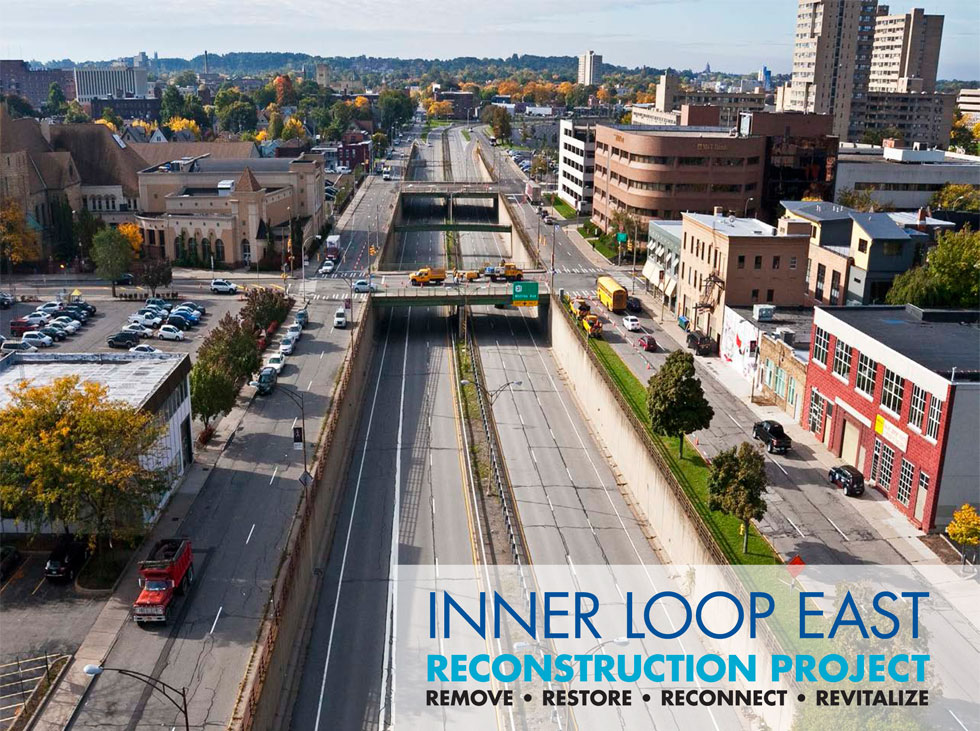
Reconnect Rochester has alerted us to an important informational meeting tonight about the Inner Loop’s future (or lack thereof). As we wait to find out whether or not this project will be a recipient of a USDOT TIGER grant, the City is moving forward with plans to scale down a large portion the underutilized 12-lane highway. Ultimately that will mean greater connectivity between downtown and the neighborhoods to the east, and lower road maintenance costs in the long run. If there was ever a big road project to support, this is it.
The shuttered National Clothing building on East Main and Stone Streets will soon be seeing new life as a Hilton Garden Inn. After reading the original post here I wanted to take an opportunity to expand on the history of the building and offer a more in-depth idea of what the rehabilitation entails. The $16 million project is being completed by DHD Ventures and is utilizing historic tax credits. The RBA Group of North Carolina is the project architect and Preservation Studios is providing all services relating to the historic tax credit program.
In 1970 a Lincoln Rochester Trust Co. advertisement in the Daily Record hailed, “Lincoln Tower… a tangible expression of our belief in the growth of Upstate New York… Through 1970 and beyond.”
The Lincoln First Tower, now called Chase Tower was completed in the summer of 1972 at a cost of $20 million. It is 398 feet tall. It contains about 356,000 square feet of office space. It is a big building. Just like the Xerox Tower, Chase Tower has roots in Seattle. John Graham and Company is an architecture firm based in Seattle…
Hey kids, you know what today is? That’s right, Fun Foto Friday! I know you’ve probably had your fill of spandex-wrapped web-slingers, street closures, and NYC squad cars blowing up everywhere. But I just wanted to post some of my pics from the last couple days of Spider-Man filming. And I’d like to see yours too. If you were able to slip past the barricades and snag a few good shots, go ahead and post a link in the comments section…
A recent story in the Rochester Business Journal had me pleasantly surprised to learn that the Hilton hotel chain is strongly considering adapting a five-story former clothing store at 155 E. Main Street into a Hilton Garden Inn. Around the corner at 25 Stone Street , a smaller two-story building (formerly the Stone Street Grill) would also be part of the 15 million dollar plan.
Normally I don’t get all revved up for national chains, but there are at least two REALLY good things happening here: Private interest/investment in Main Street (good), AND adaptive reuse of three or four old buildings (REALLY GOOD).
I also learned something very interesting about these buildings. What’s old may be new again…
I’ve given myself a photo assignment for 2013. Pick 13 subjects, and take 13 snapshots of each. Simple. We started last month with 13 mailboxes. This month I turned my lens on what I thought were some of Rochester’s most intriguing storefronts. These images were taken on the city’s east side, from Monroe Ave up to East Ridge Road…
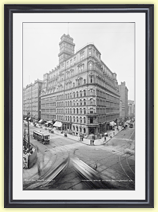
Here’s one heck of a photo – Rochester’s Main Street around the turn of the last century. It was snapped from a fire escape at 102 W. Main, near the corner of N. Plymouth Avenue, looking east. Make sure you click on the image and zoom all the way in for all the incredible detail. Across the street you’ll notice some pretty major landmarks. The most obvious one being Hotel Rochester on the far right…
Get Email Updates...
Stay up-to-date on Rochester-related stories, artifacts, and ideas that you won't find in the mainstream news.
Totally free, never spammy, and you can unsubscribe at any time.
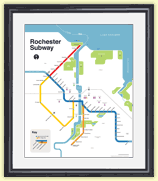
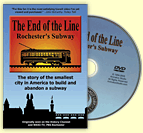
After the Erie Canal was rerouted south of downtown Rochester, the Rochester
Industrial & Rapid Transit Railway (the “subway”) was built in
its place as a link between the five different railroads and interurban trolley
lines that served the Rochester area. As the industrial landscape of Rochester
changed, and highways replaced the railroads, the Rochester subway gradually
became a relic of a bygone era. In 1956 the subway was abandoned and much of
its route was converted into Interstate 490 — built to connect Rochester
with the New York State Thruway (I-90). Read more about the history of the Rochester Subway.
RochesterSubway.com exists to help spark
public dialogue around how we can better connect the neighborhoods of Rochester
NY, surrounding communities, and their cultural offerings. Rochester’s
future is written in her past. Let's rediscover it.



















![Overhead view of Main Street from Clinton to St. Paul [PHOTO: RPL Local History Division]](https://www.rochestersubway.com/topics/wp-content/uploads/Street_Scene_1898.jpg)

![The City of Rochester has issued a Request For Proposals (RFP) to adaptively reuse, redevelop, and operate five former bus shelters on Main Street in downtown Rochester, NY. [PHOTO: Hennebery Eddy Architects, Inc.]](https://www.rochestersubway.com/images/photos/portland-bus-shelter-coffee-kiosk.jpg)
![Harvey Botzman, a local cycling advocate, is calling for protected bike lanes for the full length of Main Street in Rochester. [PHOTO: J. Stephen Conn, Flickr]](https://www.rochestersubway.com/images/photos/main-street-protected-bike-lanes-01.jpg)
![A local collective of artists/illustrators known as Hope Mountain is Kickstarting to produce a new book and put some artwork on Main Street. [Image: Peter Lazarski]](https://www.rochestersubway.com/images/photos/hope-mountain-02.jpg)

![The Powers Building at Main & State Streets, 1968. [PHOTO: Winters, via Library of Congress]](https://www.rochestersubway.com/images/photos/powers-building-rochester-1968.jpg)
![A concept by RTC president William Lang for a central transit terminal at Main & Clinton, Rochester NY. [IMAGE: Democrat & Chronicle, January 29, 1967]](https://www.rochestersubway.com/images/photos/rochester-central-transit-terminal-concept-1964.jpg)
![The Sibley Building, Rochester NY. [PHOTO: RochesterSubway.com]](https://www.rochestersubway.com/images/photos/rochester-sibley-building-01.jpg)
![Turning Point Park boardwalk. [PHOTO: Ryan Green]](https://www.rochestersubway.com/images/photos/rgbike-bike-to-lake-ontario-25-turning-point-park-boardwalk3.jpg)
![The current view looking west down Main Street, Rochester. Blah. If only we could rearrange things. [IMAGE: Google Streetview]](https://www.rochestersubway.com/images/photos/remix-your-street-01b.jpg)
![The shuttered National Clothing building on East Main and Stone Streets will soon be seeing new life as a Hilton Garden Inn. [PHOTO: Preservation Studios]](https://www.rochestersubway.com/images/photos/national-clothing-store-01.jpg)
![The Lincoln First Tower, now called Chase Tower was completed in the summer of 1972 at a cost of $20 million. It is 398 feet tall. [Looking North. Stone St. is on the left, and Broad St. on the bottom]](https://www.rochestersubway.com/images/photos/rochester-chase-tower-04.jpg)
![Filming of Spider Man 2 in Rochester, NY. [PHOTO: RochesterSubway.com]](https://www.rochestersubway.com/images/photos/spider-man-rochester-ny-01.jpg)
![The Hilton hotel chain is strongly considering adapting this five-story former National Clothing Store on Main Street into a Hilton Garden Inn. [PHOTO: Rochester Public Library]](https://www.rochestersubway.com/images/photos/national-clothing-store-rochester-2013.jpg)

![View of Main Street, Rochester, NY. c.1908. [PHOTO: Detroit Publishing Co. via Library of Congress]](https://www.rochestersubway.com/images/photos/hotel-rochester-main-street-1908.jpg)