The fourth First Niagara Rochester Fringe Festival (Thursday, September 17 – Saturday, September 26) announced its complete lineup this week at its annual BIG REVEAL at The Little Theatre. The 2015 Fringe will include more than 500 performances and events (up from 2014’s 380) featuring all genres of art in 25+ venues in downtown Rochester, with more than 120 of them offered free of charge. The full schedule is available and all tickets are on sale as of now at RochesterFringe.com …
The complex of the Rochester Psychiatric Center (a.k.a. Rochester State Hospital or Monroe County Insane Asylum) is legendary among urban explorers and history fanatics alike. Originally built in the early 1800s as the Monroe County Almshouse (or poorhouse), new buildings and facilities were gradually added to care for the mentally ill.
Although the hospital still operates to this day, a few buildings were closed in the mid-1990s and now sit in various states of decay. One notable example we’ve explored previously is the towering 16-story Terrence Building which looms over Elmwood Avenue. Another is the sprawling Walters Building (originally known as the Orleans Building) which we’ll be exploring today…
A good friend of mine, Ander Kazmerski , just posted some sweet drone footage of Rochester. The video focuses on two sites – the Rochester subway and the Carnegie building on Goodman Street just after its devastating fire. I don’t think I need to say much about it. These images speak for themselves. You’ll definitely want to go full-screen with this one…
Yesterday we took a bike ride down inside the Inner Loop with Matthew Ehlers to see how Rochester’s “big fill” was progressing. Quite nicely I’d say. But once filled, the next question becomes, what will fill the void.
RocSubway reader Ben Voellinger pointed us to a recent document posted to the City’s website that outlines recommendations for future development(s) along the new Union Street. Thanks Ben! Let’s take a look…
Get Email Updates...
Stay up-to-date on Rochester-related stories, artifacts, and ideas that you won't find in the mainstream news.
Totally free, never spammy, and you can unsubscribe at any time.
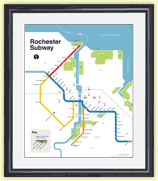
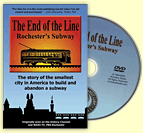
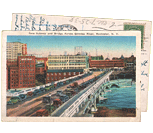
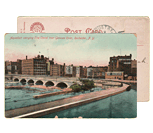
After the Erie Canal was rerouted south of downtown Rochester, the Rochester
Industrial & Rapid Transit Railway (the “subway”) was built in
its place as a link between the five different railroads and interurban trolley
lines that served the Rochester area. As the industrial landscape of Rochester
changed, and highways replaced the railroads, the Rochester subway gradually
became a relic of a bygone era. In 1956 the subway was abandoned and much of
its route was converted into Interstate 490 — built to connect Rochester
with the New York State Thruway (I-90). Read more about the history of the Rochester Subway.
RochesterSubway.com exists to help spark
public dialogue around how we can better connect the neighborhoods of Rochester
NY, surrounding communities, and their cultural offerings. Rochester’s
future is written in her past. Let's rediscover it.



















![Rochester Fringe Festival [IMAGE: RochesterFringe.com]](https://www.rochestersubway.com/images/photos/rochester-fringe-festival-2015-01.jpg)
 …
…![Inside the abandoned Walters psychiatric building. [IMAGE: Snoop Junkie - Rochester Urban Exploration Squad]](https://www.rochestersubway.com/images/photos/rochester-state-hospital-walters-building-04.jpg)
![Aerial drone footage of Rochester; the subway and Carnegie Place after fire. [IMAGE: Ander Kazmerski]](https://www.rochestersubway.com/images/photos/rochester-carnegie-building-drone-video-01.jpg)
![A recent report from Stantec outlines recommendations and suggestions for the redevelopment of Union Street after the Inner Loop is filled. [IMAGE: Philip Michael Brown Studio / City of Rochester]](https://www.rochestersubway.com/images/photos/rochester-inner-loop-development-00.jpg)