Accidents are an unfortunate yet prevalent part of everyday life, with significant risks that can often be minimized through proper awareness and preventive measures. In Rochester, as in many places, understanding the gaps in safety practices and the common causes of accidents can help in creating a safer community. By examining statistics and facts, we aim to shed light on preventable risks and explore pathways to reduce them significantly.
Bicycling Risks and Road Safety
Bicycling, although a popular mode of transport and recreation, harbors significant risks due to road accidents. Reports show that annually, approximately 1,000 bicyclists meet fatal ends on U.S. roads, with over 130,000 affected by collisions. This startling figure highlights the urgency for improved cycling infrastructure and stringent enforcement of traffic rules. In Rochester, initiatives for enhancing bike lanes and public awareness campaigns can drastically lower accident occurrences. Emphasis on wearing helmets and obeying road signals should be an integral part of these safety measures.
The concept of shared road space between cyclists and motorists is often fraught with challenges, leading to tragic incidents. It is crucial to acknowledge the vulnerabilities cyclists face while navigating through city traffic. Adopting a collaborative approach involving city planners, law enforcement, and the local community can contribute towards safer roads. For instance, the city’s role in deploying more bike-friendly pathways plays a crucial role in accident prevention. Residents of Rochester can also contribute by staying informed and respectful towards one another on the road.
Public safety campaigns focus heavily on education, ensuring that both cyclists and motorists understand their responsibilities. Enhanced visibility measures, like reflective clothing or improved street lighting, can be cornerstone strategies to prevent nighttime accidents. With the right combination of policy and public action, Rochester can set a benchmark in urban cycling safety. Continual data analysis and feedback loops will further refine prevention strategies, reducing the risk for cyclists effectively.
Automotive Accidents: A Predominant Risk
Across the country, automotive accidents present a grave concern, making up a substantial portion of injury cases. Reports indicate that 61% of personal injury claims stem from car accidents, emphasizing the need for improved vehicular safety measures. In Rochester, like many urban centers, traffic congestion amplifies the risk of collisions, underscoring the importance of defensive driving practices. Regular updating, routine check-ups, and following traffic guidelines are vital for every road user’s safety. Rochester’s municipal authorities must also invest in better traffic control systems to mitigate accident risks.
Human error is often a significant contributor to car crashes, highlighting the importance of continuous driver education. Defensive driving classes can be essential in equipping residents with the skills needed to anticipate and react appropriately in hazardous situations. The city can also leverage technology, using apps and online platforms to disseminate information quickly and efficiently to all drivers. By integrating current technologies, such as real-time traffic alerts, Rochester can take a significant step towards reducing the number and severity of road incidents. Predictive analytics can further forecast high-risk areas and times, allowing for preemptive safety measures.
Rochester’s road safety can also improve through collaboration with car manufacturers and insurers. Encouraging the adoption of new safety technologies in vehicles, such as automatic braking systems, can drastically reduce accidents. Additionally, insurance incentives for drivers who demonstrate safe practices can motivate a culture focused on accident prevention. With concerted efforts from all stakeholders, the number of road-related injuries can significantly decline, ensuring safer streets for all residents.
Workplace Safety: Addressing Lift Accidents
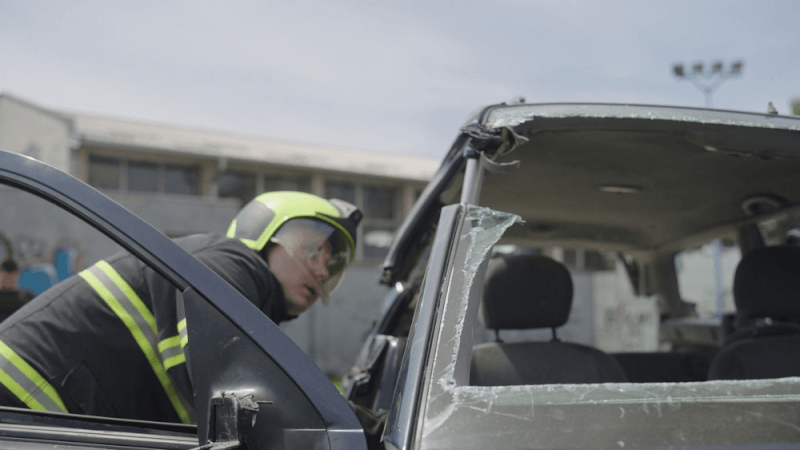
In industries where automotive lifts are frequently used, such as automotive repair, safety standards are essential to prevent avoidable accidents. Reports highlight that more than 50% of lift-related accidents occur due to inadequate maintenance and insufficient inspections. As a precaution, employers and workers in Rochester are urged to adhere strictly to safety standards and schedules for regular lift certifications. Negligence in workplace safety protocols can lead to both human and material costs, which are largely preventable through proper diligence. Creating a culture focused on proactive safety measures could significantly diminish workplace hazards.
Training programs and compliance checklists play a critical role in minimizing lift-related mishaps. Employers in Rochester should prioritize regular staff training sessions on equipment handling best practices. Implementing periodic safety audits can also ensure adherence to industry standards, thus reducing the likelihood of accidents. Additionally, providing quick access to emergency procedures can further heighten workplace safety. A culture of transparency, where workers feel comfortable reporting potential hazards without fear of retaliation, can foster a safer working environment.
Modernizing existing infrastructure in automotive repair shops by investing in state-of-the-art equipment is another prevention strategy. By continuously assessing and updating mechanical lifts and related machinery, risks can be managed effectively. Communication between safety equipment manufacturers and users is key to staying abreast of the latest safety protocols. Rochester can become a leader in workplace safety through innovation and shared responsibility. Ultimately, proactive efforts in maintaining safe workplaces will contribute to reducing overall accident statistics.
In conclusion, preventing accidents in Rochester requires a multi-faceted approach involving the cooperation of the entire community. By addressing the specific risks associated with bicycling, driving, and workplace safety, significant strides can be made. Adopting new technologies, educational campaigns, and enforcing strict safety standards can collectively bridge the safety gap, ensuring the well-being of residents and setting a precedent for other cities to follow.
Rochester is a beautiful and charming city based in Upstate New York. It’s a destination steeped in culture featuring museums, art galleries, performance arts, jazz music, and education, and is known as the “birthplace of amateur photography.” Rochester is also fondly known as the city of flowers because it’s home to magnificently beautiful lilac flowers, with the first bush planted in the 1890s. Today, Rochester also celebrates the much-anticipated annual Lilac Festival.
If you’re looking to move, today’s article discusses some things to know before relocating to Rochester, New York.
Driving down East Main Street recently, I spotted the name “Martha Matilda Harper” engraved on a building near the old Beech Nut packaging plant. My interest was piqued, since the building at 1233 East Main Street currently houses Tire Trax sales and service. It turns out that the facility is the former laboratories for Martha Matilda Harper, Inc.
I can’t believe that I’d never heard of Martha Matilda Harper, but we can thank her for just about everything having to do with our modern salon experiences, as well as her groundbreaking business methods that pioneered modern retail franchising…
Gallina Development , with the help of the Rochester Model Railroad Club , has restored a favorite old model railroad display for the holiday season. The model trains, which have sat in storage for a decade, will be in the lobby of The Metropolitan (formerly Chase Tower) at One Chase Square in Downtown Rochester through the holidays…
If there’s a cemetery tour happening in Rochester, you can be sure I’m there. For anyone interested in local history, there’s no better place to find unusual stories and bits of trivia, and I’m fascinated by the history buried all around us.
A few weeks ago, the City of Rochester hosted the annual Genesee River Romance weekend celebrating the Genesee River and its surrounding trail and gorge system. In 2014, I took full advantage of the weekend of events that include tours of the old subway and aqueducts, the Rundel Library, the Falls, and cemeteries. Somehow, I missed the adverts for this year’s event, so I only had time to catch one thing: the tour of Charlotte Cemetery…
While doing research for a recent story on the Rochester Marshmallow Company, we came across another interesting story right around the corner. This one had nothing to do with marshmallows. Wulff’s Hotel (shown above) at the corner of State and Factory Streets, was the scene of a notorious murder case…
Welcome to the old Vacuum Oil plant on the west bank of the Genesee River in Rochester’s Plymouth-Exchange neighborhood. Abandoned for nearly a century, there has been very little desire to re-develop this 26-acre site due to contamination. Now, the City of Rochester is aiming to use New York State’s Brownfield Opportunity Areas program to clean it up and plan for its future redevelopment. But as of today, this property is still highly toxic. And you guessed it—we’re going inside…
This former Rochester Plumbing Supply building at 281 Mill Street has recently been renovated and converted into 14 new apartments in downtown’s growing High Falls district. This is an exciting development not only because of the new life it will add to this neighborhood, but because this building has a pretty sweet past…
I received an email last week from George Conboy, Chairman of Brighton Securities. He asks, “Have you seen anywhere a photo of the transportation mural that was behind the long ticket counter at the old airport? I remember it as a vaguely Art Deco theme of general transportation with an emphasis, of course, on air transport.”
Mr. Conboy explained that he used to fly a lot during the “glory days” of air travel back in the 1960s when he was a kid. “I just liked that old mural. I used to see it all the time and it has always been in my mind.”
This is a great question. I had been told of this mural before but have never seen it myself. Photos of it online are practically non-existent, so this one will require some digging…
In 1870 Ellwanger & Barry (and other wealthy investors) owned a spot along the west bank of the Genesee River gorge known as Maple Grove. At the time, the Lake Avenue streetcar line stretched all the way to this point, and in an effort to stimulate traffic on the trolley line, they had built Rochester’s first water-side resort; the Glen House…
Have you ever discovered a piece of living history in your own home? It can be a thrilling moment when something that’s been hiding under your feet (or above your head) for decades suddenly reveals itself, opening a little window onto the past.
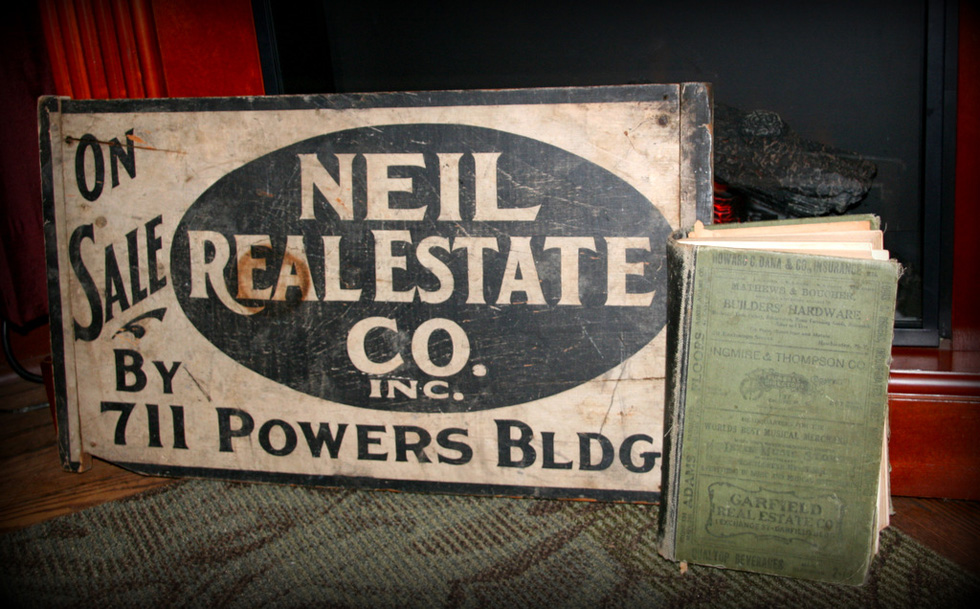
Last week Brenda Washington sent us these photos and a note that read:
“Hello! I have a home in the Highland section of town (circa 1870) and have a really cool wooden block “for sale” sign that was found in the attic, from Neil Real Estate Co. Its a pretty cool sign… Never have seen one like it!”
We know the feeling, Brenda. And we’re happy to share your discovery. Here are the photos of the sign and an old Rochester business directory Brenda also found from 1921 showing an old advertisement for Neil Real Estate Co…
Last week, Carnegie Place was largely destroyed by fire. Its life spanned some of the most crucial and drastically changing times in Rochester’s history. I had a chance to stop by after the fire and take some photographs of a building I have always enjoyed; in a part of town that was vibrant and still is the heart of the arts movement in Rochester…
Last summer Rochester developer and restauranteur, John Tachin called up RocSubway with a history mystery for us to solve. After four months of digging, we came up empty. But here’s hoping maybe YOU can help us solve the case of the stone lions.
On May 19, 1911, a 150 foot long break occurred in the wall of the New York State Barge Canal at Bushnell’s Basin. Construction on this section of canal had just been completed eight days earlier.
According to an article in the Monroe County Mail, it was a canal worker, John McCarthy, who at 4pm discovered water pouring through a narrow crack in the canal bank…
Here’s a fun little history mystery that I could use your help with. Jeannine Klee, owner of Parkleigh on Park Avenue recently acquired this Venetian glass chandelier from a friend who claims it once hung inside the original B. Forman Co. department store in downtown Rochester. The fixture, now on display above the candy counter at Parkleigh, is quite beautiful. But, could it really be from B. Forman Co.?
You may recall last year when Otto Vondrak told us the story of how the sole survivor of the Rochester subway fleet, Car 60, found its way home to Rochester. Since 1998 the car has been at the Rochester & Genesee Valley Railroad Museum awaiting restoration. To be perfectly honest, most of the volunteers who were involved in its return to Rochester passed on, putting restoration efforts on the back burner. But now, finally, this Sunday the museum will kick off a fundraising (and awareness building) campaign to restore Rochester Subway Car 60 for the public to enjoy once again…
With all of the recent flooding in our area, RocSubway reader Michael Delaney wrote in and suggested, “a great idea for an article would be about the history of flooding in Rochester and the civil engineering that has gone into solving the issue. Beyond the dams, I’ve heard that there are huge storm sewer tunnels underneath the city. It would be very interesting to know more about it.”
Situated at the intersection of the Genesee River and Erie Canal, Rochester’s geography has blessed—or cursed—us with a long long history of great floods. Before the construction of the Mount Morris Dam (1948-1952) records indicate the City of Rochester had experienced severe flooding about every seven years between 1865 and 1950. Talk about a pesky problem.
Digging into all of the engineering marvels that have spared modern Rochesterians from most of these high waters could easily span many pages. And I promise to dedicate future posts on the subject. But for now, I want to show just how bad this problem was by highlighting just one flooding disaster that occurred in late March, 1913…
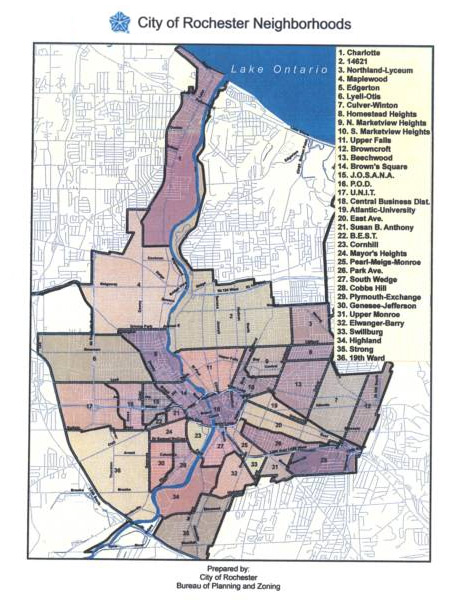
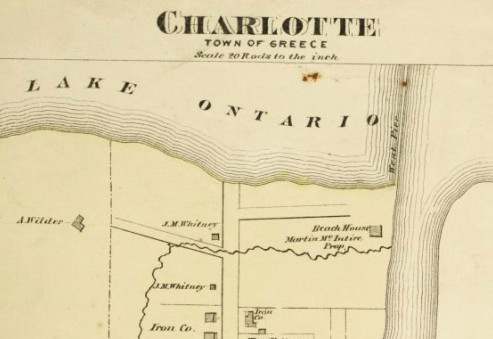
In part one of our three part Charlotte bonanza, we looked briefly at the history of Charlotte, from its formation in 1792, through its resort years and annexation in the early 20th century. In part two, we’ll look at Charlotte as it is today. Let’s start with the lay of the land. Shown above is the official definition of the city’s neighborhoods. As you know, Charlotte is the one at the top. Zooming in (and switching to Google maps) here’s what we see…
Welcome, readers, to the first of a three part series on Charlotte. This first part will serve as an introduction to the series and a brief history of Charlotte. The second part will be a survey, in the engineering sense, of the current state of Charlotte. It will include the demographics of the neighborhood and the built environment, as they exist today. Finally, the third part will layout a vision for Charlotte that works to harness all of the potential of the neighborhood. This final part will be broken into recommendations for residential and commercial development, transportation, and governance.
The plans described here will be ambitious, but we shouldn’t let ourselves shy away from ambition – as you may know, Charlotte has recently been in the news over some redevelopment plans. While Filling-In believes both plans have virtues, they both have numerous weaknesses as well. Because we are unassociated with any of the plans currently in play, and will believe they are built when we see it, the plans presented here will assume they did not happen, and instead will show a different vision of Charlotte’s future.
Get Email Updates...
Stay up-to-date on Rochester-related stories, artifacts, and ideas that you won't find in the mainstream news.
Totally free, never spammy, and you can unsubscribe at any time.
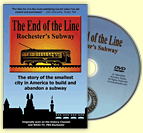
After the Erie Canal was rerouted south of downtown Rochester, the Rochester
Industrial & Rapid Transit Railway (the “subway”) was built in
its place as a link between the five different railroads and interurban trolley
lines that served the Rochester area. As the industrial landscape of Rochester
changed, and highways replaced the railroads, the Rochester subway gradually
became a relic of a bygone era. In 1956 the subway was abandoned and much of
its route was converted into Interstate 490 — built to connect Rochester
with the New York State Thruway (I-90). Read more about the history of the Rochester Subway.
RochesterSubway.com exists to help spark
public dialogue around how we can better connect the neighborhoods of Rochester
NY, surrounding communities, and their cultural offerings. Rochester’s
future is written in her past. Let's rediscover it.

















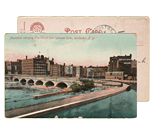

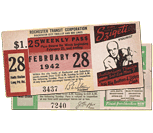


![The building at 1233 East Main St. It's between the old Beechnut Packaging plant and Greenovations. [PHOTO: Joanne Brokaw]](https://www.rochestersubway.com/images/photos/marth-matilda-harper-building.jpg)

![An old model train display has been dusted off and restored at the former Chase Tower in downtown Rochester. [PHOTO: RochesterSubway.com]](https://www.rochestersubway.com/images/photos/rochester-chase-tower-metropolitan-tower-01.jpg)
![The Charlotte lighthouse in summer, 2014. [PHOTO: Joanne Brokaw]](https://www.rochestersubway.com/images/photos/rochester-charlotte-lighthouse-01.jpg)
![Wulff's Hotel, at the corner of State and Factory Streets in Rochester; the scene of a notorious murder on December 18, 1920. [IMAGE: From the Albert R. Stone Negative Collection, Rochester Museum & Science Center, Rochester, NY.]](https://www.rochestersubway.com/images/photos/wulffs-hotel-and-rochester-marshmallow-company.jpg)
![Abandoned Vacuum Oil building. Flint Street, Rochester, NY. [IMAGE: Snoop Junkie]](https://www.rochestersubway.com/images/photos/vacuum-oil-refinery-rochester-02.jpg)
![The former Rochester Marshmallow Company factory located in the High Falls District. [PHOTO: India Lombardi-Bello]](https://www.rochestersubway.com/images/photos/rochester-marshmallow-company.jpg)
![Do you remember the mural at the old Rochester Monroe County Airport? A reader asked if we could share photos of it. [IMAGE: Rochester Public Library Local History Division]](https://www.rochestersubway.com/images/photos/rochester-monroe-county-airport-00.jpg)
![In 1870 Ellwanger & Barry (and other wealthy investors) owned a spot along the west bank of the Genesee River gorge known as Maple Grove. At the time, the Lake Avenue streetcar line stretched all the way to this point, and in an effort to stimulate traffic on the trolley line, they had built Rochester's first water-side resort; the Glen House. [PHOTO: 'Rochester's Lakeside Resorts and Amusement Parks' by Donovan Schilling]](https://www.rochestersubway.com/images/photos/glen-house-rochester-ny-01.jpg)
![Last week, Carnegie Place was largely destroyed by fire. [PHOTO: PuddleJumper Photography]](https://www.rochestersubway.com/images/photos/rochester-carnegie-building-fire-01.jpg)
![Here's hoping maybe YOU can help us solve the case of the stone lions. [PHOTO: RochesterSubway.com]](https://www.rochestersubway.com/images/photos/benvenuto-stone-lions-rochester-ny-01.jpg)
![Looking north through the gap in the north wall of newly completed Barge Canal. A break occurred at Bushnell's Basin on May 19, 1911. [PHOTO: Perinton Municipal Historian collection]](https://www.rochestersubway.com/images/photos/rochester-erie-canal-break-04.jpg)
![50 Things You Probably Didn’t Know About Rochester NY. [PHOTO: Flickr User Da Da Z]](https://www.rochestersubway.com/topics/wp-content/uploads/rochester-facts-40-1.jpg)
![This chandelier at Parkleigh once hung inside B. Forman Co. in downtown Rochester, NY. [PHOTO: RochesterSubway.com]](https://www.rochestersubway.com/images/photos/parkleigh-chandelier-b-forman-company-01.jpg)
![The last remaining Rochester subway car #60. [PHOTO: RochesterSubway.com]](https://www.rochestersubway.com/images/photos/rochester-subway-car-60-RGVRRM-04.jpg)
![A large crowd is gathered on Front Street to look at the flood at the other end of the street. Varlan's Hotel, Rosenberg's Pawnshop, Charles Adam's Sons Grinding, J.G. Zweigle's Sons, W.T. Bridle Furniture, William Pigeon Shoes, Hyman Davis Shoes, Genesee Provision Company, Myers Department Store, and the F.H. Loeffler Company are visible in the photo. March, 1913. [IMAGE: Albert R. Stone]](https://www.rochestersubway.com/images/photos/rochester-ny-flood-march-1913-01.jpg)