Welcome to the old Vacuum Oil plant on the west bank of the Genesee River in Rochester’s Plymouth-Exchange neighborhood. Abandoned for nearly a century, there has been very little desire to re-develop this 26-acre site due to contamination. Now, the City of Rochester is aiming to use New York State’s Brownfield Opportunity Areas program to clean it up and plan for its future redevelopment. But as of today, this property is still highly toxic. And you guessed it—we’re going inside…
With all of the recent flooding in our area, RocSubway reader Michael Delaney wrote in and suggested, “a great idea for an article would be about the history of flooding in Rochester and the civil engineering that has gone into solving the issue. Beyond the dams, I’ve heard that there are huge storm sewer tunnels underneath the city. It would be very interesting to know more about it.”
Situated at the intersection of the Genesee River and Erie Canal, Rochester’s geography has blessed—or cursed—us with a long long history of great floods. Before the construction of the Mount Morris Dam (1948-1952) records indicate the City of Rochester had experienced severe flooding about every seven years between 1865 and 1950. Talk about a pesky problem.
Digging into all of the engineering marvels that have spared modern Rochesterians from most of these high waters could easily span many pages. And I promise to dedicate future posts on the subject. But for now, I want to show just how bad this problem was by highlighting just one flooding disaster that occurred in late March, 1913…
On this Martin Luther King Jr. Day we are hopefully reminded of the inspiring actions and many speeches by an individual who dedicated his life to the pursuit of freedom and basic human rights—not just for one group, but for all people.
Of course, in Rochester we also remember other individuals who made tremendous contributions to this ongoing effort… Susan B. Anthony for women’s rights and suffrage. And Frederick Douglas (depicted above) for the abolition of slavery.
One speech in particular, given by Douglas on July 5, 1852 in Rochester, is arguably one of the most momentous oratories in American history. It’s one that helped set the stage for the transformation of America from a country that was, in Abraham Lincoln’s words, “half slave and half free” to one which was at least on its way to guaranteeing the “blessings of liberty” to all men (and eventually women)…
Get Email Updates...
Stay up-to-date on Rochester-related stories, artifacts, and ideas that you won't find in the mainstream news.
Totally free, never spammy, and you can unsubscribe at any time.
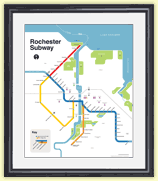
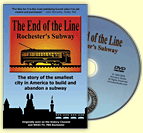
After the Erie Canal was rerouted south of downtown Rochester, the Rochester
Industrial & Rapid Transit Railway (the “subway”) was built in
its place as a link between the five different railroads and interurban trolley
lines that served the Rochester area. As the industrial landscape of Rochester
changed, and highways replaced the railroads, the Rochester subway gradually
became a relic of a bygone era. In 1956 the subway was abandoned and much of
its route was converted into Interstate 490 — built to connect Rochester
with the New York State Thruway (I-90). Read more about the history of the Rochester Subway.
RochesterSubway.com exists to help spark
public dialogue around how we can better connect the neighborhoods of Rochester
NY, surrounding communities, and their cultural offerings. Rochester’s
future is written in her past. Let's rediscover it.

















![Abandoned Vacuum Oil building. Flint Street, Rochester, NY. [IMAGE: Snoop Junkie]](https://www.rochestersubway.com/images/photos/vacuum-oil-refinery-rochester-02.jpg)
 to clean it up and plan for its future redevelopment. But as of today, this property is still highly toxic. And you guessed it—we’re going inside…
![A large crowd is gathered on Front Street to look at the flood at the other end of the street. Varlan's Hotel, Rosenberg's Pawnshop, Charles Adam's Sons Grinding, J.G. Zweigle's Sons, W.T. Bridle Furniture, William Pigeon Shoes, Hyman Davis Shoes, Genesee Provision Company, Myers Department Store, and the F.H. Loeffler Company are visible in the photo. March, 1913. [IMAGE: Albert R. Stone]](https://www.rochestersubway.com/images/photos/rochester-ny-flood-march-1913-01.jpg)
![An engraved portrait of Frederick Douglass, noted African-American abolitionist. Douglass was an active abolitionist in the Rochester area and a sought-after lecturer after the Civil War. After his home on South Avenue was destroyed by fire in 1872 he moved to Washington, D.C. [PORTRAIT BY: Ritchie, Alexander Hay, 1822-1895.]](https://www.rochestersubway.com/images/photos/frederick-douglass-portrait.jpg)