No, the headline isn’t in reference to the recent controversy surrounding the port development. I wanted to take a look back, at the “good ole days,” when Ontario Beach was known as the Coney Island of central and western New York. Here’s a birds eye of view of all the shiny happy fun… The Dentzel carousel. The L.A. Thompson’s Scenic Railway. The Auditorium (a.k.a. the House of Hilarity). Such good times.
Then I noticed the peculiar site of smoke and flames in the background (click the image for a larger view). Holy smokes! Charlotte is burning! Somebody call 9-1-1!!
Who doesn’t find dimples irresistible? In 1936 Isabella Gilbert of Rochester NY invented a spring-loaded contraption that promised to “make a fine set” by pressing a pair of knobs into the cheeks.
Well I’d say that’s another one for the long list of groundbreaking innovations at Rochester Made . Thanks to Vicki Robinson for posting this fun fact to the RocSubway wall
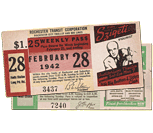
Many of you kids will be too young to remember this – thank heavens. But five years ago on this very day, Rochester NY made national headlines when it was slammed by one of the worst food shortages in our nation’s history—possibly the world. That’s right. Popeyes up on Lake Ave ran out of chicken…
The other day my three-year-old was shooting video of his stuffed animals with his big sister’s iPad, and a wave of nostalgia crashed over me. I suddenly realized my kids will probably never get to experience joy of film photography. They’ll never understand the thrill of loading a fresh roll into the back of a camera. They’ll never feel those mechanical clicks and vibrations of the film advancing to the next frame. And they’ll never know the excitement of getting a stack of pictures back from the developer.
How would I even explain this antique technology to them? I know, I’ll Google it. Hey what do you know, here’s an old manual for the Kodak Brownie Camera (No. 2)…
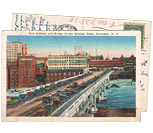
Today’s Fun Foto Friday is this 1920’s view of the Erie Canal aqueduct looking east. You’re looking at the covering over the old canal which would soon become Broad Street and the Rochester Subway beneath. In the background (center) is the Osburn House hotel. Eventually Broad Street would be extended eastward, right through that hotel. The stairwell to the City Hall subway station can be seen at the street corner. And next to the stairs, notice the construction site…
Here’s an update to last Friday’s story about Marilyn Casserino, 79. Marilyn is the girl in the dark dress in the center of the photo above. This picture was taken c.1939 on the roof of the Children’s Building at Iola Tuberculosis Sanitorium where Marilyn was a patient, along with her mother Vivian.
Unfortunately, Marilyn’s mom passed away while at the hospital. Marilyn was just 6 at the time. Looking back at those days, she now wishes she could remember more – about her mom, and about this place where they were treated for well over a year.
For starters, she wanted to try and find out who the other girls in the photo were. Would you believe in less than one week we’ve now identified two of those girls…
A couple months ago we took a look inside the Iola tuberculosis hospital on Westfall Road. The buildings have since been demolished. But for Marilyn Casserino, 79, those photos triggered memories, and questions that will linger on…
I stopped by Iola on Sunday to check on what’s left, and I snapped these pics. In front of the main building there was once a circle with concrete benches and lamp posts. To be perfectly honest I coveted the abandoned lamp posts and thought of ways I could possibly “reclaim” them, but my conscience always prevented me from doing so. Well, I should have because the picture above shows the careful attention the deconstruction crew is taking to features that could be re-used. That’s the base and the flattened steel post is above it. I think my reclamation would have been better than this treatment. Damn conscience.
The Ehrmentraut Farm Bridge is easily one of the oldest and most unique bridges in the entire United States, and that kind of distinction is something that piques my interest. There isn’t exactly a ton of information out there on the internet about old bridges on private property, but I’ve managed to piece together its pretty cool history, and then went to check it out myself…
Last winter the City of Rochester made a Hail Mary pass to save the historic Pulaski Library. They posted an offer to sell the vacant building for a thousand dollars to anyone with a serious plan to fix it up. I’m not sure how many proposals were submitted, but I’ve learned that Providence Housing Development Corporation has been given the green light.
Providence Housing has worked on similar adaptive reuse projects such as Paul Wolk Commons on State Street, and the Holy Rosary Apartments on Dewey. Although Pulaski may be smaller, it could prove to be a much bigger challenge…
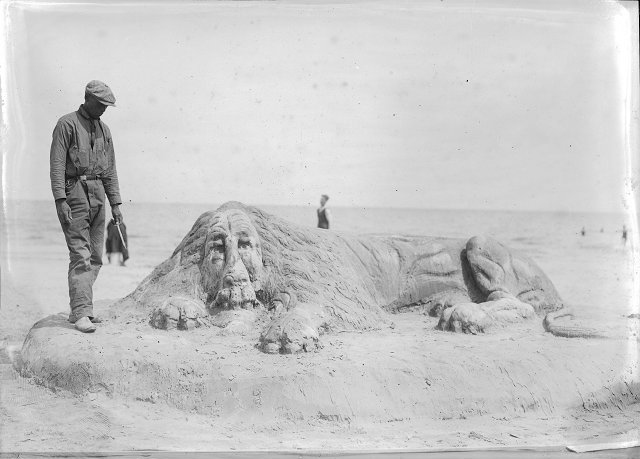
How’s this for a summertime Fun Foto Friday? This is Robert Pernell. He’s a sand artist. Or was. This photo was printed in the Rochester Herald on August 6, 1922. Robert used to entertain the crowds at Charlotte Beach with his larger-than-life creations…
RocSubway fans, This past Sunday morning (6/2/13), I went with a friend of mine to check out the Iola Campus site . I have lived in Rochester all my life and I have always been intrigued by those buildings (my aunt actually used to live in the apartments across the street). About 6 months ago, I started a little urban exploring group with some friends and coworkers; Iola was one of the first places of interest. With the CityGate project fast approaching, I knew I had to take the risk and visit Iola while I still could. Rather than taking a big group, just two of us went since we were not sure what the security situation would be like. The whole campus was great. A lot of the buildings had pretty easy access points, but there were a couple we could not get in to, due to time constraints (and proximity to the main road!). I hope that you all enjoy the shots! – Sarah Barnes
Danielle Raymo and Stephanie Rankin, two recent college grads, have just opened a new and exciting business in Village Gate. Rochester Brainery brings fun and affordable learning experiences to the public with sort of a no-strings attached philosophy. They seek out people in the community to come in and run educational workshops on various topics of interest, and anyone can sign up to take a class…
This weekend, Wegmans closed their current East Avenue store so they could transition into their new, larger building . The new store replaces a historic area that was once the center of Brighton in the 19th century. The old Village of Brighton was served by the Erie Canal (now I-490). The canal was rerouted in the early 20th century and the entire area was annexed to the City of Rochester in 1905…
Rochester’s Pulaski Library (originally the Hudson Avenue branch) was the second permanent library constructed by the City. As explained here , the library was closed in 1994, and has sat unused until last week when the City opened the doors to potential buyers. If you’re interested, the City wants your proposal by March 4. $1,000 to buy it, but you’ve got to show you’ve got a serious plan to rehab the property. Historic tax credits and grants could help take a bite out of the million dollars it could cost you when all is said and done. If you missed the open house, here’s a look inside…
Yesterday, the archival photo blog, Shorpy , shared a great photo of the Babcock family from Rochester NY. The image is one of a collection of 38 photographs by Ralph Amdursky for the U.S. Office of War Information. The series shows how the Babcocks, a “typical American war worker’s family,” lived in 1943 during the height of WWII…
Scientists have known of the existence of DNA for over fifty years. But until recently , no one had ever seen a photograph of that tricky little double-helix. For the preservation community in Rochester, the image above could be just as big of a breakthrough as photographing DNA for the first time. We had a fuzzy idea of their existence, but until today no one had ever seen a map of the city’s Designated Buildings of Historic Value (DBHV). And I mean NO ONE. Not even the people who put the list together…
Last November I had the ridiculously huge privilege to give a talk at TEDxRochester. The gravity of the honor may have been too much for my little brain to comprehend. In fact, when they initially asked me to do it I said “no thanks” – twice. Long story short, I gave in. And I’m glad I did, because the experience was one of those “once in a lifetime” things.
Since much of my talk was influenced by you, RocSubway readers and participants, I thought you’d like to watch (and share) the official video which has just been released. A word of caution: I’m not the most riveting public speaker, but there is lots of good stuff buried within this 12-minute presentation, so watch thru to the end if you can…
Hopefully you caught yesterday’s story, “Rochester’s Adventure in Optimism” about the defunct Rochester subway. If you missed it give it a read. Originally published in the City Newspaper in 1983, the article mentioned the sole surviving subway car, car #60, and the effort to bring it back to Rochester and restore it to working order. Yesterday I received a more detailed explanation of those restoration efforts from Otto M. Vondrak, one of the trustees of the Rochester & Genesee Valley Railroad Museum in Henrietta, NY. Here’s the story of subway car #60 from Otto…
Sean Kirst began his career as a writer for City Newspaper (he’s now a columnist at Syracuse’s Post Standard ). He says he fell in love with the haunting feel of Rochester’s subway tunnels and was intrigued to learn the subway began taking off just after World War II. But at a critical moment, the system was basically dismantled by community leaders who were already thinking “interstates.” Sean dug into the story and wrote a fairly in-depth story entitled “Rochester’s Adventure in Optimism.” It was published in City Newspaper on June 2, 1983. Thirty years later, City Newspaper has graciously allowed RocSubway to share the story with you again, here…
Get Email Updates...
Stay up-to-date on Rochester-related stories, artifacts, and ideas that you won't find in the mainstream news.
Totally free, never spammy, and you can unsubscribe at any time.
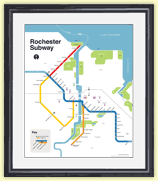
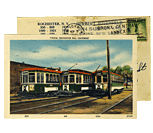
After the Erie Canal was rerouted south of downtown Rochester, the Rochester
Industrial & Rapid Transit Railway (the “subway”) was built in
its place as a link between the five different railroads and interurban trolley
lines that served the Rochester area. As the industrial landscape of Rochester
changed, and highways replaced the railroads, the Rochester subway gradually
became a relic of a bygone era. In 1956 the subway was abandoned and much of
its route was converted into Interstate 490 — built to connect Rochester
with the New York State Thruway (I-90). Read more about the history of the Rochester Subway.
RochesterSubway.com exists to help spark
public dialogue around how we can better connect the neighborhoods of Rochester
NY, surrounding communities, and their cultural offerings. Rochester’s
future is written in her past. Let's rediscover it.






















![On this date five years ago today, the Popeyes chicken chain in Rochester NY made national headlines when it ran out of its featured product. [PHOTO: TripAdvisor.com]](https://www.rochestersubway.com/images/photos/popeyes-runs-out-of-chicken-01.jpg)
![Picture taking with the Brownie camera no. 2. Published 1918 by Canadian Kodak Co. [SOURCE: OpenLibrary.org]](https://www.rochestersubway.com/images/photos/kodak-brownie-camera-manual-_Page_01.jpg)
![Rochester Subway, Broad Street tunnel construction. c.1925. [IMAGE: Rochester Municipal Archives]](https://www.rochestersubway.com/images/photos/rochester-subway-broad-street-construction-01.jpg)
![Children (patients) on the roof of Iola Tuberculosis Sanatorium (c.1939). That's Marilyn Casserino in the center. [PHOTO COURTESY OF: Marilyn Murphree]](https://www.rochestersubway.com/images/photos/iola-tuberculosis-sanatorium-children-crop.jpg)
![The abandoned Iola Tuberculosis Sanatorium. [PHOTO: Matt Rieck]](https://www.rochestersubway.com/images/photos/iola-tuberculosis-sanatorium-matt-rieck-01.jpg)
![The Ehrmentraut Farm Bridge is easily one of the oldest and most unique bridges in the entire United States. [PHOTO: Chris Clemens]](https://www.rochestersubway.com/images/photos/ehrmentraut-farm-bridge-01.jpg)
![Rochester is trying to save the vacant Pulaski Library before it's too late. [IMAGE: RochesterSubway.com]](https://www.rochestersubway.com/images/photos/rochester-pulaski-library-01b.jpg)
![The abandoned Iola Tuberculosis Sanatorium. [PHOTO: Sarah Barnes]](https://www.rochestersubway.com/images/photos/iola-tuberculosis-sanatorium-001.jpg)

![Former site of historic Brighton Village. March, 2010. [PHOTO: RochesterSubway.com]](https://www.rochestersubway.com/images/photos/brighton-village-east-avenue-wegmans-01.jpg)
![The Babcocks, an American family. Rochester, NY. March, 1943. [PHOTO: Library of Congress]](https://www.rochestersubway.com/images/photos/babcock-family-rochester-ny-portrait.jpg)
![A map of Rochester's Buildings of Historic Value [Thanks to: Jim Fraser and Joseph Becker]](https://www.rochestersubway.com/images/photos/rochester-designated-buildings-of-historic-value-map-01.jpg)
![Mike Governale at TEDxRochester. Mike is a designer, blogger, and founder of a local public transit advocacy group, Reconnect Rochester. [PHOTO: Jeffrey Hamson]](https://www.rochestersubway.com/images/photos/TEDx-Rochester-2.jpg)
![The last remaining Rochester subway car... #60. [PHOTO: Christopher Hauf, Rochester & Genesee Valley Railroad Museum]](https://www.rochestersubway.com/images/photos/rochester-subway-car-60-RGVRRM-01.jpg)
![Cover of Rochester City Newspaper. June 2, 1983. [COURTESY: CITY Newspaper]](https://www.rochestersubway.com/images/photos/city-newspaper-rochester-subway-story.jpg)