Last Friday (April 9, 2010) Louise Slaughter held a press conference at Rochester’s Amtrak Station along with Transportation Secretary Ray LaHood to officially announce the arrival of High Speed Rail to Western NY. In addition to the track improvements made possible by $151 million in federal stimulus money, Slaughter said Rochester’s outdated Amtrak station will receive modest updates to the building and platform. She also announced that Amtrak, Greyhound, and Trailways (who were in attendance) were committed to building a new multimodal station as a separate project. Also in attendance was WHAM 13’s Evan Dawson [[email protected]]. Dawson asked some tough questions. For example, “Who will subsidize the project?” Good one Dawson. Hey, does WHAM have any openings? I’d like to apply.
So this past Monday Dawson posted his commentary, High Speed Rail: Fast Forward, Not Fast Ferry… Right? It’s quite the masterpiece. The article points to a list of questions that he’d like answers to. But since he hasn’t found the answers yet… he’ll just assume that these upgrades to the nation’s rail system are unnecessary and will be the next “fast ferry”.
While I applaud Dawson’s quest to find answers to certain outstanding questions, I take issue with his use of metaphor. And since WHAM doesn’t allow user comments on their site anymore, I had to send him this email in order to let him know how I felt… (more…)
If you were at the Circulator Study Public Meeting tonight, THANK YOU! Turn out was good. It could’ve been even better… but there were plenty of people there asking questions and giving input and the room had a constant buzz. Even the media thought enough to make an appearance. There will be another public meeting in June/July to share the preliminary findings of the study so stay tuned and continue to share this story with friends and neighbors. We’ll need even more of you at the next meeting.
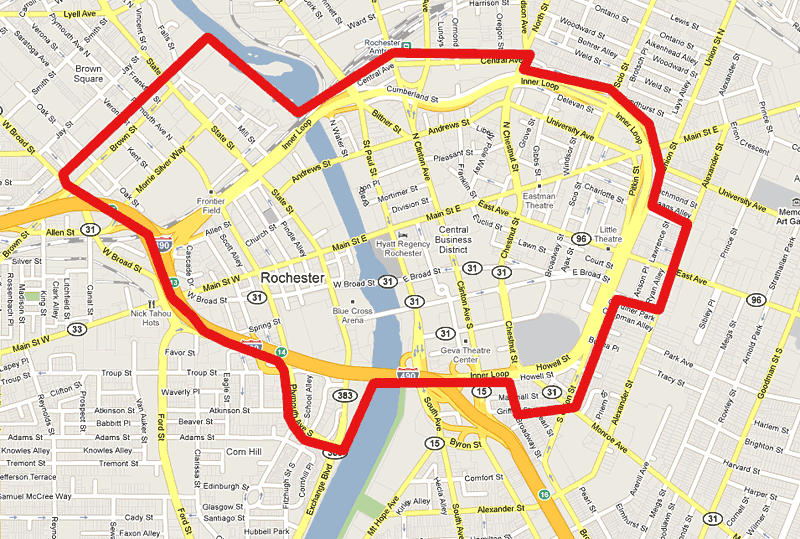
The City has partnered with C&S Companies to analyze and make recommendations to enhance commuting, circulation, and parking in Downtown Rochester. Among the potential enhancements under consideration is a circulator transit service—a.k.a shuttle buses or streetcars. Listen carefully Rochester…
Last Tuesday I attended a public presentation by the Genesee Transportation Council (GTC) to review their Draft 2011-2014 Transportation Improvement Program Project List . It contains over $500 million in new transportation spending for our region over the next few years. And I don’t mind pointing out that I was the only one in attendance. I don’t mean the only one from RochesterSubway.com… or the only one from my neighborhood… I mean THE ONLY PERSON in the entire city of Rochester and 7 county region in attendance. No one from the community, no one from the press, no raging activists… no one. It was literally me and about 5 or 6 representatives from GTC.
Do you work downtown? The City of Rochester wants downtown workers to take their “commuting” survey . But this survey is about way more than just parking. The City is considering the possibility of a “circulator” system (i.e. Shuttle Buses or Trolley/Streetcars) to move people around downtown.
Although the survey only mentions RTS Buses and Shuttle Buses as options for mass transit commuters, there is a comment box on the very last page. This is your opportunity to voice support for a downtown streetcar circulator. We want the City to give strong consideration to the impact that a streetcar line could have on economic development in Rochester. A shuttle bus is a nice idea but will have the same effect. So be sure to leave a comment in that final box!
…Okay great, now here’s an update. Since that article, traffic to RochesterSubway.com has doubled, our Facebook fan club has grown from 100 to over 400 (and counting), and my inbox hasn’t had a moments rest. This is all very encouraging and a sure sign that the people of Rochester really want to see their city thrive. The big question is; do the people of Rochester care enough to make an effort? All signs point to yes. So far we’ve got 12 people (including myself) who have risen to the challenge. Together we will lead a city wide movement to Reconnect Rochester.
A letter to the editor in this week’s City Newspaper caught my eye tonight. It echoes many thoughts that have been rattling around my own head since the feds announced $151 million in high-speed rail money for New York—but stated much more eloquently than I could ever wish to. The gist of the commentary is clear from the title, “High-Speed Rail is a Necessity”. But the real golden nugget… and the point I’d like to scream from the top of Xerox tower… was this: News of high-speed rail funds should have been hailed as a positive breakthrough for our region. Instead it drew an avalanche of skepticism and negativity—two ugly characteristics that have become hallmarks of this town and will ultimately hurt us all.
Here is the letter from Roger Brown, president of the Rochester Regional Community Design Center…
In Oregon, a battle raged for nearly twenty years over the construction of a highway project, proposed by the once acclaimed city planner Robert Moses. If approved, the Freeway would have removed more than 1% of all housing stock in Portland. In the mid 1970s, after the proposal’s defeat, the city opted to build a mass transit infrastructure instead. The result can be seen today in the form of a more pedestrian-friendly and livable city.
About a year ago I had the awesome pleasure of riding Seattle’s new South Lake Union Streetcar—a 1.3 mile line that opened in December 2007. Peep this video from Streetfilms.org. Seattle’s state-of-the-art streetcar line features real time arrival message boards, solar-powered ticket vending machines, and human-activated doors to save energy while the train is in layover mode. And check this out, you can find out the next arrival time and actually watch the streetcars moving via GPS trackers all from the Seattle Streetcar web site.
But what has this hi-tech investment done for the South Lake Union neighborhood? For one thing, a Whole Foods Market moved in—downtown Seattle’s first full service supermarket in decades. Plus, new condos, mixed-use development, and Amazon.com’s brand new world headquarters. That’s impressive.
Oh and while I was there I made sure to ride the monorail ! You know I love you Rochester, but I had some serious reservations about returning fromthat trip.
America seems to have taken a renewed interest in mobility. Maybe due to President Obama’s recent commitment to high speed rail—or perhaps the positive results seen in towns like Portland and Denver have caught our collective attention. Whatever the reason, from the top down, people are rethinking our automobile-oriented culture—and getting excited about the possibilities.
There’s also good reason to focus on transportation as a way of jump-starting economic development. Industry requires access to people. And people need to have easy access to centers of employment. Continually improving access makes further development possible. Interrupting access will have the opposite effect. Likewise, doing nothing or simply maintaining existing infrastructure for an extended period of time will also hinder development.
For 30+ years Rochester has relied on the infrastructure choices it made in the 1950’s, 60’s, and 70’s. At that time we made development choices that encouraged our population to emigrate from the downtown core. We scrapped our extensive streetcar system, choked off downtown with the construction of the inner-loop, and paved super highways to take us from the city to the NY State Thruway and beyond. Since then that’s exactly where our money, our workforce, and our future have gone—down I-490 and out of state.
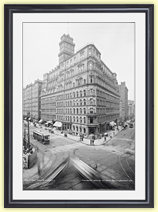
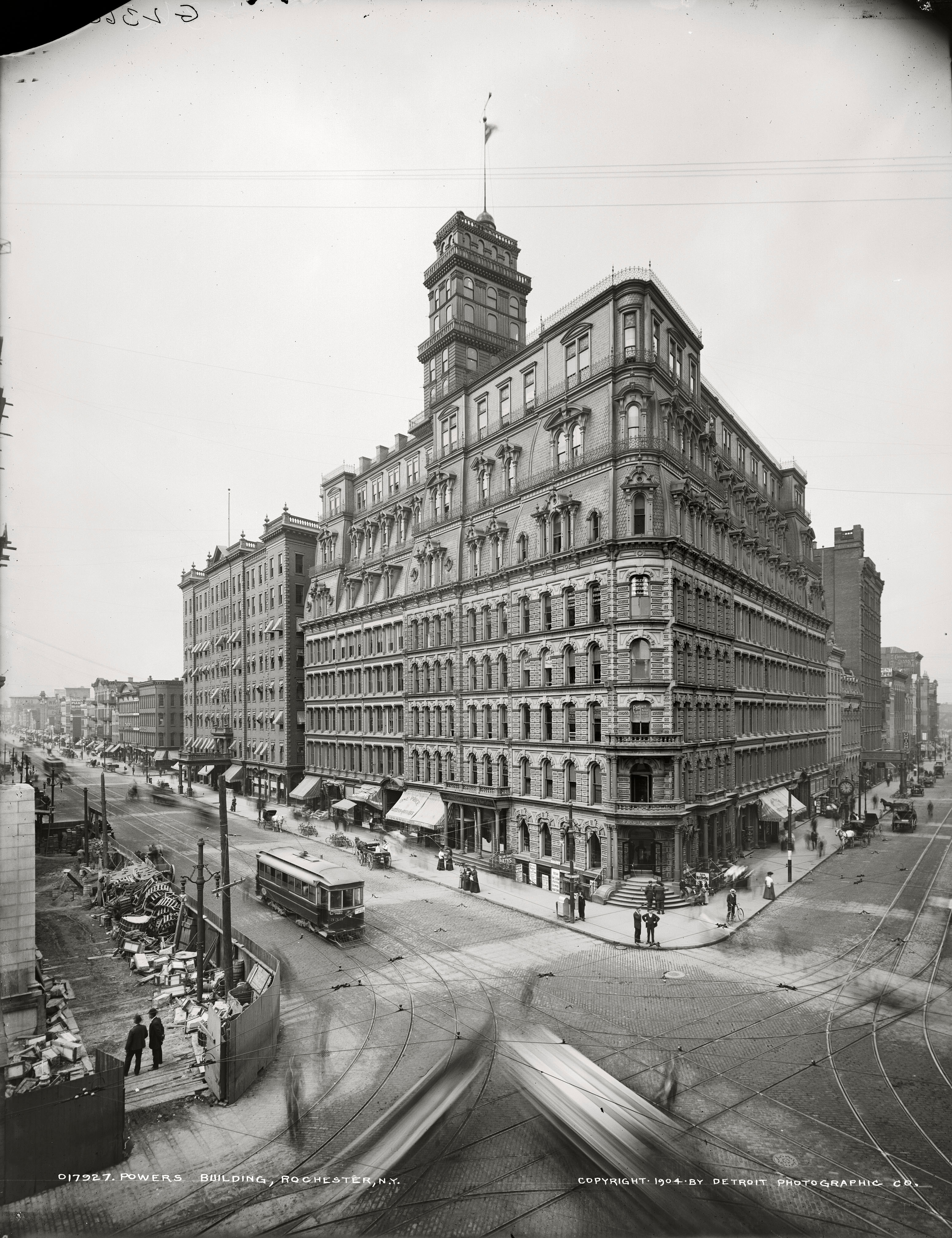
We found this old photo of the Powers Building and Rochester’s four corners recently on a vintage photos website called Shorpy.com . Not only is this a photo of one of Rochester’s most celebrated structures at one of the greatest times in the city’s history, but it’s incredibly detailed for such an old photo—right down to the logos painted on the office windows (click on the image to enlarge).
Hey, here’s a bit of fun for you… we hid the RochesterSubway.com logo somewhere in the photo. Let’s see which one of you can find it first. And while you’re searching for our hidden logo, here are a few other things you should take notice of…
Some of you may remember our story on Harry Davis last September. At that time Harry was running a long-shot campaign for Rochester City Council. He didn’t win any of the 5 open council seats. But that didn’t discourage him. He turned right around and announced he’d be write-in candidate for Mayor in November. Mayor Duffy squashed that dream pretty easily on election day. But Harry kept at it. He promptly asked to be hired by Mayor Duffy to lead a “green” urban renewal plan for the city. The Mayor turned him down.
So now Mr. Davis is coming at things from a different angle. Last month he formed his own Political Action Committee (PAC). According to Mr. Davis this new group stands for “green, sustainable development and transportation.” Davis affirms, “The importance of sustainable and efficient transportation for Rochester cannot be overstated. This would include light rail, high-speed rail, bike paths and additional pedestrian options – all of which should complement a rational and minimalist approach to automotive traffic.”
Long before hybrid cars, SUV’s, JetBlue, and even Amtrak, travel between American cities occurred largely by rail. With the industrial and technological revolution around the turn of the 20th century, America’s interurban railway developed so fast and connected so many of us, it must have seemed like the future had suddenly arrived out of nowhere. So when Henry Ford’s Model T was introduced who could have anticipated the turn transportation history would soon take.
If you’re interested in understanding the history of rail travel in American (its rise and quick fall), we’ve got a book for you. One of our readers, Laurence Keefe, recently brought this one to our attention. The following is Larry’s review…
“When we were children on summer vacation, the highlight of the day was when Dad got home from work. We would eat dinner at six o’clock, when the news came on the radio. That was because it took him 50 minutes to get from his office near the Four Corners in Rochester, NY to our farm in Victor…
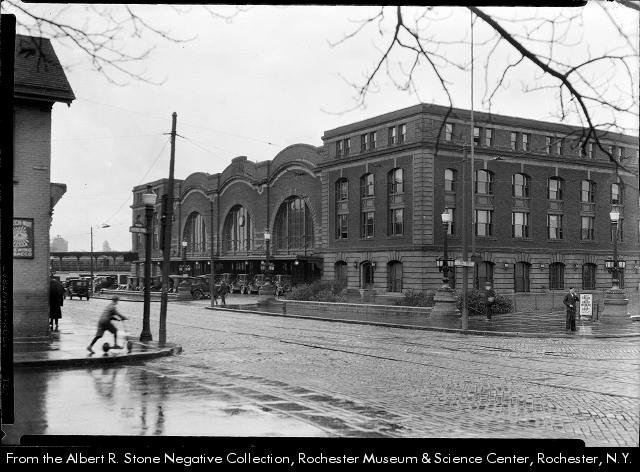
I’m a bit late on this but maybe this will be news to you. Some time last year, a notable infrastructure blog called The Infrastructurist, published a list of the top 10 greatest rail stations ever built. Standing shoulder to shoulder with some of the greatest examples of 20th Century American architecture is Rochester’s NY Central Station. What? You’ve never heard of it? That’s probably because it’s not with us anymore — may she rest in peace. The NY Central Station was demolished in 1965. In it’s place, the pretty little Amtrak Station you know and love today. In fact, all of the buildings on the Infrastructurist’s list are no longer.
Similar to how the Interstates reshaped America 50 years ago, the Chinese landscape is now being reshaped by historic levels of infrastructure spending. While the U.S. government seeks to revive it’s struggling economy in part by spending billions on shovel-ready, band-aid projects (i.e. re-surfacing roads), it seems Beijing’s goal is to put 26 million Chinese to work building new high-speed rail connections between its cities.
I recently invited my readers to attend a public meeting held by the City of Rochester and to make their voices heard. The purpose of the meeting was to inform the public about the Broad Street Tunnel Improvement Project which is slated to begin this Spring. The meeting was tonight and turnout was fair—not great, but I did get to meet a few RochesterSubway.com followers which was very encouraging!
Anyway, I wanted to share one opinion we got from a subscriber, Tim L., in response to our meeting announcement in which I pissed and moaned that the city failed to consider rail transit options for Broad Street. I don’t disagree with all of what Tim has to say, but I do want to hear more of your opinions on this, which is why I’m posting it here…
BECKY BOHRER (AP) NEW ORLEANS — The federal government is making available $280 million for street cars and other public transportation projects aimed at creating jobs and more walkable, environmentally friendly communities.
(Will Rochester see a dime?)
U.S. Transportation Secretary Ray LaHood made the announcement Tuesday at a streetcar barn in New Orleans. The city, which has been trying to overhaul its public transit system since Hurricane Katrina in 2005, was LaHood’s first stop on a listening tour on federal transportation policy.
The last transportation spending bill expired in September. While President Barack Obama’s administration has sought a reprieve into 2011, given the federal stimulus package that passed earlier this year and was aimed largely at public works projects, Congress hasn’t agreed to an extension past mid-December.
LaHood said there’s a “pent up demand” for infrastructure work around the country… (more…)
Until now I’ve tried to keep the subway stories I post limited to those out of the abandoned Rochester Subway. But recently there have been a rash of great stories from the underground I’ve just had to share. There was the drunken lady who fell onto the tracks in the Boston Subway. Then the unfortunate murder on the “D” train in Manhattan. And here’s another one. We’ve all heard stories of people living in New York’s subway tunnels. And you might immediately conjure up an image in your head of what such a person would look like. But how about a mild mannered 13 year old boy? Watch the video…
If you’re a New York motorist you’ve probably heard about Albany’s latest attempt to use your wallet to fix their budget gap. Beginning in May 2010 you may be required to buy a new set of plates for your ride (starting at $25). I say “may” because this is not a done-deal and lawmakers just might buckle under the pressure from protesters and decide against the whole idea. But if Patterson has his way, your car may soon be adorned with lovely new blue and gold plates… GAG!
Perhaps being a graphic designer disqualifies me from passing judgement, but based solely on the proposed design, I say this is a bad idea. But let’s take an informal poll…
After receiving rave reviews for his 2008 lecture on global rail travel, “Wish You Were Here” series sponsor Thomas N. Tischer has agreed to present again at the Dryden Theater — this time to discuss the role streetcars and trolleys played in the development of U.S. cities and their European counterparts.
Get Email Updates...
Stay up-to-date on Rochester-related stories, artifacts, and ideas that you won't find in the mainstream news.
Totally free, never spammy, and you can unsubscribe at any time.
After the Erie Canal was rerouted south of downtown Rochester, the Rochester
Industrial & Rapid Transit Railway (the “subway”) was built in
its place as a link between the five different railroads and interurban trolley
lines that served the Rochester area. As the industrial landscape of Rochester
changed, and highways replaced the railroads, the Rochester subway gradually
became a relic of a bygone era. In 1956 the subway was abandoned and much of
its route was converted into Interstate 490 — built to connect Rochester
with the New York State Thruway (I-90). Read more about the history of the Rochester Subway.
RochesterSubway.com exists to help spark
public dialogue around how we can better connect the neighborhoods of Rochester
NY, surrounding communities, and their cultural offerings. Rochester’s
future is written in her past. Let's rediscover it.























 A letter to the editor in this week’s City Newspaper caught my eye tonight. It echoes many thoughts that have been rattling around my own head since the feds announced $151 million in high-speed rail money for New York—but stated much more eloquently than I could ever wish to. The gist of the commentary is clear from the title, “High-Speed Rail is a Necessity”. But the real golden nugget… and the point I’d like to scream from the top of Xerox tower… was this: News of high-speed rail funds should have been hailed as a positive breakthrough for our region. Instead it drew an avalanche of skepticism and negativity—two ugly characteristics that have become hallmarks of this town and will ultimately hurt us all.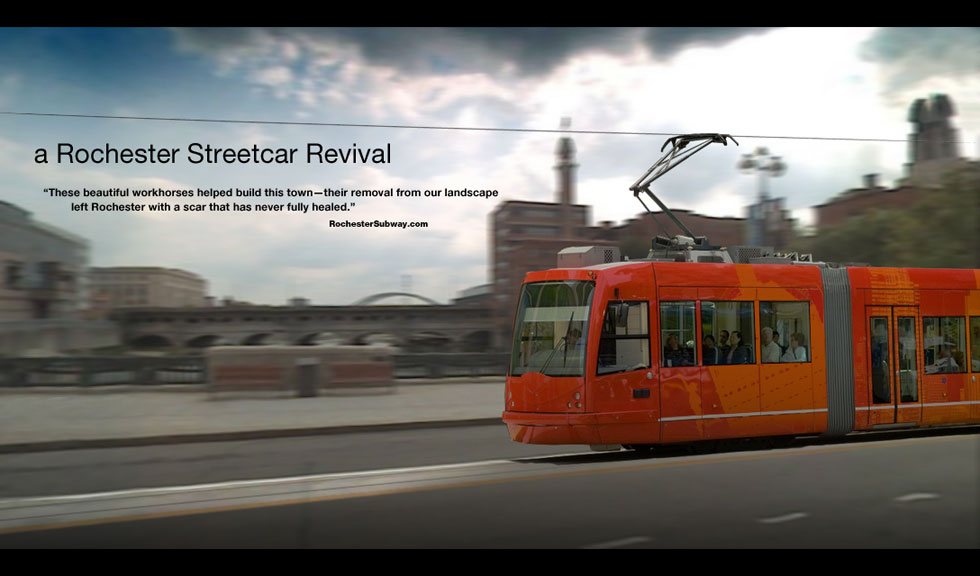




![Francisco Hernandez Jr., who has Asperger's, a developmental disorder that affects the ability to socialize and communicate, disappeared on October 15, after he thought he was in trouble at school, according to his mother, Marsiela Garcia of Brooklyn. [source: CNN]](https://www.rochestersubway.com/images/photos/new_york_subway_boy.jpg)