Last summer Rochester developer and restauranteur, John Tachin called up RocSubway with a history mystery for us to solve. After four months of digging, we came up empty. But here’s hoping maybe YOU can help us solve the case of the stone lions.
Sorry for the Tina Turner reference… it was all I could think of to describe the enormity of this big wheel. I’m talking 25 foot and 12 tons just under 20 ton*!! Um, ok so who are these hooded dudes, and just where do they think they’re going with our giant wheel? These strange photos were taken late Tuesday afternoon by Tom Dubois and Peter Simpson…
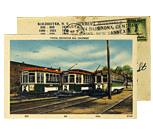
The New York Museum of Transportation presents a 40-minute slide talk on the Rochester Subway. The show is at 1:00 p.m., Sunday, January 11, 2015 and is free with admission of $5 adults and $4 under age 12. Images from the museum’s vast photo archive portray the Rochester Subway from construction, through operation, to its abandonment almost 60 years ago. The presentation of B&W and color slides will be narrated by the museum trustee, Jim Dierks…
The transformation at the Carriage Factory building has been nothing short of amazing. Located at 33 Litchfield Street in the Susan B. Anthony neighborhood, the former factory building that was close to the landfill has been reborn as seventy-one affordable and special needs apartments. The rehabilitation of the building was a long time coming and was not without its challenges and delays…
On May 19, 1911, a 150 foot long break occurred in the wall of the New York State Barge Canal at Bushnell’s Basin. Construction on this section of canal had just been completed eight days earlier.
According to an article in the Monroe County Mail, it was a canal worker, John McCarthy, who at 4pm discovered water pouring through a narrow crack in the canal bank…
Preface: I am a total geek and I have stopped caring who knows it. With that out of the way, one of my favorite things in the world to do is study old maps. And my favorite part of old maps are the titles! I told you, total… geek.
I’ve always been amazed at how much attention used to go into the details of these hand-drawn works of art. These days all we do is send a satellite up into space, or someone out to drive around and snap pictures of our streets – and don’t get me wrong, that’s pretty neat for other reasons. But Google streetview ain’t got nuthin on this. Go ahead, geek out…
Next month Rochester’s transportation authority, Regional Transit Service (RTS) will open a new $50 million transit center at Mortimer Street in downtown Rochester. According to a D&C story RTS has requested that the City change the name of Mortimer Street to “RTS Way.” Mortimer Street has quietly existed between N. Clinton Ave and Saint Paul Street since Rochesterville was incorporated in 1817.
I’ve spent the last five years of my life advocating for Rochester’s public transit system and building a good working relationship with folks at RTS. That’s why I know they will take what I’m about to say as constructive criticism, and nothing more. Here it goes:
Renaming Mortimer Street after yourself is a bad idea. Don’t do it!! Now, let me explain…
The following post by Amy Cavalier was originally published at DePaul.org.
Thousands of miles, several movie appearances and more than 140 years after leaving the Cunningham Carriage Factory on Litchfield Street in Rochester NY, a late-19th century brougham-style carriage returned home on Tuesday, September 30…
Several years ago the west end of Rochester’s abandoned subway tunnel was filled as part of the Broad Street Improvement Project. Now a planned downtown development could permanently close off one of the last remaining entry points to Rochester’s old subway tunnel. Morgan Management is waiting for approvals to build a five-story luxury apartment complex at Court Street and South Avenue, right smack on top of the subway’s east entrance and the former site of the Court Street subway platform…
The abandoned subway tunnel beneath Rochester’s Broad Street has become one of the most popular sites for students of architecture and design to test their creative chops. You may remember the ROC Low Line; an underground park designed by a team of RIT students. Soon after that we reviewed a more serious plan to install an underground shopping mall and entertainment venue called Broad Street Underground.
Yet another thought-provoking concept and set of renderings have been shared with us. This one elaborates on the idea of using the interior space as a nightclub, with various (wet and wild) public spaces…
Durand Eastman Park has long been a popular recreational destination for Rochesterians. Last year while digging into the legend of the Lady in White I came across some old photos of the park’s construction, as well as some interesting old structures. The stone foundation of the old refectory is still there (often mistaken for a fort or castle ruins). But there was another interesting feature of the park which has long vanished. The bath house…
The corner of Averill Avenue and Ashland Street is buzzing as a major renovation takes place at Calvary St. Andrew’s Presbyterian Parish . The winter of 2014, which brought ice dams and water damage to the historic structure, also brought an insurance settlement and a generous benefactor to restore the building to its original luster…
On July 24, 1964 a series of events took place which led to three of the darkest days in Rochester’s history. They had come to Rochester seeking a better life, yet African Americans in Rochester at that time still had to fight for jobs, fight for education, fight for housing… even for the simple right to stand on the sidewalk in their own neighborhood and not be questioned by police. By the 1960s the mistreatment of black people in this country—over the course of centuries—finally reached a boiling point. And Rochester was in the eye of the storm…
My buddies Chris Clemens and Luke Myer (from the Burned Over District blog) recently shared these photos with me. Chris and Luke were on their way to Sodus on an unrelated exploration trip when they recalled stories of a nearby abandoned Girl Scout camp and decided to stop and check it out [map ].
Luke says his mother camped here when she was a little girl. In fact, many Girl Scouts earned a badge or two here over its 60+ year history. This was camp Beech-Wood and the following is an excerpt from NYfalls.com about its history…
Within the last year I have written a great deal about cities and the historic buildings they should be obligated to see maintained. Many cities cannot, will not, or do not want to penalize or fine the industrial and commercial property owners who fail to maintain the buildings within their care. Often what happens is that these neglected buildings are then demolished because they are supposedly beyond repair or structurally unsound.
It should be noted that buildings are rarely too far gone, even when roofs are missing and the “elements” have begun to reek havoc, and that often these very buildings are “structurally sound.”
“Double Jeopardy” wasn’t invented by Alex Trebek. It’s actually a procedural defense in our system of justice that forbids a defendant from being tried more than once for the same (or similar) charges. Unfortunately this rule doesn’t seem to apply with historic preservation in Rochester. Because the very same owner of this historic church at 660 West Main Street will, for a second time, ask the Zoning Board for permission to demolish the structure to make way for a discount store.
Dawn Noto is president of the Susan B. Anthony Neighborhood Association. She was concerned about the demolition plans in March of 2013 when the Zoning Board blocked them the first time. This time Dawn says the conditions are no different and the City should be working with the owner on a plan to rehab the church building instead of entertaining his plan for a second time…
You know those faded advertisements on the sides of old brick buildings? You may have heard them referred to as ghost signs because they’re usually just barely there, hanging on like spirits of a bygone era. Yeah, I love those things. Probably because they combine my two favorite hobbies: graphic design and local history.
The building I work in (in the High Falls neighborhood) has one of these signs on it. So naturally I took notice when someone began painting over it…
You may recall last year when Otto Vondrak told us the story of how the sole survivor of the Rochester subway fleet, Car 60, found its way home to Rochester. Since 1998 the car has been at the Rochester & Genesee Valley Railroad Museum awaiting restoration. To be perfectly honest, most of the volunteers who were involved in its return to Rochester passed on, putting restoration efforts on the back burner. But now, finally, this Sunday the museum will kick off a fundraising (and awareness building) campaign to restore Rochester Subway Car 60 for the public to enjoy once again…
Rochester has long been home to a vibrant and diverse music scene. Original music has always had room to find an audience here, a luxury most cities cannot claim, but we support our own. Even in the pre-punk days local bands like The Invictas , Soul Brothers Six and Duke Jupiter were able to make a name on a national level. But beyond those lucky few lie the stories of dozens of bands who achieved their own form of greatness. With an array of clubs and bars encouraging original voices there has never been a lack of up-and-comers (and should-have-made-its) hitting the stage on any given night.
A little over twenty years ago David Baumgartner, Sean Leahy, Will Veeder and Kris Durso joined those ranks as Muler . During their two decade career, Muler has embodied everything that makes this scene unique. They were just four guys who made loud tuneful rock and roll in the least pretentious way possible…
Get Email Updates...
Stay up-to-date on Rochester-related stories, artifacts, and ideas that you won't find in the mainstream news.
Totally free, never spammy, and you can unsubscribe at any time.
After the Erie Canal was rerouted south of downtown Rochester, the Rochester
Industrial & Rapid Transit Railway (the “subway”) was built in
its place as a link between the five different railroads and interurban trolley
lines that served the Rochester area. As the industrial landscape of Rochester
changed, and highways replaced the railroads, the Rochester subway gradually
became a relic of a bygone era. In 1956 the subway was abandoned and much of
its route was converted into Interstate 490 — built to connect Rochester
with the New York State Thruway (I-90). Read more about the history of the Rochester Subway.
RochesterSubway.com exists to help spark
public dialogue around how we can better connect the neighborhoods of Rochester
NY, surrounding communities, and their cultural offerings. Rochester’s
future is written in her past. Let's rediscover it.





















![Here's hoping maybe YOU can help us solve the case of the stone lions. [PHOTO: RochesterSubway.com]](https://www.rochestersubway.com/images/photos/benvenuto-stone-lions-rochester-ny-01.jpg)
 , this one’s a doozy…
![The triphammer water wheel in High Falls, Rochester NY being removed from its housing so it can be restored. [PHOTO: Tom Dubois]](https://www.rochestersubway.com/images/photos/rochester-high-falls-triphammer-water-wheel-01.jpg)

![Carriage Factory, Rochester NY. [PHOTO PROVIDED BY: Preservation Studios]](https://www.rochestersubway.com/images/photos/rochester-cunningham-carriage-factory-south-side-before.jpg)
![Looking north through the gap in the north wall of newly completed Barge Canal. A break occurred at Bushnell's Basin on May 19, 1911. [PHOTO: Perinton Municipal Historian collection]](https://www.rochestersubway.com/images/photos/rochester-erie-canal-break-04.jpg)
![Rochester Map Typography [IMAGE: Rochester Public Library]](https://www.rochestersubway.com/images/photos/rochester-map-typography-1910-detail.jpg)
![50 Things You Probably Didn’t Know About Rochester NY. [PHOTO: Flickr User Da Da Z]](https://www.rochestersubway.com/topics/wp-content/uploads/rochester-facts-40-1.jpg)


![This proposed luxury apartment complex by Morgan Management could permanently close off one of the last remaining entry points to Rochester's old subway tunnel. [IMAGE: Morgan Management]](https://www.rochestersubway.com/images/photos/rochester-court-street-apartments-by-morgan-01.jpg)
![Kenneth Martin chose to focus on Rochester's abandoned subway tunnel for his Master of Architecture Thesis. This is his concept for breathing new life into the space. [IMAGE: Kenneth Martin]](https://www.rochestersubway.com/images/photos/ken-martin-aqueduct-concept.jpg)
![This was the bath house at Durand Eastman Beach. It opened in 1916 and by 1949 was closed due to high water. [PHOTO: Rochester Municipal Archives]](https://www.rochestersubway.com/images/photos/rochester-durand-eastman-beach-bath-house-01.jpg)
![Calvary St. Andrew’s Presbyterian Church at the corner of Averill and Ashland St, Rochester NY. [PHOTO: Provided]](https://www.rochestersubway.com/images/photos/rochester-saint-andrews-church-renovation-01.jpg)
![Scene from the Rochester riots, July 24-26, 1964. [PHOTO: Rochester Municipal Archives]](https://www.rochestersubway.com/images/photos/rochester-riots-1964-02.jpg)
![Beechwood Park in Sodus, NY is a former Girl Scouts of America summer camp. The property has been left as it was abandoned in 1996. [PHOTO: Chris Clemens and Luke Myer]](https://www.rochestersubway.com/images/photos/rochester-abandoned-camp-beechwood-01.jpg)
![The demolished Bethlehem Steel North Office Building in Lackawanna, NY. [PHOTO: Chris Smart]](https://www.rochestersubway.com/images/photos/bethlehem-steel-administration-building-lackawanna.jpg)
![The Zoning Board will decide AGAIN whether or not to allow the former Westminster Presbyterian Church at 660 West Main Street to be demolished. [PHOTO: RochesterSubway.com]](https://www.rochestersubway.com/images/photos/rochester-westminster-church-660-west-main-01.jpg)
![The High Falls Business Association has been repainting some of the old 'ghost' advertising signs on buildings along Mill Street. [PHOTO: RochesterSubway.com]](https://www.rochestersubway.com/images/photos/rochester-high-falls-ghost-advertising-signs-repainted-03.jpg)
![The last remaining Rochester subway car #60. [PHOTO: RochesterSubway.com]](https://www.rochestersubway.com/images/photos/rochester-subway-car-60-RGVRRM-04.jpg)
![Muler. April 2012. [PHOTO: Facebook]](https://www.rochestersubway.com/images/photos/muler-band-2012-04.jpg)