It’s December 24, 1914, and two fashionably dressed little girls have Santa Claus cornered at the entrance to a downtown Rochester department store. And they are absolutely spellbound. Be sure to click on this image for a closer look. If this is not the definition of the holidays I don’t know what is. I like to imagine what the girls were saying at this moment; “Hey shouldn’t you be at the North Pole making our toys?! … Can we swing from your beard? … You know, you don’t look nearly as fat in real life, Santa.”
Yes, I am forever grateful to you, Mr. Photographer, for capturing this moment in time. A moment which would have otherwise been lost somewhere in the ether, has been wrapped up and handed to us with a great big bow. Yes, Virginia, Santa is real. Oh, and if you’re wondering where exactly this conversation with Santa took place…
Do you remember window shopping at the big downtown department stores? Freezing cold holiday shoppers all pressed up against the plate glass like moths to a porch light. Dreams of sugar plums and reindeer and presents under the tree were fueled by these sparkling menageries of the latest and greatest stuff. The displays themselves were an art form; and drawing people in off the street was the ultimate goal. In all but our largest metros, scenes like these have been lost as retailers gradually moved to suburban malls. Yesterday we went window shopping at the old Sibley, Lindsay & Curr Co. department store. Today let’s browse a series of pictures (also from the Rochester Public Library) documenting some of the windows at McCurdy & Co. department store in downtown Rochester more than 70 years ago…
Do you remember window shopping at the big downtown department stores? Freezing cold holiday shoppers all pressed up against the plate glass like moths to a porch light. Dreams of sugar plums and reindeer and presents under the tree were fueled by these sparkling menageries of the latest and greatest stuff. The displays themselves were an art form; and pulling people in off the street was the ultimate goal. In all but our largest metros, scenes like these have been lost as retailers gradually moved to suburban malls. This series of pictures from the Rochester Public Library documents some of the windows at Sibley, Lindsay and Curr Co. department store in downtown Rochester more than 70 years ago…
About a month ago, someone set up a petition in opposition to a plan to demolish 660 West Main Street (formerly Westminster Presbyterian Church) and to prevent the building of a Dollar General in its place. The owner of the petition is using “Susan B. Anthony” as an alias. And this week “Susan B. Anthony” sent me a plea for help via email…
J. Frank O’Connor, known by his clients and friends as “Scrappy” O’Connor, was a merchant tailor. After a long weekend of partying, he would be murdered during a drunken battle in his office (shown above) on the second floor of Rochester’s Sibley Building. O’Connor’s body was found about 6:00 p.m., Monday, August 28, 1922. These are actual crime scene photos by Albert R. Stone…
The image above was printed in the Rochester Herald on October 10, 1908. This was Main Street looking east from the Four Corners on a busy day in October. The sidewalks are thronged with pedestrians. Several traffic police are standing at various spots in the intersection. A cluster of westbound trolleys, one labeled “Plymouth” and the other “Saratoga”, have stopped in their tracks. A few people are waiting to board, and others are crossing the street in front of the stopped cars. Several wagons, some covered, are traveling along the street. But then the trolley tracks were ripped up…
Often times while I’m doing research for a story, I’ll stumble upon something new and get completely sidetracked. Today I was digging for information on the Academy Building when I found the image above. It’s a shot of the Rochester Savings Bank building located at the corner of West Main and Fitzhugh. The Academy Building is to the immediate left of the bank. But forget the buildings for now. Do you see that strange little man standing in the lower left corner of the photo? That was actually a drinking fountain named Cogswell…
RochesterSubway.com has learned that Marvin Maye, owner of 660 W. Main Street, is making a renewed push to demolish the historic church. And one local theatre group has expressed interest in saving the building…
Dawn Noto, President of the Susan B. Anthony Neighborhood Association says this section of the city is in the early stages of a renaissance. But the turn around of West Main and the Susan B. Anthony neighborhood isn’t happening by accident. Years of planning, community involvement, public and private investment, and careful preservation of valuable historic assets have been key factors. Noto knows this progress is fragile. That with one short sighted development decision, years of work could begin to unravel.
The church shown above sits vacant at 660 W. Main Street . It’s on the City’s list of historic buildings and potentially eligible for the National or State Register of Historic Places. Unfortunately the building’s owner is itching to demolish it… to clear the way for a new Dollar General store…
All the controversy over whether or not to demolish the 120 year-old brewhouse at 13 Cataract Street got us thinking. Those in favor of demolishing the building say it’s an eyesore and a haven for drug dealers; even prostitutes. So, just remove the building and our problems go away.
Right?
But if we demolished every eyesore in Rochester, would we have solved all the City’s problems? Or might we end up tossing the proverbial “baby” out with the bath water? For the next two weeks we’ll take a look at some local eyesores …or rather, opportunities, nearly lost.
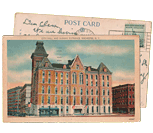
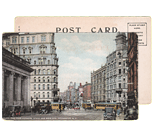
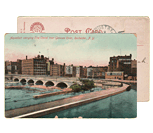
Greetings from Rochester! Lately you may have noticed lots of old images stuck to the sides of the buildings downtown. The images are actually larger reproductions of old postcards—some a century old—and they pay homage to the gorgeous buildings that once lined Rochester’s streets. For the past two years I’ve been collecting a lot of these same vintage postcards. I like to say “vintage” instead of “old” because most of them are new to me – plus I can’t imagine these incredible images ever getting old in the other sense of the word.
Well, I finally did it. It was a monumental task but now you can flip thru my entire collection of vintage Rochester postcard images right from your computer. All 178 views – scanned, uploaded, and labeled for your viewing pleasure…
On February 26, 1904 a fire leveled 1¾ acres of the Main Street shopping district. The fire started in the Rochester Dry Goods Company and the flames quickly spread west to Saint Paul Street and north across Division Street via a footbridge. Faulty electrical wires in an elevator shaft were to blame. More photos after the jump…
Lots of news has been brewing lately over the future of Rochester’s beat-up, 32-year-old Amtrak station on Central Avenue. Congresswoman Louise Slaughter recently announced that a $1.5 million federal stimulus grant has been awarded to New York state to plan for a new multi-modal station on the site. A $2.5 million appropriation to pay for the station design is expected to pass Congress next month. And Governor-elect Andrew Cuomo has just made it abundantly clear that New York will take whatever federal money is left on the table by newly elected GOP governors in Ohio and Wisconsin.
So for now, let’s just assume that something very interesting is in the works for our pitiful excuse for a train station. This is the perfect time to take a step back in time—to be inspired by Rochester’s grand old stations…
I’ve never shared this with anyone before… but I have a disorder. I’m an excessive wallpaper changer. I’m in therapy (and doing a little self-medicating) but still, I have a hard time keeping one background graphic on my computer desktop for more than a day or two (at most). Maybe I have ADHD? Or maybe I just need a life. I CAN’T HELP IT! I just get bored staring at the same image for too long. I tear through so many wallpapers I’ve had to start making my own…
If you happened to pass by Main Street on Friday afternoon you would have seen crowds of downtown workers staring up at the sky. That’s because more than 70 members of the local business community were dangling from the First Federal Building as part of a fundraiser organized by the Seneca Waterways Council of the Boy Scouts of America.
Participants each raised $1,000 to earn themselves the opportunity to rappel down the exterior of the 21-story, “flying saucer” capped building at 28 East Main Street. Proceeds will be used to support urban programs of the Boy Scouts.
Last week members of City Council voted 8 to 1 in favor of a resolution supporting a new RGRTA bus station on Mortimer Street. The single vote against the plan came from Councilmember Carolee Conklin, who said the plan is “a 19th Century solution to a 21st Century problem.” RochesterSubway.com has obtained the following memo from Conklin to Mayor Duffy. In it she explains in detail why she is opposed to RGRTA’s proposal…
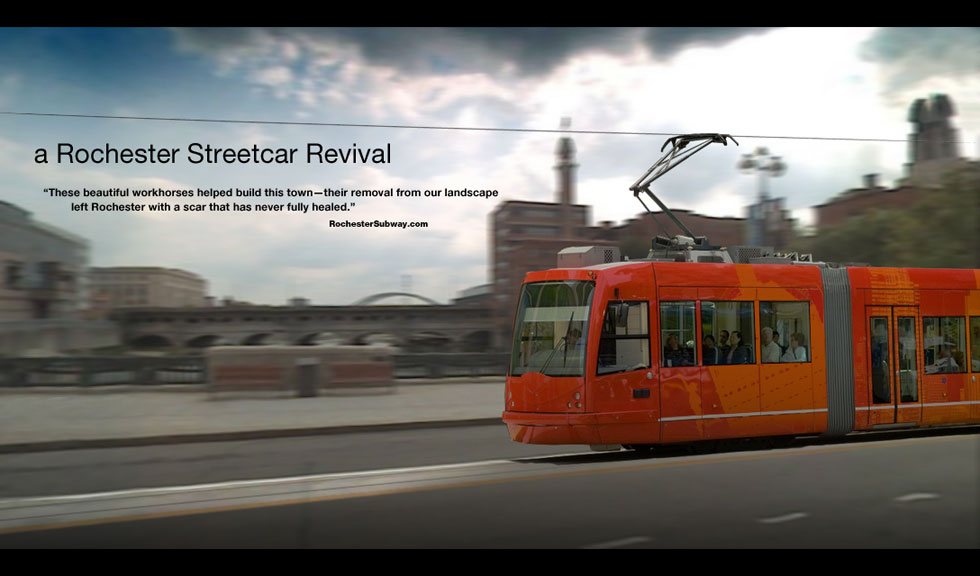
America seems to have taken a renewed interest in mobility. Maybe due to President Obama’s recent commitment to high speed rail—or perhaps the positive results seen in towns like Portland and Denver have caught our collective attention. Whatever the reason, from the top down, people are rethinking our automobile-oriented culture—and getting excited about the possibilities.
There’s also good reason to focus on transportation as a way of jump-starting economic development. Industry requires access to people. And people need to have easy access to centers of employment. Continually improving access makes further development possible. Interrupting access will have the opposite effect. Likewise, doing nothing or simply maintaining existing infrastructure for an extended period of time will also hinder development.
For 30+ years Rochester has relied on the infrastructure choices it made in the 1950’s, 60’s, and 70’s. At that time we made development choices that encouraged our population to emigrate from the downtown core. We scrapped our extensive streetcar system, choked off downtown with the construction of the inner-loop, and paved super highways to take us from the city to the NY State Thruway and beyond. Since then that’s exactly where our money, our workforce, and our future have gone—down I-490 and out of state.
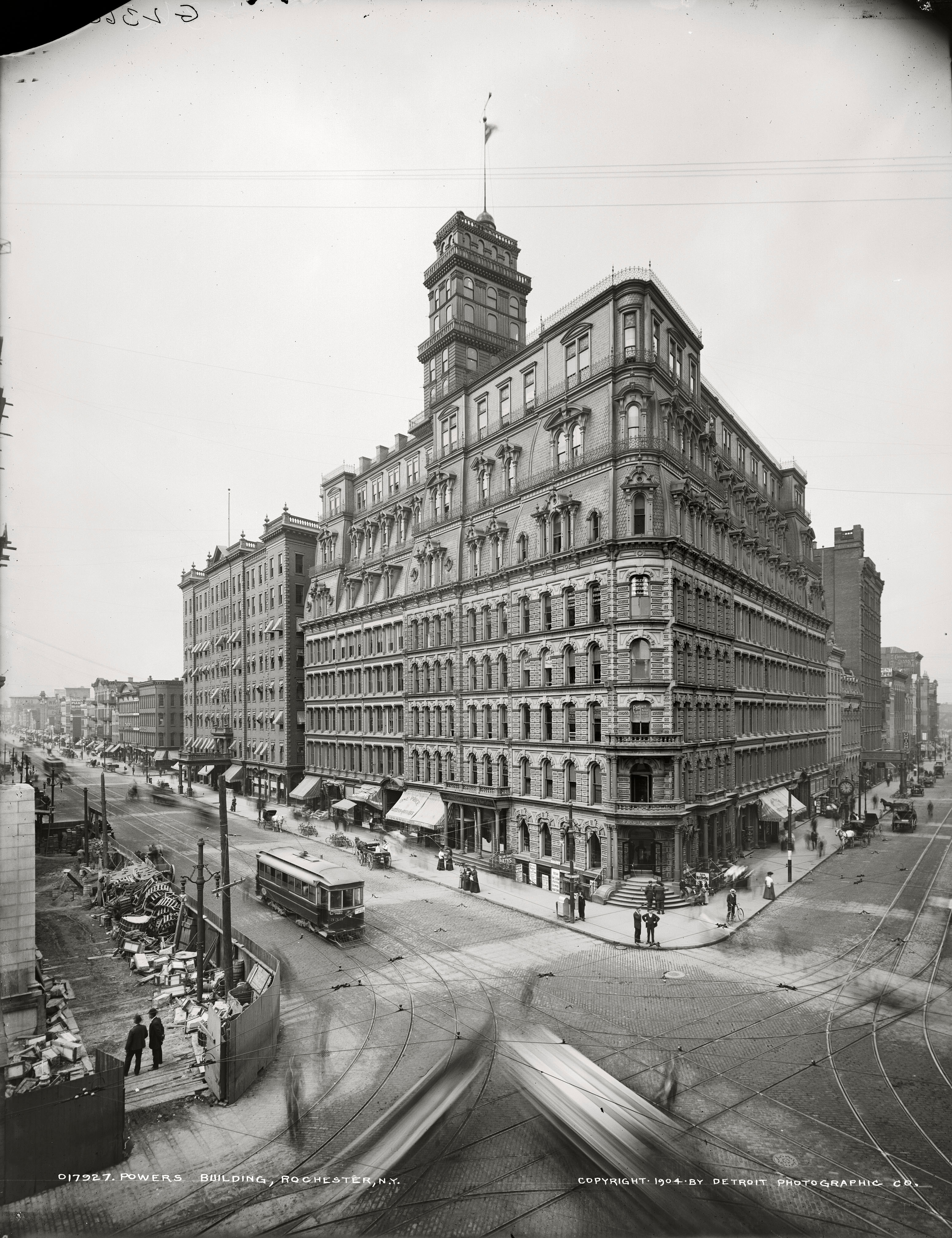
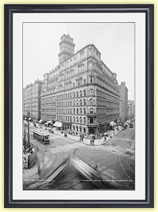
We found this old photo of the Powers Building and Rochester’s four corners recently on a vintage photos website called Shorpy.com . Not only is this a photo of one of Rochester’s most celebrated structures at one of the greatest times in the city’s history, but it’s incredibly detailed for such an old photo—right down to the logos painted on the office windows (click on the image to enlarge).
Hey, here’s a bit of fun for you… we hid the RochesterSubway.com logo somewhere in the photo. Let’s see which one of you can find it first. And while you’re searching for our hidden logo, here are a few other things you should take notice of…
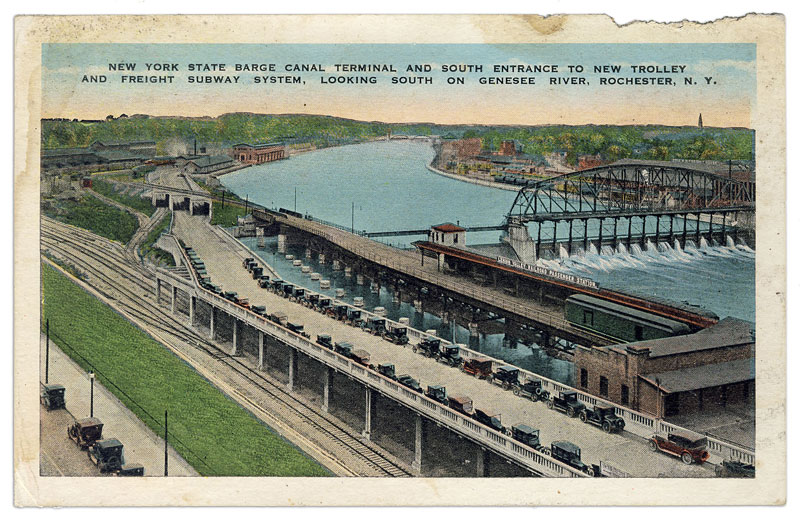
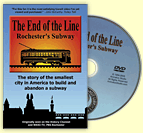
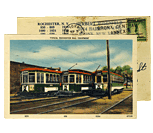
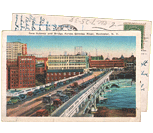
Recently we acquired this postcard (shown above) of the Rochester subway entrance at Court Street. And while I was reading up on the history of Rochester and the Erie Canal, I came across some pretty neat photos of downtown, the old canal, and later the construction of the Rochester Subway. These images say a thousand words so I’ll just start the slide show with this incredible panorama of Rochester from 1906…
Get Email Updates...
Stay up-to-date on Rochester-related stories, artifacts, and ideas that you won't find in the mainstream news.
Totally free, never spammy, and you can unsubscribe at any time.
After the Erie Canal was rerouted south of downtown Rochester, the Rochester
Industrial & Rapid Transit Railway (the “subway”) was built in
its place as a link between the five different railroads and interurban trolley
lines that served the Rochester area. As the industrial landscape of Rochester
changed, and highways replaced the railroads, the Rochester subway gradually
became a relic of a bygone era. In 1956 the subway was abandoned and much of
its route was converted into Interstate 490 — built to connect Rochester
with the New York State Thruway (I-90). Read more about the history of the Rochester Subway.
RochesterSubway.com exists to help spark
public dialogue around how we can better connect the neighborhoods of Rochester
NY, surrounding communities, and their cultural offerings. Rochester’s
future is written in her past. Let's rediscover it.



















![Two little girls have a chat with Santa in front of the Duffy-Powers Department Store on the corner of W. Main and Fitzhugh Streets, Rochester, NY. Printed in Rochester Herald, December 24, 1914. [PHOTO: Albert R. Stone collection]](https://www.rochestersubway.com/images/photos/rochester-duffy-mcinnerney-santa.jpg)
![The McCurdy & Norwell Company department store was located at 285-291 Main Street East, at the corner of Elm Street. The display windows are crowded with goods. The store occupied several attached buildings of various heights and styles. c.1901-1913 [PHOTO: Albert R. Stone Collection]](https://www.rochestersubway.com/images/photos/rochester-mccurdy-department-store-windows-02.jpg)
![An exterior view of Sibley's as seen at nighttime and decorated for Christmas. 1939. [PHOTO: Rochester Public Library]](https://www.rochestersubway.com/images/photos/rochester-sibley-department-store-windows-02.jpg)


![This was the Sibley Building office, and murder scene, of J. Frank O'Connor, a tailor merchant. A sewing machine and its table have been knocked over and lie in front of the radiator. The cutting table is at the right. A lower table, on the left, holds a bolt of fabric, a pressing board for sleeves, and an electric iron. A chair and a box of material sit in front of the lower table. [PHOTO: Albert R. Stone Collection]](https://www.rochestersubway.com/images/photos/sibley-murder-scene-3.jpg)
![Main Street Rochester. c.1908 [PHOTO: Albert R. Stone Collection]](https://www.rochestersubway.com/images/photos/rochester-main-street-then-and-now-1.jpg)
![This was the corner of Main and Fitzhugh Streets (1884). Can you find Cogswell? [PHOTO: Rochester Public Library]](https://www.rochestersubway.com/images/photos/rochester-savings-bank-cogswell.jpg)