This Wednesday the Preservation Board will decide whether or not to sponsor a citizen’s request to nominate 13 Cataract St. for Landmark Designation. If they sponsor the nomination it will move on to a public hearing and to the Planning Board for consideration later this month. If they don’t, it could spell the end for this valuable piece of our history and any possible redevelopment on the eastern rim of the High Falls gorge. In the meantime, North American Breweries, Inc. continues to move ahead with work on their visitor center across the street. No problems posed so far by the big bad historic building across the street.
The following is a letter I will be submitting to the Preservation Board (via Peter Siegrist, [email protected]).
Bret Garwood, Director, Business & Housing Development [email protected]
If you would like for 13 Cataract to be preserved, you should do the same. Use the email addresses above. And feel free to steal from my letter if you’d like…
The spate of recent articles in the D&C regarding local construction projects also means that there will be a great amount of demolition of older buildings and historic properties. Take, for example, the recent decision to demolish the Cataract Brewery buildings in High Falls. The cost to demolish the properties alone—estimated at $800,000 to $1 million—is more than twice the amount for which Genesee Brewery was recently selling the two Cataract Brewery buildings and a large parking lot. That same amount could be used to install a new roof and windows, “button up” the building, and abate the lead paint, within the older “gem” brewery building. Although the oldest Cataract building is currently a “liability” in the words of a developer who recently toured the property, it could actually act as the driver for redevelopment. Historic Preservation Tax Credits, coupled with city, county, state, and federal monies, could pay for at least 30-40% of construction costs, and potentially way more if the City took on the lead abatement costs and Genesee Brewery and its owner, KPS Capital, acted as an investor or partner in redevelopment.
Rendering of renovated buildings and GardenAerial trail
I realize that sometimes it’s a bit difficult to see the potential in something. Especially when that “potential” is hidden beneath layers of mustard yellow paint, rusty corrugated siding, and 25+ years of plain old tired…
The way things look now (click for larger views)
Why, just the other day Howard S. Decker, FAIA said, “” Mr. Decker is former Principal of DLK Architecture (Chicago) and former Chief Curator of the National Building Museum (Washington DC). He knows a thing or two about buildings, and places that are worth saving for future generations. His highly experienced eyes see the potential in 13 Cataract Street and the neighborhood it lives in.
But what about the rest of us? How can we be sure this building is worth the money and effort it will take to bring it back to life? What is the alternative to demolition? And will we lose our Brewery Visitor Center if we don’t tear this other building down??
Let’s start with an excerpt taken from a document filed by the Landmark Society in 1984 with the New York State Parks and Recreation Division for Historic Preservation…
On Friday officials at the Genesee Brewery unveiled plans they say will “create a destination for beer lovers that anchors development on downtown Rochester’s Northeast side.” Before we get too excited, let’s think.
Firstly, did you know Genesee Brewery is owned by a New York City investment firm called KPS Capital Partners? KPS Capital Partners established North American Breweries, Inc. in 2009 to manage its brewery acquisitions. One of those acquisitions was our beloved Genesee. They will tell you North American Breweries is headquartered in Rochester. But Genesee Brewery is no longer a locally owned company.
North American Breweries says their planned “Genesee Brew House…will celebrate the storied history and experience of the Genesee brand” and that they want to “tell the story of [this] resilient company with a rich history that dates back to 1878.” But to do this they will demolish this building; the centerpiece of Rochester’s historic brewing district, built 1899.
If there’s one thing the Great Recession can teach us, it’s that one need not pay an admission fee and tip toe through the great white halls of the Memorial Art Gallery to be able to enjoy fine art. Rochester’s streets are a hotbed of modern artistic expression. All too often we dismiss street art as thoughtless vulgarity or worthless scribble. I say it depends on the frame; and the lens.
Throw on a French beret and grab your monocle. We’re hitting the streets and public spaces of Rochester to broaden our understanding of what art is…
9/11 destroyed the lives of thousands of innocent people and had a profound impact on countless others. But 9/11 didn’t end on that September morning ten years ago.
RochesterSubway.com’s home page went dark today — honoring the people who lost their lives that morning. Also listed are the thousands of coalition causalities from the Iraq and Afghanstan wars.
Not listed are the families, husbands, wives, and children who have been left behind. Not listed are the hundreds of thousands of Iraqi and Afghani civilian casualties or their families. Not listed are the people who will be lost tomorrow or the next day; on the battle field, or in acts of terror.
We will never forget 9/11. And we continue to wait for 9/12.
While visiting Seattle a few years ago something occurred to me. Here I was on the other side of the country in a city I had never been to before in my life, and I was navigating their bus system like seasoned Seattleite. There were no fancy digital real-time signs, I had no smart phone, no GPS anything… I didn’t even have a printed schedule. I didn’t need any of those things because I had this…
Over the past few years Rochester has seen several area roadways slimmed down. East and University Avenues in the City and route 590 and Saint Paul Boulevard heading up to the lake have all been reduced from 4 lanes to 2 (usually with a center turning lane). Dan Burden of the Walkable and Livable Communities Institute coined the phrase “road diet”. Basically, a road diet is when one or more auto lanes are removed and replaced with either a center turning lane, bike lanes, wider shoulders, wider sidewalks or any combination of those things.
Personally, I LOVE this. Not only do less auto lanes make me feel more at ease as a pedestrian or riding my bike… but as a driver, I’ve found that I’m much more relaxed when I’m not thinking about the speedy jackass who’s trying to pass me from the righthand lane. And what’s good for my blood pressure is good for everyone. Believe me.
But before you make up your mind, take a look at this video from Streetfilms…
If you didn’t already know I have severe OCD, this post is surely going to tip my hand. But here goes.
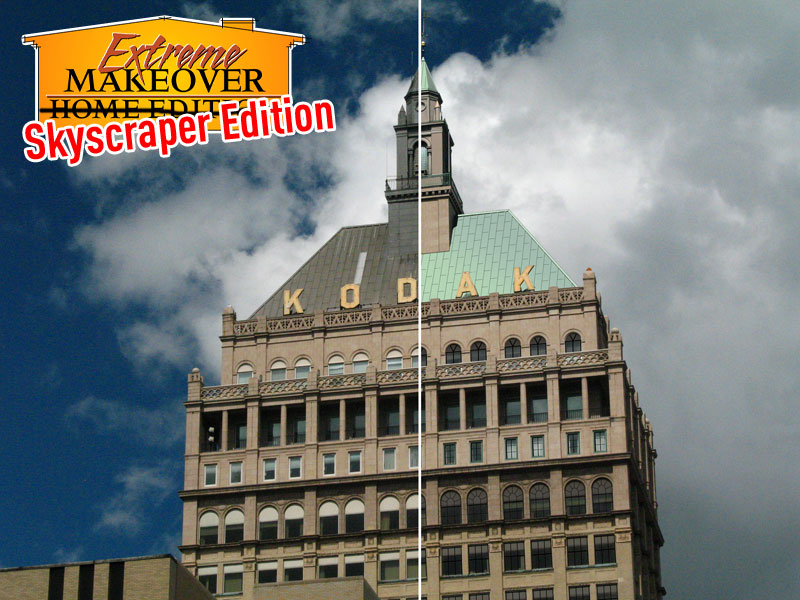
I LOVE Kodak. I own 3 Kodak cameras (one on me at all times) and countless “Kodak moments” hanging on my walls. In fact the very first thing my children saw after the nurses wiped the goop out of their eyes was—you guessed it—a Kodak camera. But there’s one itty bitty thing that bugs me about Kodak… their 19 story office tower. It looks like it was blown up and patched back together with superglue (which by the way was invented by a Kodak chemist).
I pass by Kodak tower everyday on my to and from work; and everyday I cringe a little bit. Don’t misunderstand me, it’s a gorgeous building with great bones. I just think it needs the 1970’s dusted off. And by George, with a little Photoshop magic I’m going give it my best shot. First a bit of history…
A recent story in the City Newspaper, “Glamming Rochester’s Gateways” touched on the idea that filling in part of the Inner Loop would help reconnect certain neighborhoods with downtown and improve Rochester’s eastern gateways. Then came the raging comments from readers who blindly defended the inner loop and its many blessings.
One letter sent in from James R. Boehler went like this… (more…)
Tonight was the City Council’s final public hearing and vote on whether or not to release a portion of Mortimer Street (in the heart of downtown Rochester) to the transit authority to build a 26-bay bus terminal. I used the opportunity not to denounce the bus terminal but more so to point out that the City of Rochester has no transportation plan. Also to sharpen my public speaking skills, which, after tonight I realize can only get better. I stumbled, I was shakey, I lost my place several times, and my mouth was so dry my tongue kept making this annoying clicking sound with every syllable. But, I delivered my message and that’s what counts. Anyway, here is the text of my statement:
According to an article in today’s Democrat & Chronicle, RGRTA has decided it does not need to produce an environmental study for it’s proposed bus garage on Mortimer Street. And the project that was despised by the public and the City when it was part of Renaissance Square looks like it will be embraced warmly at next week’s City Council meeting.
Let’s be honest, this is more than just a project…
Howard Decker is new to Rochester. He moved here last Fall after spending much of his professional life designing transit systems from Chicago to Houston to Washington DC. He is a lifelong historic preservationist, an FAIA, architect, urban designer, and former Chief Curator of the National Building Museum. As a self-proclaimed “transit-geek” he is now spending time familiarizing himself with, and blogging about Rochester and working with groups such as the RRCDC and Reconnect Rochester . Last week Howard attended the public input meeting on RGRTA’s planned transit center on Mortimer Street. Today he posted his opinion on the whole thing. Read his article (below). And please attend the final public input meeting tomorrow night (May 5).
Buses and Subways and Trains, Oh My
A Town Square (May 4, 2010) — Our home place here is in the midst of considering a change to its transit system. As usual, Rochester is the perfect case study of how cities can screw themselves up with the greatest of ease. My newly adopted city, like so many of its sister places, has made a vast litany of urban gaffes over the last century, and we are about to see yet another. Let me explain.
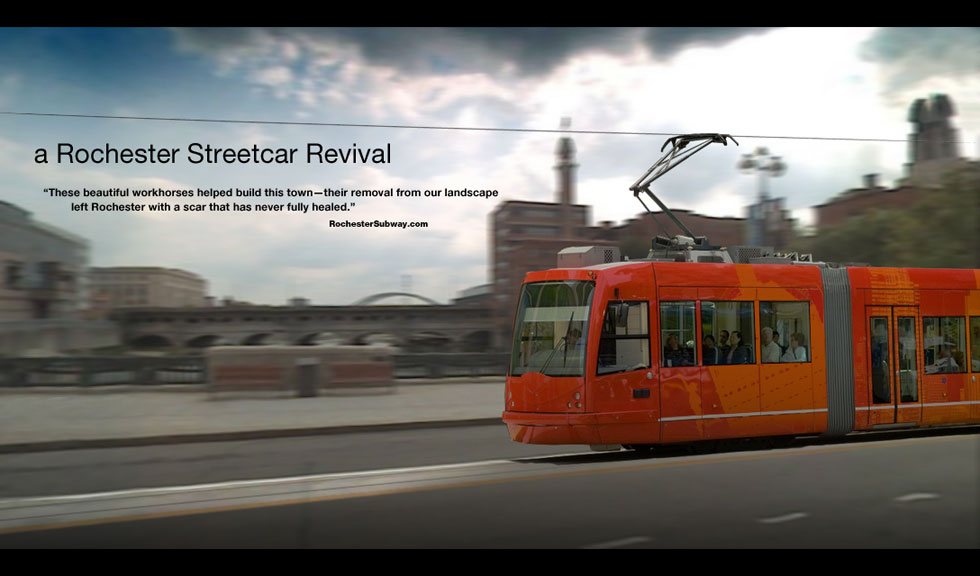
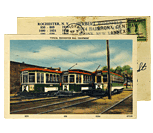
In the early 20th century, Rochester had a system of streetcars and interurbans and even a subway, all of which provided transit options to citizens. In those days, say the 1920s, the population of the city was quite a bit larger than today, though the region was much smaller – sprawl was only just getting started.
By the mid 1950s, everything was gone. Streetcars gone. Interurbans gone. Subway gone. Left on the roads? Cars, and buses. Retail was headed out of town, following all those who began to sprawl. Downtown’s fate was sealed…
Yesterday I wrote to Evan Dawson from WHAM News 13 in an effort to find out why he chose to compare HSR to the Rochester/Toronto fast ferry in his recent article, High Speed Rail: Fast Forward, Not Fast Ferry… Right? My concern was that this was an unfair, apples-to-oranges comparison. After all, passenger rail has served our region for over 150 years and if NY doesn’t want the upgrade it will go to Florida, Texas, California, Ohio, etc. To Dawson’s credit he took the time to write me back. He didn’t have to and I appreciate that. BUT, he missed the point I was trying to make and for the record, I still take issue with his comparison to the failed ferry and his line of questioning directed at Congresswoman Slaughter. Below is his response to my first email. Below that is MY response to his response. More to come I’m sure…
Last Friday (April 9, 2010) Louise Slaughter held a press conference at Rochester’s Amtrak Station along with Transportation Secretary Ray LaHood to officially announce the arrival of High Speed Rail to Western NY. In addition to the track improvements made possible by $151 million in federal stimulus money, Slaughter said Rochester’s outdated Amtrak station will receive modest updates to the building and platform. She also announced that Amtrak, Greyhound, and Trailways (who were in attendance) were committed to building a new multimodal station as a separate project. Also in attendance was WHAM 13’s Evan Dawson [[email protected]]. Dawson asked some tough questions. For example, “Who will subsidize the project?” Good one Dawson. Hey, does WHAM have any openings? I’d like to apply.
So this past Monday Dawson posted his commentary, High Speed Rail: Fast Forward, Not Fast Ferry… Right? It’s quite the masterpiece. The article points to a list of questions that he’d like answers to. But since he hasn’t found the answers yet… he’ll just assume that these upgrades to the nation’s rail system are unnecessary and will be the next “fast ferry”.
While I applaud Dawson’s quest to find answers to certain outstanding questions, I take issue with his use of metaphor. And since WHAM doesn’t allow user comments on their site anymore, I had to send him this email in order to let him know how I felt… (more…)
A letter to the editor in this week’s City Newspaper caught my eye tonight. It echoes many thoughts that have been rattling around my own head since the feds announced $151 million in high-speed rail money for New York—but stated much more eloquently than I could ever wish to. The gist of the commentary is clear from the title, “High-Speed Rail is a Necessity”. But the real golden nugget… and the point I’d like to scream from the top of Xerox tower… was this: News of high-speed rail funds should have been hailed as a positive breakthrough for our region. Instead it drew an avalanche of skepticism and negativity—two ugly characteristics that have become hallmarks of this town and will ultimately hurt us all.
Here is the letter from Roger Brown, president of the Rochester Regional Community Design Center…
America seems to have taken a renewed interest in mobility. Maybe due to President Obama’s recent commitment to high speed rail—or perhaps the positive results seen in towns like Portland and Denver have caught our collective attention. Whatever the reason, from the top down, people are rethinking our automobile-oriented culture—and getting excited about the possibilities.
There’s also good reason to focus on transportation as a way of jump-starting economic development. Industry requires access to people. And people need to have easy access to centers of employment. Continually improving access makes further development possible. Interrupting access will have the opposite effect. Likewise, doing nothing or simply maintaining existing infrastructure for an extended period of time will also hinder development.
For 30+ years Rochester has relied on the infrastructure choices it made in the 1950’s, 60’s, and 70’s. At that time we made development choices that encouraged our population to emigrate from the downtown core. We scrapped our extensive streetcar system, choked off downtown with the construction of the inner-loop, and paved super highways to take us from the city to the NY State Thruway and beyond. Since then that’s exactly where our money, our workforce, and our future have gone—down I-490 and out of state.
Let me just preface this. Those of you who follow RochesterSubway.com know I am not trying to bring back the Subway—although if Mayor Duffy announced its re-opening tomorrow I’d promptly nominate him to be crowned King of Rochester. My mission is plainly stated at the bottom of every page on this site. I support any initiative that will improve the quality of life for all Rochesterians. A bike lane here or there. Perhaps a few good grocery stores downtown, etc. etc. My goal is to get Rochester thinking about the possibilities and to spark public dialogue.
Most of the feedback I get from my readers is very positive and I’ve had a lot of great ideas thrown my way. But for every 20 people I hear from, there’s usually one person who’s… well… a real visionary. This month’s award goes to Christine B. from Rochester. In fact, I may have to name the award after her. Christine makes the assumption that I am out to garnish her paycheck and use it to bring back the Rochester Subway. And oh boy is she P.O.’d!
A word of caution before you read her monologue… if you’re a Kodak employee, a “liberal”, unemployed, gay, or if you are homeless, some of Christine’s ideas may offend you. But if you read between the lines, I’m sure you’ll see where she’s going with this line of thought. Oh, and PLEASE share your opinions in the comments. I know Christine will appreciate your feedback…
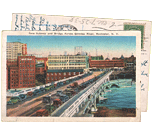
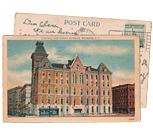
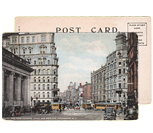
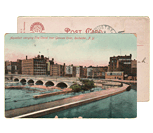
Long before hybrid cars, SUV’s, JetBlue, and even Amtrak, travel between American cities occurred largely by rail. With the industrial and technological revolution around the turn of the 20th century, America’s interurban railway developed so fast and connected so many of us, it must have seemed like the future had suddenly arrived out of nowhere. So when Henry Ford’s Model T was introduced who could have anticipated the turn transportation history would soon take.
If you’re interested in understanding the history of rail travel in American (its rise and quick fall), we’ve got a book for you. One of our readers, Laurence Keefe, recently brought this one to our attention. The following is Larry’s review…
“When we were children on summer vacation, the highlight of the day was when Dad got home from work. We would eat dinner at six o’clock, when the news came on the radio. That was because it took him 50 minutes to get from his office near the Four Corners in Rochester, NY to our farm in Victor…
Get Email Updates...
Stay up-to-date on Rochester-related stories, artifacts, and ideas that you won't find in the mainstream news.
Totally free, never spammy, and you can unsubscribe at any time.
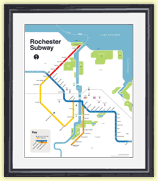
After the Erie Canal was rerouted south of downtown Rochester, the Rochester
Industrial & Rapid Transit Railway (the “subway”) was built in
its place as a link between the five different railroads and interurban trolley
lines that served the Rochester area. As the industrial landscape of Rochester
changed, and highways replaced the railroads, the Rochester subway gradually
became a relic of a bygone era. In 1956 the subway was abandoned and much of
its route was converted into Interstate 490 — built to connect Rochester
with the New York State Thruway (I-90). Read more about the history of the Rochester Subway.
RochesterSubway.com exists to help spark
public dialogue around how we can better connect the neighborhoods of Rochester
NY, surrounding communities, and their cultural offerings. Rochester’s
future is written in her past. Let's rediscover it.




















![13 Cataract Street at night. [Flickr Photo: Steven Yacuzzo]](https://www.rochestersubway.com/images/photos/cataract-brewery-night.jpg)
 for Landmark Designation. If they sponsor the nomination it will move on to a public hearing and to the Planning Board for consideration later this month. If they don’t, it could spell the end for this valuable piece of our history and any possible redevelopment on the eastern rim of the High Falls gorge. In the meantime, North American Breweries, Inc. continues to move ahead with work on their visitor center across the street. No problems posed so far by the big bad historic building across the street.
![Genesee Brewery. [Flickr Photo: _Yoshi_]](https://www.rochestersubway.com/images/photos/genesee-brewery-sign-yoshi.jpg)
![A view of what could one day be Rochester's Historic Brewery Square and entrance to the GardenAerial trail (right). [RENDERING: RochesterSubway.com]](https://www.rochestersubway.com/images/photos/cataract-rendering-empty.jpg)
![The original panorama photo set used to create the rendering of Brewery Square. [PHOTO: RochesterSubway.com]](https://www.rochestersubway.com/images/photos/cataract-rendering-original.jpg)
![The building as it was in 1899. [PHOTO: Rochester Public Library]](https://www.rochestersubway.com/images/photos/genesee-brewery.jpg)

![A September 11 memorial. [Flickr Photo: Peregrinari]](https://www.rochestersubway.com/images/photos/september-11-memorial.jpg)

![You probably don't even remember what University Avenue was like before it looked this. Four lanes curb-to-curb and certainly no room for those pretty daisies. [PHOTO: Google Streetview]!](https://www.rochestersubway.com/images/photos/university-avenue-rochester.jpg)


 A letter to the editor in this week’s City Newspaper caught my eye tonight. It echoes many thoughts that have been rattling around my own head since the feds announced $151 million in high-speed rail money for New York—but stated much more eloquently than I could ever wish to. The gist of the commentary is clear from the title, “High-Speed Rail is a Necessity”. But the real golden nugget… and the point I’d like to scream from the top of Xerox tower… was this: News of high-speed rail funds should have been hailed as a positive breakthrough for our region. Instead it drew an avalanche of skepticism and negativity—two ugly characteristics that have become hallmarks of this town and will ultimately hurt us all.