Recent commentary from the Green Party candidate for mayor made me realize that for many, there are simplistic black and white arguments regarding the value of investing in downtown versus investment in education and poverty alleviation.
The Green Party outrage over the sale of Midtown to Buckingham/Morgan developers for $2.00 is one example. I’d like to talk about how the economics work, and why I think there’s a bigger picture being overlooked…
Rochester is a city with a rich history that has experienced a steady decline in population, quality of life, and reputation. Despite this the city has many proud residents who are not satisfied with the status quo. Due to repeated failures we’re skeptical of large projects. This environment of pride mixed with skepticism has produced a generation of Rochester supporters who embrace progressive ideas, respect history, and proceed with caution. My personal contribution is a plan to establish a large State University in Downtown Rochester. We’ll call it SUNY Rochester.
There’s a new development called I-Square being built right now in Irondequoit. It’s one of those “new urban” designs with mixed-use buildings placed along the sidewalk and a little public space in the center of it all. Where’s the parking? Right where it should be, behind the buildings, hidden from the street. The end result will be an attractive street front and a destination for people to come and walk around – maybe spend a little time and money. Very exciting.
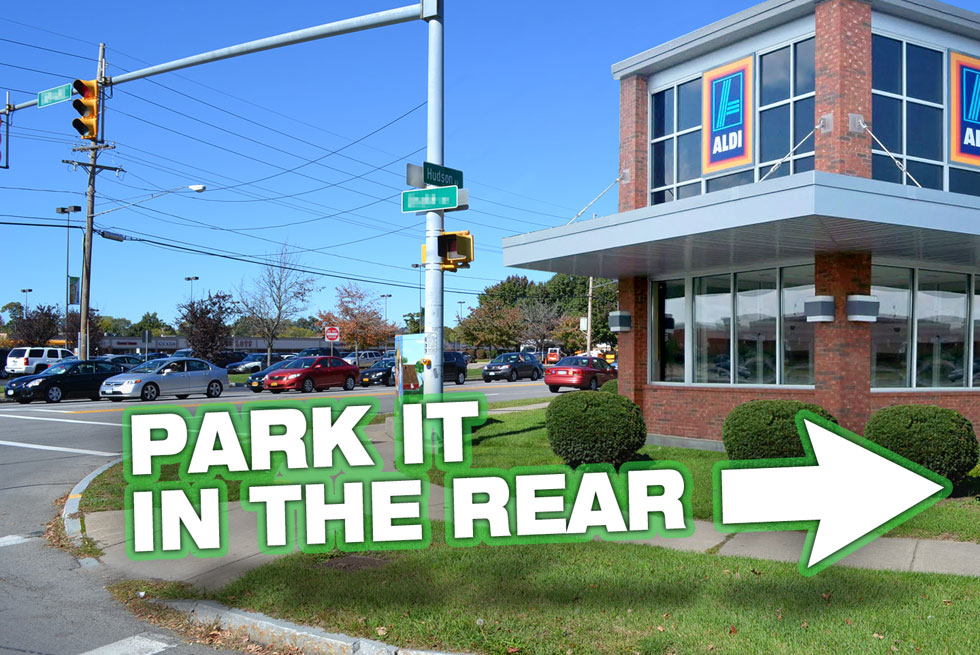
But right around the corner, on Hudson Avenue, is a proposal for a new Aldi grocery store. It’s the exact opposite of I-Square – a more typical, drive in & drive out, sub-urban design. This got me thinking…
I stopped by Iola on Sunday to check on what’s left, and I snapped these pics. In front of the main building there was once a circle with concrete benches and lamp posts. To be perfectly honest I coveted the abandoned lamp posts and thought of ways I could possibly “reclaim” them, but my conscience always prevented me from doing so. Well, I should have because the picture above shows the careful attention the deconstruction crew is taking to features that could be re-used. That’s the base and the flattened steel post is above it. I think my reclamation would have been better than this treatment. Damn conscience.
Within a 30 minute drive of downtown Rochester, beyond the suburban development surrounding the city, is the Village of Honeoye Falls. Honeoye Falls is not a typical crossroads village though. Like Rochester, it was settled due to the location of the waterfalls to provide power to mills in the early 1800s. Unlike Rochester though, it never grew large enough to lose the majority of its Main Street to large suburban plazas, malls, and ‘big boxes’.
Dunkin’ Donuts is interested in constructing a new location with a drive-thru, in a section of the village which currently has a small concentration of commercial development, but the village code currently disallows drive-thru restaurants. The Mayor and some members of the Village Board are supporting a proposal to change the code to allow Dunkin’ Donuts to build a drive-thru even though the village is in the midst of updating the Comprehensive Plan. Convenience and an additional source of revenue for the village government may come at a high cost though if a drive-thru is allowed…
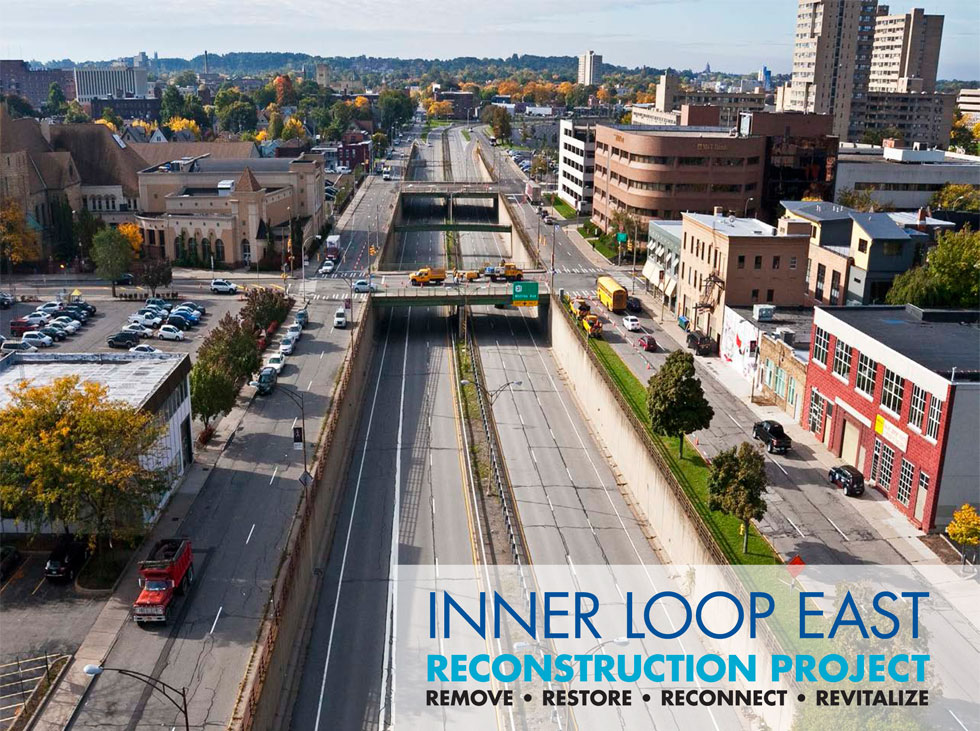
Reconnect Rochester has alerted us to an important informational meeting tonight about the Inner Loop’s future (or lack thereof). As we wait to find out whether or not this project will be a recipient of a USDOT TIGER grant, the City is moving forward with plans to scale down a large portion the underutilized 12-lane highway. Ultimately that will mean greater connectivity between downtown and the neighborhoods to the east, and lower road maintenance costs in the long run. If there was ever a big road project to support, this is it.
One of the sites that the city has, let’s say aspirationally, earmarked for development is the site of the former Sherwood Shoe Company. The shoe company itself was incorporated in 1905 by Frederick A. Sherwood, and the factory for it was built on this site at roughly the same time. I’m less sure when it was torn down, but it is on the 1935 plat maps, so it was certainly there through the depression. (UPDATE: the photo above is from 1956)
As for what to do here, I think there are a million great ideas, and I am hoping that we are able to get a good conversation of the various uses: lofts where the factory used to be? More houses? All of these things and more? All great ideas, and I’m not one to come to the table empty handed, so let’s take a look at what I think should go here.
A couple of weeks ago photographer Clarke Conde shared some dirty photos of Rochester’s riverfront on Facebook. Those photos made me sad. Dead trees, algae and trash had been collecting in this section of the river for over well over year. Smelly algae and logs are one thing. But add piles of plastic bottles, clothing, styrofoam, truck tires, other undesirables, and let stew for a year or more? To me, that’s more than a cosmetic problem. If I’m from out of town, I’d probably think Rochesterians just don’t give a hoot.
Thankfully, we all know that isn’t true. We pulled together. And we made a difference…
I went to a big expensive university to study art for four years. I’ve traveled to Italy and marveled at the work of the great masters. I’ve gone out of my way to tip-toe through all the fancy art museums and galleries in New York and Toronto.
Earlier in the week I rode my bike down Rochester’s El Camino Trail. I’m not sure why, but art has never taken my breath away quite like this…
If you’ve been following along, you know how we’ve been trying to apply a little design for the betterment of our transit system. First we took a shot at designing a better bus stop sign for Rochester. RGRTA is currently studying that concept in anticipation of one day replacing their existing signs. Next we designed a better bus pass for which RGRTA gave a nod of approval. The new passes will be rolled out very soon!
But wait, there’s more! RGRTA has now asked for help redesigning one of the most important transit tools of all; their big, bad, bus schedules…
WHOA! Not so fast.
It appears RocSubway jumped the gun and accidentally published some information that wasn’t ready for primetime. New bus schedule designs are being worked on, but it will be some time before they are finalized and ready to be shared. If you caught the sneak peek, congrats. And thanks for providing your feedback!
The City of Rochester recently put the finishing touches on some beautiful hardscaping and pathways connecting Mount Hope Avenue to the Genesee River Trail. Doesn’t a stroll along the river on a warm summer evening sound divine?
Umm, nah… I’ll take a rain check maybe. Have you seen our river lately?! LOOK at this…
Welcome back dear readers. Today we’re going to try something a little different at Filling In. Let’s actually walk through a lightweight proposal in response to the city’s RFP for 19 and 21-23 Berlin St (due by 4pm this Friday, 7/19). Just as a disclaimer; I do not intend to submit this proposal. Additionally, you are welcome to take it and submit it, but I am not to be held liable for any damages should you do so.
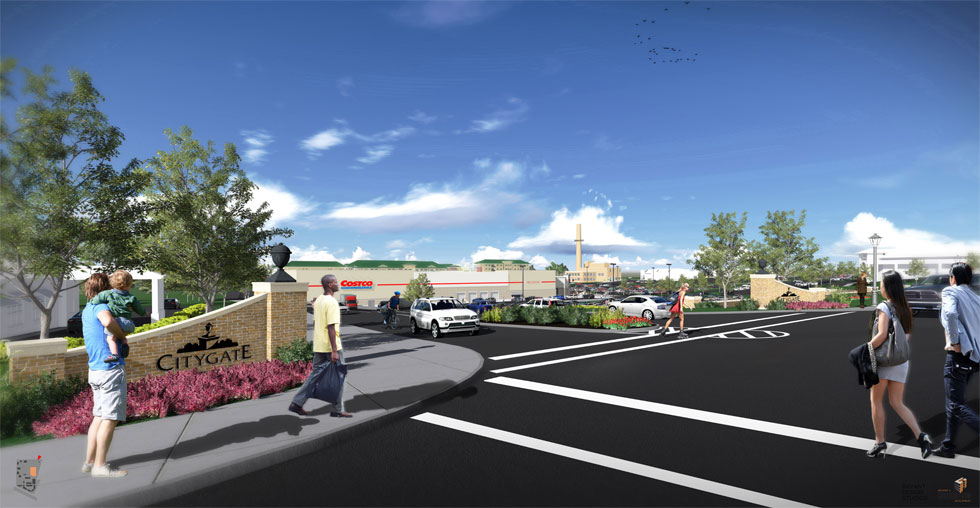
I have been arguing about CityGate for some time, but have come to the realization that this project appears mostly a “done deal” and that it appears to have community support, which is unfortunate given the atrocious new Site Plans and Renderings.
What I hope to show in this post is that although the project appears to be moving forward and that Anthony J. Costello and Son appear to be “listening” to the community, I beg to differ. Here are some of the fallacies, as I see them and as have been reported on this blog, as well as my responses. Let us call them the “seven myths” of CityGate…
Wow it’s been a while! This week, Let us take a look at Rochester’s best shot at an iconic piece of post-modern architecture downtown. No, not Midtown Tower. I’m talking about Midtown Plaza’s undeveloped “site 6”. As a quick refresher, here are the current plans:
New renderings were released this week of the proposed development called CityGate. Wow, look at all the fake pedestrians. Very exciting! Here’s my full analysis…
Can you believe it’s been two years since I tried to redesign Rochester’s bus stop signs? Everyone seemed to agree that a makeover was in order – even the folks at RTS who were nice enough to meet with me. But a year later there had been no serious progress on that front. At which point I turned my attention to something else I thought I could improve on; the fare cards. This time I was able to make some real progress…
It is through the process of defining what we want as a town that we are becoming a real community. It is through the act of participation that we change.
This is not simply a story of not-in-my-backyard. It is the unfolding tale of how a small community … is rising to its own defense, saying, we believe we have a stake in the future of our own community, which we choose to define beyond our own boundaries of time and space and species…
Don’t you hate it when this happens? You’re truckin’ along, you got your radio cranked way up, sippin’ on some blue Gatorade. You’re feeling pretty good… then, all of a sudden – WOOSH! Your Gatorade bottle gets sucked right out the window and lands on the side of the road. ARRRRH! I HATE that!
Oh 1926, it seems like you were only 87 years ago. Oh wait, what, it was only 87 years ago? Ok then. Well, since the Neighborhood of the Arts is receiving so much press these days, let’s take a look at a piece of the neighborhood from then and see what was happening.
Welcoming Costco and RGRTA to CityGate is great. Ignoring walkability and losing all historic buildings isn’t. Our community needs walkable places. We need development that calms traffic and makes walking easy and safe. Moreover, our community needs to preserve its historic fabric. We need development that repurposes old buildings for new uses…
Get Email Updates...
Stay up-to-date on Rochester-related stories, artifacts, and ideas that you won't find in the mainstream news.
Totally free, never spammy, and you can unsubscribe at any time.
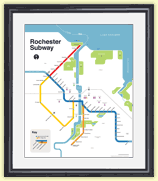
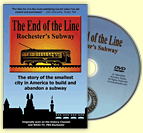
After the Erie Canal was rerouted south of downtown Rochester, the Rochester
Industrial & Rapid Transit Railway (the “subway”) was built in
its place as a link between the five different railroads and interurban trolley
lines that served the Rochester area. As the industrial landscape of Rochester
changed, and highways replaced the railroads, the Rochester subway gradually
became a relic of a bygone era. In 1956 the subway was abandoned and much of
its route was converted into Interstate 490 — built to connect Rochester
with the New York State Thruway (I-90). Read more about the history of the Rochester Subway.
RochesterSubway.com exists to help spark
public dialogue around how we can better connect the neighborhoods of Rochester
NY, surrounding communities, and their cultural offerings. Rochester’s
future is written in her past. Let's rediscover it.


















![Midtown Tower construction site. [PHOTO: Jimmy Combs]](https://www.rochestersubway.com/images/photos/public-private-investment-midtown-rochester-01.jpg)
 from the Green Party candidate for mayor made me realize that for many, there are simplistic black and white arguments regarding the value of investing in downtown versus investment in education and poverty alleviation.
![Donald J. Sullivan would like to see a SUNY college in downtown Rochester. [PHOTO: Flickr, PatrickHashley]](https://www.rochestersubway.com/images/photos/sunyroc-suny-rochester-skyline-patrickhashley.jpg)
![The abandoned Iola Tuberculosis Sanatorium. [PHOTO: Matt Rieck]](https://www.rochestersubway.com/images/photos/iola-tuberculosis-sanatorium-matt-rieck-01.jpg)

![A view of the Rochester Subway looking east from the Meigs Street bridge. A westbound car is shown approaching the Goodman-Meigs station. The Sherwood Shoe Company building on Goodman Street and Uhlen Place is seen in the right background. [PHOTO: Rochester Municipal Archives]](https://www.rochestersubway.com/images/photos/rochester-subway-and-sherwood-shoe-company-1956.jpg)
![Local photographer Clarke Conde has been snapping photos of the Genesee River all year. This patch of trash had been growing slowly like a giant, smelly tumor. [PHOTO: Clarke Conde]](https://www.rochestersubway.com/images/photos/genesee-river-garbage-clarke-conde-01.jpg)
![Art from the Wall Therapy project along Rochester's El Camino Trail. [PHOTO: RochesterSubway.com]](https://www.rochestersubway.com/images/photos/wall-therapy-el-camino-trail-rochester.jpg)

![19-23 Berlin Street [IMAGE: Google Maps]](https://www.rochestersubway.com/images/photos/19-23-berlin-street-rochester.jpg)
![Iola Building 1 with copper wire removed and other trash. [PHOTO: Joel Helfrich]](https://www.rochestersubway.com/images/photos/iola-building-1-with-copper-wire-removed-and-other-trash-01.jpg)


![Monroe County Tuberculosis Sanatorium, Children's Building. To be demolished. [PHOTO: Albert R. Stone, 1911.]](https://www.rochestersubway.com/images/photos/iola-tuberculosis-sanatorium-1911.jpg)
![Don't you hate it when your Gatorade gets sucked out your car window? [PHOTO: RochesterSubway.com]](https://www.rochestersubway.com/images/photos/rons-plumbing-ac-heating-litter-03.jpg)
![The corner of Atlantic and Anderson in the Holmes Tract. Gleason doesn't want this lot anymore. Maybe we can put it to good use? [PHOTO: Google Streetview]](https://www.rochestersubway.com/images/photos/filling-in-holmes-tract-01.jpg)
![The abandoned Iola Tuberculosis Sanatorium, Nurses' Building. [PHOTO: Mike Bouwmeester]](https://www.rochestersubway.com/images/photos/rochester-iola-sanatorium-nurses-building.jpg)