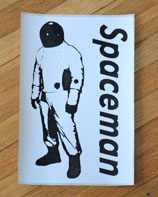
A few months ago this woman caught the attention of motorists on I-490 near downtown Rochester. The image immediately made me think of early works by Banksy or Shepard Fairey , artists who catapulted themselves into pop culture stardom by plastering their towns with often graphic and politically-charged poster art. I wondered, was this Rochester artist making a political/social statement? Or is this half-nude character with the peace sign pasty simply a random piece of visual titillation?
A few people on Facebook claimed to know the artist, but my attempts to track him (or her) down were fruitless. Then yesterday a friend* of mine spotted a similar image stuck to a 490/590 support column at the Can of Worms interchange…
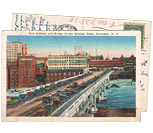
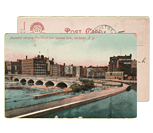
Last week we explored some of the caves in Rochester’s Genesee River gorge. While digging around for information about Lower Falls, I came across some great stuff on the nearby Driving Park Bridge. The bridge that you know today was built in 1989. But the previous bridge (shown above) had been there for nearly 100 years. That’s pretty remarkable when you consider its length of 717 feet, the icy Rochester weather, and the relentless spray from the Lower Falls below. Be sure to click on the image above for a much larger view. And check out the link at the end of this article to watch the explosive demolition of the old steel bridge in the 1980’s…
Just when I think I’ve done everything there is to do in Rochester, I discover another little hole in the wall. Literally. Check out these photos of what is unofficially known as “Rico Cave” near Lower Falls…
First, a little bit of history. The building shown above was one of Rochester’s earliest rail stations. Make sure you click to see all the great detail in the photo. It was located on Central Avenue between St. Paul & Clinton near the site of the current Amtrak Station. This view is looking west from Clinton Avenue, sometime between 1905-1914. In 1914 this station was replaced by the great Bragdon station in 1914, which was demolished in 1965…
Earlier this week a collection of photos of Rochester’s RKO Palace Theater was discovered thanks to the Rochester Theater Organ Society. Mixed in with those RKO Palace photos were a few interior shots of Rochester’s other lost movie palace… Loew’s Theater. So I thought it only fair to shine the spotlight on this one too. Loew’s Theater also happened to be on Clinton Avenue, just four or five blocks south of the RKO. Xerox Tower now occupies the spot. Take a look…
A few weeks after we discovered the RKO Palace Theater floor at the site of RGRTA’s future transit center, Russ Shaner, president of the Rochester Theater Organ Society contacted me. These were the guys who saved the old Wurlitzer pipe organ from the RKO Palace before the building was demolished. And as it turns out, one of their founding members, D.O. Schultz, captured a treasure trove of photographs and left them with the Organ Society before he moved to Florida years ago. Russ asked RochesterSubway.com for help, both archiving the photos, and sharing them with you, the public. Yesterday you saw part 1, and now, here is part 2 of this awesome collection…
A few weeks after we discovered the RKO Palace Theater floor at the site of RGRTA’s future transit center, Russ Shaner, president of the Rochester Theater Organ Society contacted me. These were the guys who saved the old Wurlitzer pipe organ from the RKO Palace before the building was demolished. And as it turns out, one of their founding members, D.O. Schultz, captured a treasure trove of photographs and left them with the Organ Society before he moved to Florida years ago. Russ asked RochesterSubway.com for help, both archiving the photos, and sharing them with you, the public. Below is part 1 of this awesome collection…
J. Frank O’Connor, known by his clients and friends as “Scrappy” O’Connor, was a merchant tailor. After a long weekend of partying, he would be murdered during a drunken battle in his office (shown above) on the second floor of Rochester’s Sibley Building. O’Connor’s body was found about 6:00 p.m., Monday, August 28, 1922. These are actual crime scene photos by Albert R. Stone…
The image above was printed in the Rochester Herald on October 10, 1908. This was Main Street looking east from the Four Corners on a busy day in October. The sidewalks are thronged with pedestrians. Several traffic police are standing at various spots in the intersection. A cluster of westbound trolleys, one labeled “Plymouth” and the other “Saratoga”, have stopped in their tracks. A few people are waiting to board, and others are crossing the street in front of the stopped cars. Several wagons, some covered, are traveling along the street. But then the trolley tracks were ripped up…
Often times while I’m doing research for a story, I’ll stumble upon something new and get completely sidetracked. Today I was digging for information on the Academy Building when I found the image above. It’s a shot of the Rochester Savings Bank building located at the corner of West Main and Fitzhugh. The Academy Building is to the immediate left of the bank. But forget the buildings for now. Do you see that strange little man standing in the lower left corner of the photo? That was actually a drinking fountain named Cogswell…
“Listed in the National Register of Historic Places and designated a city landmark, the old Federal Building is considered a fine example of Richardsonian Romanesque architecture. No one’s particularly interested in using it, however, because inside it’s dark, gloomy, usually uncomfortable and just plain ramshackle. Blow it up. It’s an ugly thing…and not particularly interesting inside or out…It should be demolished. A modern, tax-producing building would be a better use for the site and would give more new life to that section of downtown…”
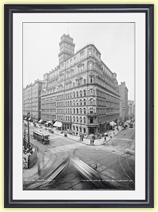
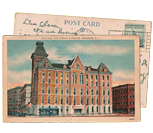
On September 14, 1908 a new 300 room hotel with ballroom, several dining rooms and meeting rooms opened its doors – right smack on the same spot where Windstream (Paetec) is constructing its new building today.
The following article was published in the New York Times on Monday September 14, 1908…
Yesterday I was having my typical kind of crappy Monday when this flyer caught my attention in a downtown parking garage. It was selling things like Love, Peace, and Happiness. I smiled and thought to myself, “No way! How can this be? I need me some of that.” But when I moved in closer I noticed there was no name or number to call. “GODDAMMIT!!” I was pissed off again.
I swear I will find the evil-doer responsible for this and bring them to justice.
In February we heard rumors that the iconic High Falls smoke stack might be coming down. Yesterday I noticed scaffolding going up around the structure. Today I learned the stack will be completely demolished, probably before winter…
“I believe when we’re born into this world we’re entrusted with certain things. Our grandparents trust that we’ll work hard to keep and maintain the world that they’ve broken themselves to build. And our children need us to preserve it, and leave it a little bit better than how we inherited it. Preservation is often difficult. But in many ways it’s all we have to keep us grounded; as a society and as people. Future generations need to know what came before them. What was it that made this city great? Who designed and built this place? Who worked here and why? If we destroy the evidence, we cut our children off from the answers forever; and impede our own ability to progress.”
These are words I live by. They’re also the reason I keep this web site. While my family and I are enjoying this sunny Labor Day weekend on the shores of Lake Ontario, I’ll take pause to think about why we have it so damn good in this time and place. For me, the answer can be found in the portraits that follow. These are some of the men, woman, and even children who labored to make the way of life we enjoy today…
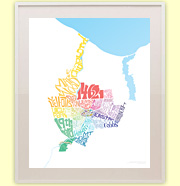
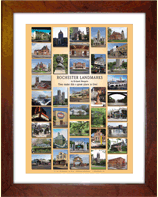
Now you can admire your hometown of Rochester, NY and the diversity of its many communities without ever putting on a pair of pants.* Introducing two awesome new posters depicting the neighborhoods of Rochester…
There are few places Rochesterians talk about with such fondness as the old RKO Palace Theater that once stood on Clinton Avenue. Looking at old pictures, I can see why. The place was all dressed up and sparkled inside and out like a glitzy Vegas showgirl. But like many of Rochester’s brick and mortar beauties, she grew old, was chopped up into little pieces, and buried where she stood. All in the name of “urban renewal.” Fast forward fifty years. RGRTA breaks ground on a new bus terminal. And guess what shows up? That’s right – the skeleton of Rochester’s most beautiful movie theater…
One evening sometime during the fall of 2011, my friend Chris and I were sitting around complaining about the ways of the world. The conversation eventually turned towards discussing how despite both of us having been born and raised in Rochester, NY, how neither one of us had ever bothered to visit any of the “cool looking” spiritual places of worship in the area, like St. Michael’s Church or St. Stanislaus Church…
It’s no secret. We all love a good implosion. So like any good citizen I woke up early (9:45am) and made my way over (and around police barricades) to the wrecking site so’s I could shoot some video of this one. I should apologize for the quality, however. With all the local streets closed off to traffic and officials encouraging people not to come out, this was the best location I could find. But you’ll get the idea. It’s an implosion. Wooo hoooo. Roll the video…
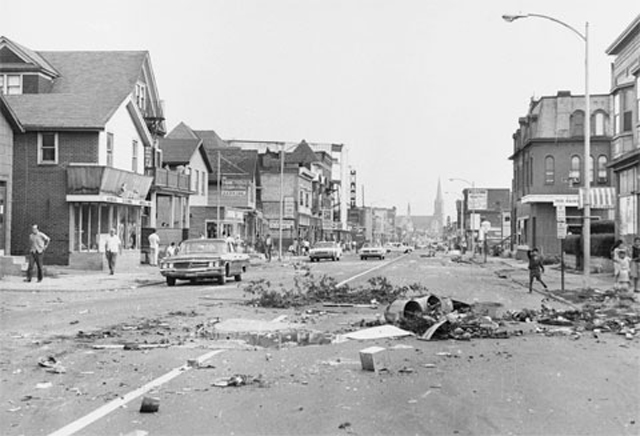
Today marks the 48th anniversary of Rochester’s 1964 “Race Riot” . While doing a little research on the 1964 riot I stumbled upon a completely different (and lesser known) incident. This one could also be called a “race riot” and it occurred 44 years earlier, on the streets of Fairport, NY.
Get Email Updates...
Stay up-to-date on Rochester-related stories, artifacts, and ideas that you won't find in the mainstream news.
Totally free, never spammy, and you can unsubscribe at any time.
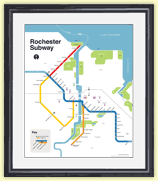
After the Erie Canal was rerouted south of downtown Rochester, the Rochester
Industrial & Rapid Transit Railway (the “subway”) was built in
its place as a link between the five different railroads and interurban trolley
lines that served the Rochester area. As the industrial landscape of Rochester
changed, and highways replaced the railroads, the Rochester subway gradually
became a relic of a bygone era. In 1956 the subway was abandoned and much of
its route was converted into Interstate 490 — built to connect Rochester
with the New York State Thruway (I-90). Read more about the history of the Rochester Subway.
RochesterSubway.com exists to help spark
public dialogue around how we can better connect the neighborhoods of Rochester
NY, surrounding communities, and their cultural offerings. Rochester’s
future is written in her past. Let's rediscover it.




















 on I-490 near downtown Rochester. The image immediately made me think of early works by Banksy
![Rico Cave in the Genesee River gorge near Lower Falls. [Flickr PHOTO: bobbybeans]](https://www.rochestersubway.com/images/photos/rochester-rico-cave-bobbybeans-1.jpg)
![New York Central Railroad Station c.1905-1914 [PHOTO: Detroit Publishing via Library of Congress]](https://www.rochestersubway.com/images/photos/rochester-ny-central-railroad-station.jpg)
![Loew's Rochester Theatre, Rochester. On the marquee: Greta Garbo, Charles Bickford, Maria Dressler in “Anna Christie” and on stage Barto and Mann, Harry Girard’s Ensemble, and A. Robbins. Photo by George Mann of the comedy dance team, Barto and Mann. April 26, 1930. [PHOTO: George Mann of the comedy dance team, Barto and Mann. Via Brad Smith's Flickr Stream]](https://www.rochestersubway.com/images/photos/loews-theater-rochester-01.jpg)
![Rochester's RKO Palace Theater during demolition. 1965. [PHOTO: D.O. Schultz / Rochester Theater Organ Society]](https://www.rochestersubway.com/images/photos/RKO-Palace-013-AuditoriumNorthWall.jpg)
![Rochester's RKO Palace Theater during WWII. Main entrance on Clinton Ave. 1942. [PHOTO: D.O. Schultz / Rochester Theater Organ Society]](https://www.rochestersubway.com/images/photos/RKO-Palace-001-ClintonAveEntrance1942.jpg)
![This was the Sibley Building office, and murder scene, of J. Frank O'Connor, a tailor merchant. A sewing machine and its table have been knocked over and lie in front of the radiator. The cutting table is at the right. A lower table, on the left, holds a bolt of fabric, a pressing board for sleeves, and an electric iron. A chair and a box of material sit in front of the lower table. [PHOTO: Albert R. Stone Collection]](https://www.rochestersubway.com/images/photos/sibley-murder-scene-3.jpg)
![Main Street Rochester. c.1908 [PHOTO: Albert R. Stone Collection]](https://www.rochestersubway.com/images/photos/rochester-main-street-then-and-now-1.jpg)
![This was the corner of Main and Fitzhugh Streets (1884). Can you find Cogswell? [PHOTO: Rochester Public Library]](https://www.rochestersubway.com/images/photos/rochester-savings-bank-cogswell.jpg)
![Old Federal Building (now City Hall). [PHOTO: Richard Margolis]](https://www.rochestersubway.com/images/photos/rochester-city-hall-richard-margolis.jpg)
![The Seneca Hotel, 26 S. Clinton Avenue, south of E. Main Street on the east side of the street. The stores in front, left to right, are Laurabelle's Greeting Cards, Ringclear Hosery Co., and Rochester Cleaning & Dyeing Co. [PHOTO: Rochester Municiple Archives]](https://www.rochestersubway.com/images/photos/rochester-seneca-hotel-front.jpg)
![A flyer in a downtown parking garage selling Love, Peace, and Happiness? But no number to call. Dammit! [PHOTO: RochesterSubway.com]](https://www.rochestersubway.com/images/photos/take-what-you-need-flyer.jpg)
![The end is near for the iconic High Falls smoke stack. [PHOTO: RochesterSubway.com]](https://www.rochestersubway.com/images/photos/high-falls-smoke-stack.jpg)
![Six unidentified female railroad workers pose at Lincoln Park Station. The railroad line is the Buffalo, Rochester and Pittsburgh Railway Company. In 1917-1918, many jobs traditionally held by men were filled by women, while the men served in the Armed Services in World War I. [PHOTO: Albert R. Stone Collection]](https://www.rochestersubway.com/images/photos/rochester-woman-railroad-workers-c1917.jpg)
![Rochester Neighborhoods Map [BY: RochesterSubway.com]](https://www.rochestersubway.com/images/photos/rochester-neighborhoods-map.jpg)

![A stained glass window in Rochester's Saint Michael's Church, Rochester NY. [IMAGE: www.exploringtheburnedoverdistrict.wordpress.com]](https://www.rochestersubway.com/images/photos/saint-michaels-church-stained-glass-rochester.jpg)