“The units at Erie Harbor are very poorly designed and overpriced… The ground floor units don’t even have a view of the river – it is blocked by a berm… Shoddy construction… The stairs creak… Tacky… Ugliest building in Rochester…” These are all comments you may have heard about the Erie Harbor Apartments which were officially opened last fall .
When comments like these were left under a recent post on RochesterSubway.com, Jim Mayer didn’t take it sitting down. He contacted me and invited me to visit his home. He and his wife Irene sold their home in Brighton and now live at Erie Harbor. I admit, after nearly a three hour visit, I left feeling a bit jealous at just how much this couple is loving life in their new digs…
Well, dear readers, I must admit that this is not exactly what I had planned when I left you the last time. That said, please bear with me while we look at something a little bit different.
John Baker, Steve Gullace, Chris Gullace have proposed to construct a new gym and a 48 unit apartment building at 759 Park Ave . The gym would be for the Talmudic Institute next door, while the apartments would be for rent. This has, not surprisingly, drawn a raft of criticism from the residents of the Park Ave neighborhood…
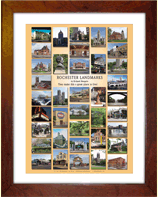
When I first moved to Rochester’s Swillburg neighborhood thirteen years ago, my favorite place to eat was Highland Park Diner. I remember this Rochester Landmarks poster, by Richard Margolis, hung over one of the booths there. I used to stare and study those landmarks all the while shoveling Aunt Bee’s Homestyle Meatloaf into my face. Ah, my first taste of Rochester. Today I own that poster, and I’ve now been to all but one of the 38 landmarks on it. It’s a great feeling!
Now you can get your hands on a copy of this Landmark poster from the RochesterSubway.com Gift Shop, and start checking them off your list too. Can you name all 38 landmarks? No peeking! The answers are after the jump…
This weekend, Wegmans closed their current East Avenue store so they could transition into their new, larger building . The new store replaces a historic area that was once the center of Brighton in the 19th century. The old Village of Brighton was served by the Erie Canal (now I-490). The canal was rerouted in the early 20th century and the entire area was annexed to the City of Rochester in 1905…
Mary Smith has lived at 53 Cutler Street on the city’s north side for 30 years. After her husband died, and some serious health problems (spinal surgeries and years of therapy) Mary says she fell behind on her taxes – by about $30,000. The City of Rochester and Monroe County then sold her tax debt to a Florida company called American Tax Funding . Mary says she now has the ability to pay her debt, but American Tax Funding will not negotiate. On Tuesday, they may throw her out of her house and auction off the property. Volunteers with a group called Take Back the Land is helping Mary with a petition to ask CEO, Matthew A. Marini, to cancel the foreclosure auction and negotiate a settlement…
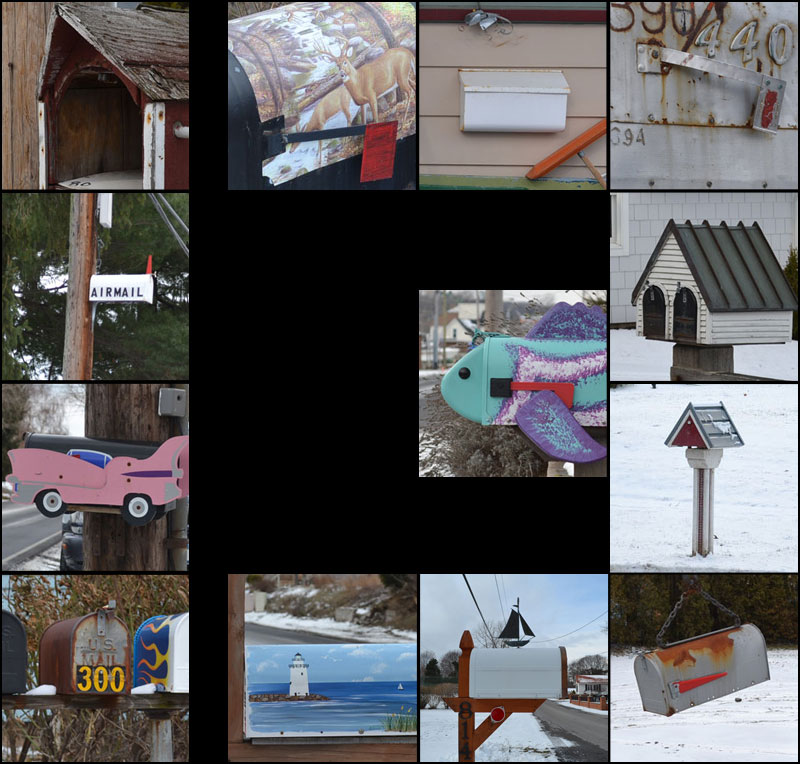
I don’t know why, but I really like the number 13. Some people go out of their way to avoid 13. Not me. In fact, I’m about to embark on a yearlong project for 2013. I’m going to pick 13 random subjects. Take 13 snapshots of each. And we’ll see if we can paint a portrait of Rochester.
Let’s start with the seemingly mundane mailbox. Most of these snapshots were taken near Sea Breeze…
GardenAerial is a non-profit organization working to transform the High Falls gorge, including its industrial structures and trails, into a multi-use, public green space. Full disclosure…I serve on the board of the GardenAerial. I jumped at the opportunity to support this organization because I believe the High Falls and surrounding area could be great assets for this city, but they are woefully underutilized. We’re working to change that. And here’s a tremendous opportunity for you to help right now…
Welcome back! Last week we looked at a block that almost had it all. This week, let’s see what we can do on a much larger scale with a block that needs a little more work. A roughly 600’x600’ square mega block at the southern entrance to downtown. There are a few good things going on here; Geva Theater , Capron Lofts , Plan Architects . And, a few not so good; a sweeping highway off-ramp, a GIANT parking lot across the street from TWO garages, and random weedy surface lots…
“It’s one of the eeriest, strangest places I’ve ever been.” That’s what Chris Seward said of this little known spot on the University of Rochester campus when he took these photos. The Merle Spurrier Gymnasium opened in 1955 as part of a women’s center and the Susan B. Anthony women’s dormitory. Spurrier housed this 25-yard-long, six lane swimming pool. According to a 2004 Campus Times article , the pool has been closed ever since the women’s gym facilities were moved to the Robert B. Goergen Athletic Center in 1982…
Forty days after the insanity on Lake Road I thought I’d take a drive out there to see it for myself. To have some quiet time. And to reflect. These photos were taken on Saturday, February 2, 2013…
Rochester’s Pulaski Library (originally the Hudson Avenue branch) was the second permanent library constructed by the City. As explained here , the library was closed in 1994, and has sat unused until last week when the City opened the doors to potential buyers. If you’re interested, the City wants your proposal by March 4. $1,000 to buy it, but you’ve got to show you’ve got a serious plan to rehab the property. Historic tax credits and grants could help take a bite out of the million dollars it could cost you when all is said and done. If you missed the open house, here’s a look inside…
Welcome to the first post in what will be an ongoing series called Filling In. One of the key elements of any great city is a tightly knit urban fabric. Whether you’re in New York City, San Francisco, or our own beloved Rochester, building an appealing city scape at a human, walkable scale promotes health, wealth, and wisdom. We’ve also learned that parks next to parks next to barren windswept plazas don’t put butts in seats, as they say. With that in mind, Filling In aims to explore vacant or underutilized pieces of Rochester in an effort to rebuild or strengthen our built environment. The aerial photo above was taken in 1929, when downtown was dense and energetic. And here is a reminder of what we’re up against…
Love’em or hate’em, these feathered Rochesterians may be here for the long haul. Last February the City and USDA used spotlights, pyrotechnics, lasers and recordings of distress calls to scare a pesky flock of crows out of Washington Square Park. But the birds came back. So, in December City Council approved another $21,000 for crow removal and they tried it again. For now, Washington Square seems to be free and clear. But the family of roughly 40,000 didn’t move very far. In fact, they’re hiding in plain sight…
Last November I had the ridiculously huge privilege to give a talk at TEDxRochester. The gravity of the honor may have been too much for my little brain to comprehend. In fact, when they initially asked me to do it I said “no thanks” – twice. Long story short, I gave in. And I’m glad I did, because the experience was one of those “once in a lifetime” things.
Since much of my talk was influenced by you, RocSubway readers and participants, I thought you’d like to watch (and share) the official video which has just been released. A word of caution: I’m not the most riveting public speaker, but there is lots of good stuff buried within this 12-minute presentation, so watch thru to the end if you can…
Today’s Fun Foto Friday may not be very fun for rail fans and admirers of the old Hojack Swing Bridge near the Port of Rochester. This is an aerial photo of where the bridge used to be. The shot was taken just a few days ago, on January 14, by Bob Biakowski. Here’s what it looked like before it was dismantled…
Last night the City of Rochester held the first of two informational/public input sessions for the new Center City Master Plan . This meeting was primarily intended for residents of downtown, although many people who work or live outside the inner loop also gave input.
I listened for about an hour as many great ideas were put on the table… “Plant trees down the middle of Main Street to make it nicer for pedestrians.” “Make people feel safer about walking downtown.” “Stop demolishing older and historic buildings.”
Then one resident announced, “Sometimes I go to the bathroom and I need toilet paper, but the only place to find toilet paper is Wegmans or Tops which are too far to walk to.” So, simply put, downtown could use more retailers and small grocers – for life’s little necessities (i.e. T.P.). Brilliant!
Hopefully you caught yesterday’s story, “Rochester’s Adventure in Optimism” about the defunct Rochester subway. If you missed it give it a read. Originally published in the City Newspaper in 1983, the article mentioned the sole surviving subway car, car #60, and the effort to bring it back to Rochester and restore it to working order. Yesterday I received a more detailed explanation of those restoration efforts from Otto M. Vondrak, one of the trustees of the Rochester & Genesee Valley Railroad Museum in Henrietta, NY. Here’s the story of subway car #60 from Otto…
Sean Kirst began his career as a writer for City Newspaper (he’s now a columnist at Syracuse’s Post Standard ). He says he fell in love with the haunting feel of Rochester’s subway tunnels and was intrigued to learn the subway began taking off just after World War II. But at a critical moment, the system was basically dismantled by community leaders who were already thinking “interstates.” Sean dug into the story and wrote a fairly in-depth story entitled “Rochester’s Adventure in Optimism.” It was published in City Newspaper on June 2, 1983. Thirty years later, City Newspaper has graciously allowed RocSubway to share the story with you again, here…
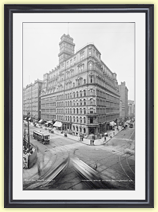
Here’s one heck of a photo – Rochester’s Main Street around the turn of the last century. It was snapped from a fire escape at 102 W. Main, near the corner of N. Plymouth Avenue, looking east. Make sure you click on the image and zoom all the way in for all the incredible detail. Across the street you’ll notice some pretty major landmarks. The most obvious one being Hotel Rochester on the far right…
I live in America’s first boom town—Rochester, New York—on Linden Street. Linden trees, unsurprisingly, line much of my street. Down the street is the Genesee River, once one of America’s most polluted—and possibly still. My street is a historic district that was once part of the world’s largest nursery. The Ellwanger and Barry Company supplied the first fruit trees to California…
Get Email Updates...
Stay up-to-date on Rochester-related stories, artifacts, and ideas that you won't find in the mainstream news.
Totally free, never spammy, and you can unsubscribe at any time.
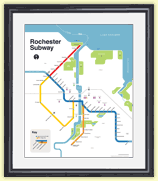
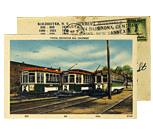
After the Erie Canal was rerouted south of downtown Rochester, the Rochester
Industrial & Rapid Transit Railway (the “subway”) was built in
its place as a link between the five different railroads and interurban trolley
lines that served the Rochester area. As the industrial landscape of Rochester
changed, and highways replaced the railroads, the Rochester subway gradually
became a relic of a bygone era. In 1956 the subway was abandoned and much of
its route was converted into Interstate 490 — built to connect Rochester
with the New York State Thruway (I-90). Read more about the history of the Rochester Subway.
RochesterSubway.com exists to help spark
public dialogue around how we can better connect the neighborhoods of Rochester
NY, surrounding communities, and their cultural offerings. Rochester’s
future is written in her past. Let's rediscover it.



















![Jim Mayer and his wife Irene invite us into their home at Erie Harbor Apartments. [PHOTO: RochesterSubway.com]](https://www.rochestersubway.com/images/photos/erie-harbor-apartments-01.jpg)
 which were officially opened last fall
 ![John Baker, Steve Gullace, Chris Gullace have proposed to construct a new gym and a 48 unit apartment building here at 759 Park Ave. [IMAGE: Bing Maps]](https://www.rochestersubway.com/images/photos/filling-in-park-avenue-02.jpg)
![Rochester Landmarks Poster [IMAGE: Richard Margolis]](https://www.rochestersubway.com/images/photos/rochester-landmarks-poster-richard-margolis.jpg)
![Former site of historic Brighton Village. March, 2010. [PHOTO: RochesterSubway.com]](https://www.rochestersubway.com/images/photos/brighton-village-east-avenue-wegmans-01.jpg)
![Mary Smith is fighting to keep her home of 30 years. [PHOTO: Julie Gelfand]](https://www.rochestersubway.com/images/photos/mary-smith-take-back-the-land-rochester-01.jpg)
![Concept for a Sunken Garden at Browns Race, High Falls. Rochester, NY. [IMAGE: Bryant Design Studios]](https://www.rochestersubway.com/images/photos/rochester-sunken-garden.jpg)
![Our second installment of 'Filling In' looks at developing the parking lots between Capron Lofts and Geva Theater. [IMAGE: Google Streetview]](https://www.rochestersubway.com/images/photos/filling-in-capron-street-01.jpg)
![A little known abandoned swimming pool at University of Rochester. [IMAGE: Chris Seward]](https://www.rochestersubway.com/images/photos/university-of-rochester-abandoned-pool-01.jpg)
![40 days after the insanity on Lake Road. Rochester, NY. [PHOTO: RochesterSubway.com]](https://www.rochestersubway.com/images/photos/lake-road-rochester-01.jpg)
![Inside Rochester's Pulaski Library. [IMAGE: RochesterSubway.com]](https://www.rochestersubway.com/images/photos/rochester-pulaski-library-01b.jpg)
![Aerial view of the Main Street bridge. 1929. [IMAGE: Rochester Municipal Archives]](https://www.rochestersubway.com/images/photos/aerial-main-street-bridge-rochester-1929.jpg)
![A large roost of crows was spotted last week on the edge of the Genesee River gorge near the Smith Street Bridge. [FILE PHOTO: Terri Heisele]](https://www.rochestersubway.com/images/photos/crows-02-terri-heisele.jpg)
![Mike Governale at TEDxRochester. Mike is a designer, blogger, and founder of a local public transit advocacy group, Reconnect Rochester. [PHOTO: Jeffrey Hamson]](https://www.rochestersubway.com/images/photos/TEDx-Rochester-2.jpg)
![Old site of the Hojack Swing Bridge near the Port of Rochester. [AERIAL PHOTO: Bob Biakowski]](https://www.rochestersubway.com/images/photos/Swing-Bridge-Aerial-Photo-Bob-Biakowski.jpg)

![The last remaining Rochester subway car... #60. [PHOTO: Christopher Hauf, Rochester & Genesee Valley Railroad Museum]](https://www.rochestersubway.com/images/photos/rochester-subway-car-60-RGVRRM-01.jpg)
![Cover of Rochester City Newspaper. June 2, 1983. [COURTESY: CITY Newspaper]](https://www.rochestersubway.com/images/photos/city-newspaper-rochester-subway-story.jpg)
![View of Main Street, Rochester, NY. c.1908. [PHOTO: Detroit Publishing Co. via Library of Congress]](https://www.rochestersubway.com/images/photos/hotel-rochester-main-street-1908.jpg)
![Lilacs in Highland Park, Rochester, NY. [PHOTO: Rich Engelbrecht, via Flickr]](https://www.rochestersubway.com/images/photos/lilacs-highland-park-rochester.jpg)