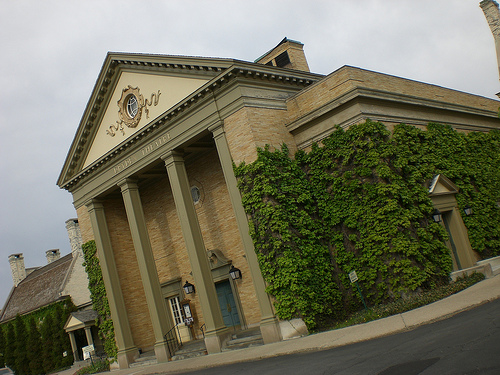
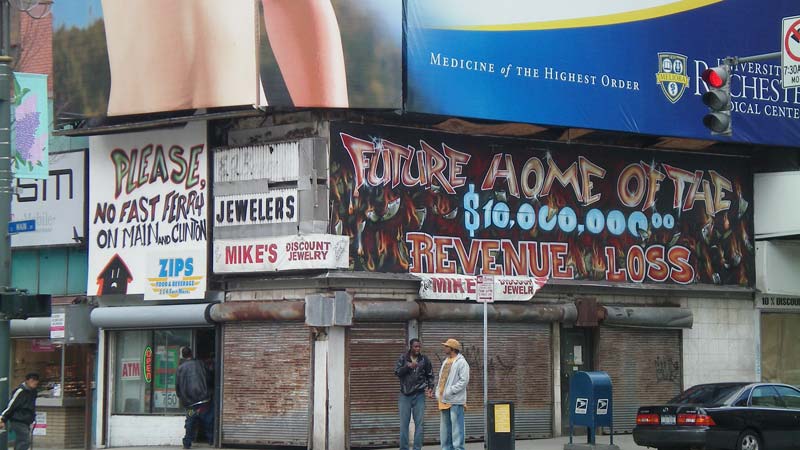
Howard Decker is new to Rochester. He moved here last Fall after spending much of his professional life designing transit systems from Chicago to Houston to Washington DC. He is a lifelong historic preservationist, an FAIA, architect, urban designer, and former Chief Curator of the National Building Museum. As a self-proclaimed “transit-geek” he is now spending time familiarizing himself with, and blogging about Rochester and working with groups such as the RRCDC and Reconnect Rochester . Last week Howard attended the public input meeting on RGRTA’s planned transit center on Mortimer Street. Today he posted his opinion on the whole thing. Read his article (below). And please attend the final public input meeting tomorrow night (May 5).
Buses and Subways and Trains, Oh My
A Town Square (May 4, 2010) — Our home place here is in the midst of considering a change to its transit system. As usual, Rochester is the perfect case study of how cities can screw themselves up with the greatest of ease. My newly adopted city, like so many of its sister places, has made a vast litany of urban gaffes over the last century, and we are about to see yet another. Let me explain.
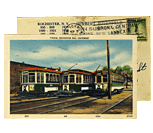
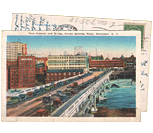
In the early 20th century, Rochester had a system of streetcars and interurbans and even a subway, all of which provided transit options to citizens. In those days, say the 1920s, the population of the city was quite a bit larger than today, though the region was much smaller – sprawl was only just getting started.
By the mid 1950s, everything was gone. Streetcars gone. Interurbans gone. Subway gone. Left on the roads? Cars, and buses. Retail was headed out of town, following all those who began to sprawl. Downtown’s fate was sealed…
Rochester is buzzing with talk about new downtown development, new transit stations, high speed rail, and downtown circulators. But how do these pieces fit together? Cities across America are using transportation investments like these to transform themselves in a big way. And, if we play our cards right, we too can join the list of revitalized American cities.
On May 10, 2010, John Robert Smith — CEO of Reconnecting America and one of the people who helped spark this revolution — will be in Rochester to help give us some perspective. Come see how he and others are reconnecting America and find out how transportation can help shape a new Rochester.
If you were at the Circulator Study Public Meeting tonight, THANK YOU! Turn out was good. It could’ve been even better… but there were plenty of people there asking questions and giving input and the room had a constant buzz. Even the media thought enough to make an appearance. There will be another public meeting in June/July to share the preliminary findings of the study so stay tuned and continue to share this story with friends and neighbors. We’ll need even more of you at the next meeting.
The City has partnered with C&S Companies to analyze and make recommendations to enhance commuting, circulation, and parking in Downtown Rochester. Among the potential enhancements under consideration is a circulator transit service—a.k.a shuttle buses or streetcars. Listen carefully Rochester…
America seems to have taken a renewed interest in mobility. Maybe due to President Obama’s recent commitment to high speed rail—or perhaps the positive results seen in towns like Portland and Denver have caught our collective attention. Whatever the reason, from the top down, people are rethinking our automobile-oriented culture—and getting excited about the possibilities.
There’s also good reason to focus on transportation as a way of jump-starting economic development. Industry requires access to people. And people need to have easy access to centers of employment. Continually improving access makes further development possible. Interrupting access will have the opposite effect. Likewise, doing nothing or simply maintaining existing infrastructure for an extended period of time will also hinder development.
For 30+ years Rochester has relied on the infrastructure choices it made in the 1950’s, 60’s, and 70’s. At that time we made development choices that encouraged our population to emigrate from the downtown core. We scrapped our extensive streetcar system, choked off downtown with the construction of the inner-loop, and paved super highways to take us from the city to the NY State Thruway and beyond. Since then that’s exactly where our money, our workforce, and our future have gone—down I-490 and out of state.
Some of you may remember our story on Harry Davis last September. At that time Harry was running a long-shot campaign for Rochester City Council. He didn’t win any of the 5 open council seats. But that didn’t discourage him. He turned right around and announced he’d be write-in candidate for Mayor in November. Mayor Duffy squashed that dream pretty easily on election day. But Harry kept at it. He promptly asked to be hired by Mayor Duffy to lead a “green” urban renewal plan for the city. The Mayor turned him down.
So now Mr. Davis is coming at things from a different angle. Last month he formed his own Political Action Committee (PAC). According to Mr. Davis this new group stands for “green, sustainable development and transportation.” Davis affirms, “The importance of sustainable and efficient transportation for Rochester cannot be overstated. This would include light rail, high-speed rail, bike paths and additional pedestrian options – all of which should complement a rational and minimalist approach to automotive traffic.”
Long before hybrid cars, SUV’s, JetBlue, and even Amtrak, travel between American cities occurred largely by rail. With the industrial and technological revolution around the turn of the 20th century, America’s interurban railway developed so fast and connected so many of us, it must have seemed like the future had suddenly arrived out of nowhere. So when Henry Ford’s Model T was introduced who could have anticipated the turn transportation history would soon take.
If you’re interested in understanding the history of rail travel in American (its rise and quick fall), we’ve got a book for you. One of our readers, Laurence Keefe, recently brought this one to our attention. The following is Larry’s review…
“When we were children on summer vacation, the highlight of the day was when Dad got home from work. We would eat dinner at six o’clock, when the news came on the radio. That was because it took him 50 minutes to get from his office near the Four Corners in Rochester, NY to our farm in Victor…
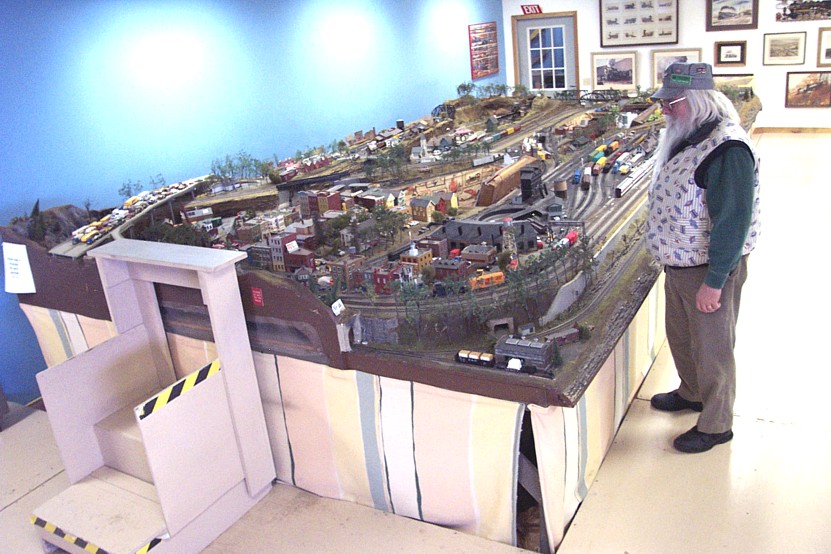
If you and the kiddies find yourselves moping around the house this winter watching the lint in your bellybuttons pile up, don’t blame the good people at the New York Museum of Transportation! That’s because NYMT is holding “Bring Your Own Train Sundays” every Sunday now through April 25. Visitors who bring there own model trains can take over the throttles under the supervision of museum volunteers. Visitors are also welcome to become a subway motorman for a day on the museum’s N-scale model of the Rochester Subway.
Similar to how the Interstates reshaped America 50 years ago, the Chinese landscape is now being reshaped by historic levels of infrastructure spending. While the U.S. government seeks to revive it’s struggling economy in part by spending billions on shovel-ready, band-aid projects (i.e. re-surfacing roads), it seems Beijing’s goal is to put 26 million Chinese to work building new high-speed rail connections between its cities.
Wow, this match wasn’t even close. An Arizona driver runs a red rail crossing signal and gets plowed into by an oncoming commuter train. Her van is then dragged… well, I don’t need to give you the play-by-play. The entire violent fiasco was caught on the train’s onboard surveillance camera! Watch the video…
Until now I’ve tried to keep the subway stories I post limited to those out of the abandoned Rochester Subway. But recently there have been a rash of great stories from the underground I’ve just had to share. There was the drunken lady who fell onto the tracks in the Boston Subway. Then the unfortunate murder on the “D” train in Manhattan. And here’s another one. We’ve all heard stories of people living in New York’s subway tunnels. And you might immediately conjure up an image in your head of what such a person would look like. But how about a mild mannered 13 year old boy? Watch the video…
After receiving rave reviews for his 2008 lecture on global rail travel, “Wish You Were Here” series sponsor Thomas N. Tischer has agreed to present again at the Dryden Theater — this time to discuss the role streetcars and trolleys played in the development of U.S. cities and their European counterparts.
Okay, the cat’s out of the bag. Our fans have been patiently awaiting this news for nearly a year. The 1928 Rochester Subway Poster is now in production and will be available to purchase right here beginning July 1! But subscribers to our newsletter have already put their orders in. “How’s this possible” you ask? That’s because our dedicated followers received an invitation to pre-order a copy of the 1928 poster early. BUT WAIT, there’s more… not only did these lucky railfans get to pre-order, they also received a hefty discount offer. Want to find out how much they saved? Oh alright you beat it out of me… Sign up for our newsletter before July 4, 2009 and I’ll send you the very same offer! Tick, tock.
UPDATE: This offer has expired. Email me for new offers & promotions on our Rochester Subway merchandise.
The City Newspaper this week published an interview with Mayor Duffy, ‘It’s not too late to change’: Duffy on Ren Square . In it Duffy explains his recent coming out against the project as it is currently proposed. He cites recent changes in the business and development landscape downtown, new transportation stimulus funding, and sort of a personal awakening for his change of heart. Let’s show the Mayor we support him…
If you’re visiting Rochester, or you and the kids are looking for something to do this weekend, the New York Museum of Transportation should be at the very top of your “to-do” list. The NYMT, located just off the New York State Thruway and I-390 in Rush, NY, focuses on not only the State of New York’s rail history but also its transportation history in general as well. Its exhibits range from railroading equipment and trolley cars to historic vehicles and carriages. Jim Dierks, a member of the NYMT Board of Trustees, tells us the museum also boasts plenty of Rochester Subway artifacts. “…not the least of which is the Casey Jones speeder… the only surviving piece of Subway rolling stock that is in operating condition. We also have models, station signs, and a video that operates continuously in our gallery.” Dierks adds, “We also operate a mile-long electrified interurban trolley line…the only trolley operation in New York State.”
Fast forward or rewind? The dream of high speed rail in Upstate NY is nothing new. Back in 1993 Mario Cuomo wanted to see Amtrak service upgraded to 125mph between Albany and Buffalo. And the idea has been studied up and down since the 70’s. But now with Obama and Biden calling for a new high speed rail network to ease congestion on U.S. roadways, and Representative Louise Slaughter spearheading a new push to bring high speed upstate , what’s old just may be new again. Check out this poster…
Today was an historic day for America in many ways. Whether you voted for President Obama or not, most Americans agree on one thing — our infrastructure could use a few upgrades. During his campaign, Obama expressed that one of his priorities would be to rebuild America’s aging schools, roads, and power grid. Today, in his first address as President, he restated this intention.
Get Email Updates...
Stay up-to-date on Rochester-related stories, artifacts, and ideas that you won't find in the mainstream news.
Totally free, never spammy, and you can unsubscribe at any time.
After the Erie Canal was rerouted south of downtown Rochester, the Rochester
Industrial & Rapid Transit Railway (the “subway”) was built in
its place as a link between the five different railroads and interurban trolley
lines that served the Rochester area. As the industrial landscape of Rochester
changed, and highways replaced the railroads, the Rochester subway gradually
became a relic of a bygone era. In 1956 the subway was abandoned and much of
its route was converted into Interstate 490 — built to connect Rochester
with the New York State Thruway (I-90). Read more about the history of the Rochester Subway.
RochesterSubway.com exists to help spark
public dialogue around how we can better connect the neighborhoods of Rochester
NY, surrounding communities, and their cultural offerings. Rochester’s
future is written in her past. Let's rediscover it.

















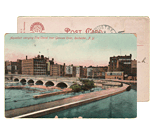

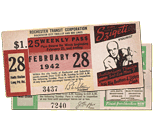



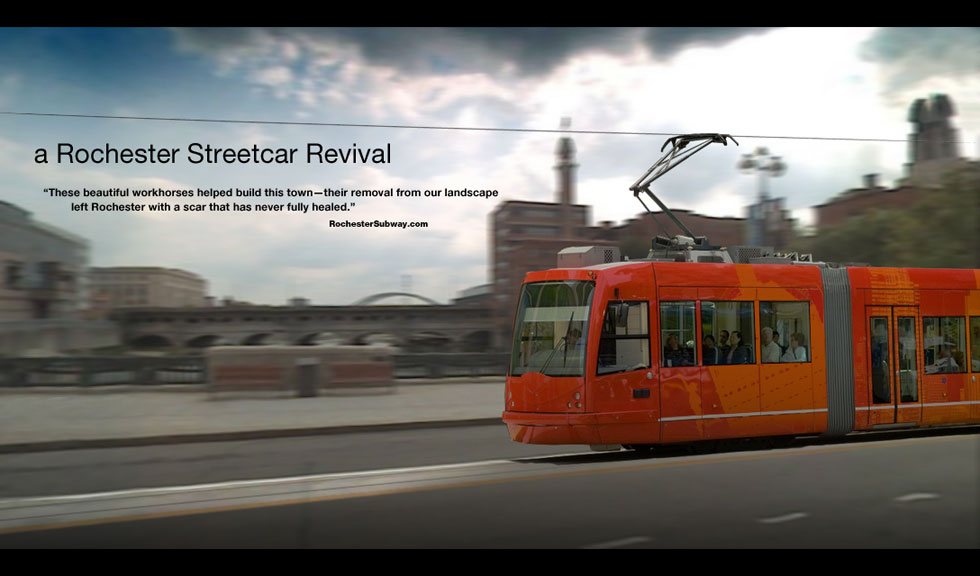
 A Town Square (May 4, 2010) — Our home place here is in the midst of considering a change to its transit system. As usual, Rochester is the perfect case study of how cities can screw themselves up with the greatest of ease. My newly adopted city, like so many of its sister places, has made a vast litany of urban gaffes over the last century, and we are about to see yet another. Let me explain.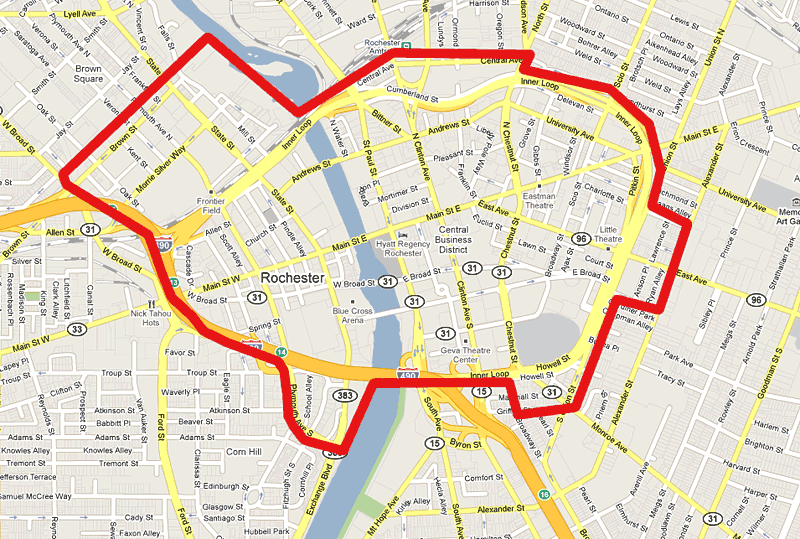






![Francisco Hernandez Jr., who has Asperger's, a developmental disorder that affects the ability to socialize and communicate, disappeared on October 15, after he thought he was in trouble at school, according to his mother, Marsiela Garcia of Brooklyn. [source: CNN]](https://www.rochestersubway.com/images/photos/new_york_subway_boy.jpg)