Since 1955, Camp Haccamo has been a fun filled getaway for both adults and children with varying mental and physical disabilities. First established on Panorama Creek Drive in Penfield (just behind Panorama Plaza), Haccamo was free to the 300 plus campers per year who participated. But in 2009 camp organizers ended their relationship with the town of Penfield and moved to Rush, NY – while, oddly, leaving quite a bit of stuff behind…
The complex of the Rochester Psychiatric Center (a.k.a. Rochester State Hospital or Monroe County Insane Asylum) is legendary among urban explorers and history fanatics alike. Originally built in the early 1800s as the Monroe County Almshouse (or poorhouse), new buildings and facilities were gradually added to care for the mentally ill.
Although the hospital still operates to this day, a few buildings were closed in the mid-1990s and now sit in various states of decay. One notable example we’ve explored previously is the towering 16-story Terrence Building which looms over Elmwood Avenue. Another is the sprawling Walters Building (originally known as the Orleans Building) which we’ll be exploring today…
I noticed grass growing on the piles of dirt in the Inner Loop construction project today. It’s as if nature can’t wait for the filling in of the Inner Loop to complete before reclaiming the land…
School’s out, Sea Breeze is open, and summer is officially in full swing. But before you head out to the beaches this weekend, take note of the latest trends in swimwear. You don’t want to be caught looking silly wearing last year’s style.
For 2015, that vintage look is back, and we’ve dug up some real classics – from Rochester’s old natatoriums to the shores of Lake Ontario…
In 1870 Ellwanger & Barry (and other wealthy investors) owned a spot along the west bank of the Genesee River gorge known as Maple Grove. At the time, the Lake Avenue streetcar line stretched all the way to this point, and in an effort to stimulate traffic on the trolley line, they had built Rochester’s first water-side resort; the Glen House…
A few weeks ago we took you on a trip to Van Lare Wastewater Treatment Facility to see where Rochester’s dirty water goes to get cleaned up. It was there that we learned of an extensive deep rock tunnel system that that captures major storm runoff until it can be treated. Known as the Combined Sewer Overflow Abatement Program, or CSOAP, this system saves over 1 billion gallons of sewage from overflowing into the Genesee River and Irondequoit Bay each year.
More importantly, this means there are 30 miles of giant smelly tunnels beneath our city just waiting to be explored! Come on let’s go…
Joe Henderson (34) was an earth science teacher at Rush Henrietta Central School District before graduating last year from University of Rochester with a Ph.D. in Education – with a focus on environmental education. Joe has taken many 8th graders on field trips to Frank E. Van Lare Wastewater Treatment Facility . And today, he’s arranged to bring all of you, RocSubway friends…
At a cost to the New York taxpayer of just about half that of the Louisiana Purchase fourteen years earlier, “Clinton’s Ditch” faced the ageless and indestructible rancor of the New York State Legislature and the animosity of the press statewide. It is hard to overstate the impact the investment taxpayers made in building the canal had on the development of Rochester and New York State. Now, it is almost impossible to imagine a project like the canal ever being built in today’s political climate and maybe that is not such a good thing. In this edition of Wear to Where we stop by Lock 33 and ask, “What’s the big idea?”…
About a year and a half ago we shared some photos from inside the abandoned Sykes Datatronics building on Orchard Street (south of Lyell Ave). That building was part of a complex that was home to many different companies from 1915 until Sykes Datatronics (a computer company) left in 1992. Demolition crews have been slowly deconstructing the property since the fall…
Today I’d like to take a slight departure from our normal Filling In fare. No, I don’t propose to fill in all the banks in Rochester, although that’s not such a bad idea, now that I think about it. What I’d like to talk about is banks and buying stuff. Well, not just any stuff, specifically real estate…
This week’s Fun Foto Friday is a snapshot from 1893. That’s Nick Brayer, an engineering contractor working on a new sewer beneath Front Street in downtown Rochester. In his hands is a tin box. It’s not a sewer pipe. It’s actually a time capsule and he’s preparing to lay it at the project site to be buried. Looks like quite the event; a crowd of neighborhood kids have formed behind him to get in on the photo op.
Fast forward to 2015 and the burning question for readers of this blog will undoubtedly be: Where is this capsule now? And what’s inside…
A recent email from a RocSubway reader asks: “There is a building on Moore Road in Genesee Valley Park that looks like some kind of bird house, maybe a pigeon coop. It’s so close to the edge of the [University of Rochester] property that I wondered if it was theirs, rather than part of the park. Someone is taking care of it as the paint doesn’t appear to be that old. Thought its origin might be interesting. Any ideas?”
I’ve noticed this building before too, and because of those tiny holes in the upper level, I’ve always assumed it was a birdhouse. But I admit, I really am not sure. So I asked JoAnn Beck, Senior Landscape Architect with the City of Rochester…
Last week, Carnegie Place was largely destroyed by fire. Its life spanned some of the most crucial and drastically changing times in Rochester’s history. I had a chance to stop by after the fire and take some photographs of a building I have always enjoyed; in a part of town that was vibrant and still is the heart of the arts movement in Rochester…
Today’s RocLink photo was taken by Chris Seward on April 3, 2010 in an abandoned building in Lockport. Chris says the three-story building was brimming with antique motorcycles and parts. According to this article the bikes made their way here from Kohl’s Cycle Salvage shop on the north side of the Erie Canal. The Mr. Kohl died in 2002, and the motorcycles were left here until the building crumbled around them.
And now, from local development to just plain news of the weird, here are your RocLinks for this past week…
The image above was created by Tristan O’Tierney last October in the Rochester Subway. Tristan attached a common kitchen whisk to some string, put some fine grade steel wool inside the whisk, lit the wool on fire, and then swung the whisk around for a 30 second exposure. The result is perhaps the most beautiful version of spin art we’ve ever seen.
From local development, to just plain news of the weird, here are your RocLinks for this past week…
We brave the cold in this edition of Wear to Where to visit the oldest place in Monroe County – the Landmark Society’s Stone-Tolan House and their heirloom apple orchard…
Sorry for the Tina Turner reference… it was all I could think of to describe the enormity of this big wheel. I’m talking 25 foot and 12 tons just under 20 ton*!! Um, ok so who are these hooded dudes, and just where do they think they’re going with our giant wheel? These strange photos were taken late Tuesday afternoon by Tom Dubois and Peter Simpson…
For those of us that have friends and family in town for the holidays, one of the most difficult things to explain to outsiders about this place may be Rochester’s grocery store obsession. In this holiday edition of Wear to Where, we stop in at the grocery store and pick up a few things…
The transformation at the Carriage Factory building has been nothing short of amazing. Located at 33 Litchfield Street in the Susan B. Anthony neighborhood, the former factory building that was close to the landfill has been reborn as seventy-one affordable and special needs apartments. The rehabilitation of the building was a long time coming and was not without its challenges and delays…
Next in the Wear to Where series, we look to the Irondequoit Bay Outlet Bridge. For years this span of 180 feet has been less of a unifier than a divider in this community, but Senator Chuck Schumer has an idea (or rather wants someone to come up with an idea) that could change that permanently…
Get Email Updates...
Stay up-to-date on Rochester-related stories, artifacts, and ideas that you won't find in the mainstream news.
Totally free, never spammy, and you can unsubscribe at any time.
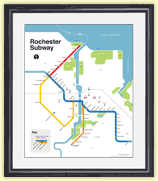
After the Erie Canal was rerouted south of downtown Rochester, the Rochester
Industrial & Rapid Transit Railway (the “subway”) was built in
its place as a link between the five different railroads and interurban trolley
lines that served the Rochester area. As the industrial landscape of Rochester
changed, and highways replaced the railroads, the Rochester subway gradually
became a relic of a bygone era. In 1956 the subway was abandoned and much of
its route was converted into Interstate 490 — built to connect Rochester
with the New York State Thruway (I-90). Read more about the history of the Rochester Subway.
RochesterSubway.com exists to help spark
public dialogue around how we can better connect the neighborhoods of Rochester
NY, surrounding communities, and their cultural offerings. Rochester’s
future is written in her past. Let's rediscover it.





















![Abandoned Camp Haccamo, Penfield NY. [IMAGE: Snoop Junkie]](https://www.rochestersubway.com/images/photos/camp-haccamo-rochester-56.jpg)
 (just behind Panorama Plaza), Haccamo was free to the 300 plus campers per year who participated. But in 2009 camp organizers ended their relationship with the town of Penfield and moved to Rush, NY – while, oddly, leaving quite a bit of stuff behind…
![Inside the abandoned Walters psychiatric building. [IMAGE: Snoop Junkie - Rochester Urban Exploration Squad]](https://www.rochestersubway.com/images/photos/rochester-state-hospital-walters-building-04.jpg)
![I noticed grass growing on the piles of dirt in the Inner Loop construction project today. It’s as if nature can’t wait for the filling in of the Inner Loop to complete before reclaiming the land. [PHOTO: Matthew Ehlers]](https://www.rochestersubway.com/images/photos/rochester-innerloop-fill-grass.jpg)
![Vintage swimwear. Rochester NY. [IMAGE: Albert R. Stone]](https://www.rochestersubway.com/images/photos/rochester-vintage-swimsuits.jpg)
![In 1870 Ellwanger & Barry (and other wealthy investors) owned a spot along the west bank of the Genesee River gorge known as Maple Grove. At the time, the Lake Avenue streetcar line stretched all the way to this point, and in an effort to stimulate traffic on the trolley line, they had built Rochester's first water-side resort; the Glen House. [PHOTO: 'Rochester's Lakeside Resorts and Amusement Parks' by Donovan Schilling]](https://www.rochestersubway.com/images/photos/glen-house-rochester-ny-01.jpg)
![Let's explore Rochester's deep rock sewer tunnels! [PHOTO: RochesterSubway.com]](https://www.rochestersubway.com/images/photos/csoap-deep-rock-sewer-tunnel-rochester-00.jpg)
![Grab your nose plugs. Today we're going inside Frank E. Van Lare Wastewater Treatment Facility. [PHOTO: RochesterSubway.com]](https://www.rochestersubway.com/images/photos/van-lare-water-treatment-plant-rochester-00.jpg)
![It is almost impossible to imagine a project like the canal ever being built in today’s political climate and maybe that is not such a good thing. In this edition of Wear to Where we stop by Lock 33 and ask, 'What’s the big idea?' [PHOTO: Clarke Condé]](https://www.rochestersubway.com/images/photos/rochester-fashion-wear-to-where-erie-canal-lock-33-01.jpg)
![Abandoned Sykes Datatronics building on Orchard Street. Demolition work has been going on since the fall. [PHOTO: Anonymous]](https://www.rochestersubway.com/images/photos/return-to-abandoned-sykes-datatronics-building-04.jpg)
![Rochester Savings Bank [PHOTO: Rochester Public Library]](http://rochestersubway.com/images/photos/denker/banks/Rochester_Savings_Bank.jpg)
![Nick Brayer preparing to lay a time capsule under Front Street, Rochester. 1893. [PHOTO: Rochester Municipal Archives]](https://www.rochestersubway.com/images/photos/front-street-time-capsule-rochester-ny-01.jpg)

![Last week, Carnegie Place was largely destroyed by fire. [PHOTO: PuddleJumper Photography]](https://www.rochestersubway.com/images/photos/rochester-carnegie-building-fire-01.jpg)
![Motorcycles in an abandoned warehouse in Lockport, NY. [PHOTO: Chris Seward, Flickr]](http://rochestersubway.com/images/photos/lockport-motorcycles-chris-seward.jpg)
![Tristan O'Tierney creates a fiery version of spin art in the Rochester Subway. [PHOTO: Tristan O'Tierney, Flickr]](http://rochestersubway.com/images/photos/rochester-subway-sparks-tristanotierney.jpg)
![We brave the cold in this edition of Wear to Where to visit the oldest place in Monroe County – the Landmark Society’s Stone-Tolan House and their heirloom apple orchard. [PHOTO: Clarke Condé]](https://www.rochestersubway.com/images/photos/rochester-fashion-wear-to-where-stone-tolan-orchard-01.jpg)
![The triphammer water wheel in High Falls, Rochester NY being removed from its housing so it can be restored. [PHOTO: Tom Dubois]](https://www.rochestersubway.com/images/photos/rochester-high-falls-triphammer-water-wheel-01.jpg)
![In this holiday edition of Wear to Where, we stop in at the grocery store and pick up a few things. [PHOTO: Clarke Condé]](https://www.rochestersubway.com/images/photos/rochester-fashion-wear-to-where-mise-en-place-01.jpg)
![Carriage Factory, Rochester NY. [PHOTO PROVIDED BY: Preservation Studios]](https://www.rochestersubway.com/images/photos/rochester-cunningham-carriage-factory-south-side-before.jpg)
![Next in the Wear to Where series, we look to the Irondequoit Bay Outlet Bridge. [PHOTO: Clarke Condé]](https://www.rochestersubway.com/images/photos/rochester-fashion-wear-to-where-irondequoit-bay-01.jpg)