























![Greater Rochester and Monroe County fantasy subway map. [IMAGE: Marshall Allen]](https://www.rochestersubway.com/images/photos/monroe-county-subway-map-01.gif)
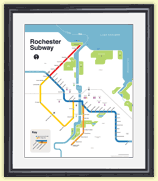
Here’s something that turned up in the RocSubway email box a few weeks ago and we thought it pretty neat. Rochester expatriate Marshall Allen designed this Greater Rochester / Monroe County subway map for no other reason than to satisfy his own geeky curiosity. Sounds familiar. We’ll add this one to our collection of fantasy Rochester subway maps…
Author Archive...

Take a Trip on the Monroe County Subway
Tuesday, May 19th, 2015Tags: Monroe County Subway, Rochester, Rochester NY, subway map
Posted in Art + Culture, Reader Submitted Stories, Subways Around the Globe, Train/Railroad Stuff, Transit + Infrastructure | 6 Comments »
City of Rochester Now Seeking Proposals for Main Street Bus Shelters
Sunday, May 10th, 2015![The City of Rochester has issued a Request For Proposals (RFP) to adaptively reuse, redevelop, and operate five former bus shelters on Main Street in downtown Rochester, NY. [PHOTO: Hennebery Eddy Architects, Inc.]](https://www.rochestersubway.com/images/photos/portland-bus-shelter-coffee-kiosk.jpg)
Story via Reconnect Rochester.
Submit your story today.
The City of Rochester has issued a Request For Proposals (RFP)  to adaptively reuse, redevelop, and operate five former bus shelters on Main Street in downtown Rochester, NY. The deadline to respond is June 26 and successful proposals are expected to be announced by July 31…
Tags: adaptive reuse, bus shelter, downtown Rochester, Main Street, Office of Innovation and Strategic Initiatives, preservation, Reconnect Rochester, Regional Transit Service (RTS), Rochester, Rochester NY, RTS Transit Center, transit shelter
Posted in Rochester News, Transit + Infrastructure, Urban Development | 3 Comments »
The Glen House – Rochester’s First Water-side Retreat
Monday, April 27th, 2015![In 1870 Ellwanger & Barry (and other wealthy investors) owned a spot along the west bank of the Genesee River gorge known as Maple Grove. At the time, the Lake Avenue streetcar line stretched all the way to this point, and in an effort to stimulate traffic on the trolley line, they had built Rochester's first water-side resort; the Glen House. [PHOTO: 'Rochester's Lakeside Resorts and Amusement Parks' by Donovan Schilling]](https://www.rochestersubway.com/images/photos/glen-house-rochester-ny-01.jpg)
In 1870 Ellwanger & Barry (and other wealthy investors) owned a spot along the west bank of the Genesee River gorge known as Maple Grove. At the time, the Lake Avenue streetcar line stretched all the way to this point, and in an effort to stimulate traffic on the trolley line, they had built Rochester’s first water-side resort; the Glen House…
Tags: Charlotte, City of Rochester Steamboat, Eastman Kodak, Ellwanger-Barry, Genesee River, Genesee River Gorge, Glen House, history of Rochester, Kodak Park, Lake Avenue, Lake Ontario, Lake Ontario Steamboat Company, Maple Grove, Maplewood Park, old photos of Rochester, old photos of Rochester NY, Ontario Beach Park, riverboat, Rochester, Rochester history, Rochester NY, Seabreeze, Sylvan Stream
Posted in Architecture, Rochester Destinations, Rochester History, Rochester Images, Transit + Infrastructure, Urban Exploration | 11 Comments »
A “Better Block” Being Created In The 19th Ward
Tuesday, April 21st, 2015![On Saturday, April 25th, from 11am to 7pm, Arnett Boulevard between Rugby Avenue and Wellington Avenue in southwest Rochester’s 19th Ward Neighborhood will come alive with events, artwork, and temporary small businesses. [PHOTO: BetterBlock.org]](https://www.rochestersubway.com/images/photos/better-block-01.jpg)
The following is a guest post submitted by Dr. Dan DeMarle.
Submit your story today.
On Saturday, April 25th, from 11am to 7pm, Arnett Boulevard between Rugby Avenue and Wellington Avenue in southwest Rochester’s 19th Ward Neighborhood will come alive with events, artwork, and temporary small businesses.
This Better Block project, in the historic Arnett Trolley Stop District, is part of a nation-wide movement to demonstrate possibilities for revitalizing urban neighborhoods.
Tags: 19th Ward, 19th Ward neighborhood, 362 Arnett Boulevard, Arnett Boulevard, Arnett Trolley Stop Better Block, Better Block Project, City of Rochester, complete streets, Dr. Dan DeMarle, event, In the City/Off the Grid, Jason Roberts, pop up shop, pop up store, Rochester, Rochester NY, urban development
Posted in Events, Reader Submitted Stories, Rochester News, Urban Development | 1 Comment »
Rochester Bicycle Film Festival Presents Power to the Pedals
Monday, April 20th, 2015
The following is a guest post submitted by Scott Wagner.
Submit your story today.
On Monday April 27 at 7pm, Rochester Bicycle Film Festival will present its first of three films, Power to the Pedals, and panel discussion with the filmmaker and other cycling advocates at Little Theatre…
Tags: Bob Nesson, cycling, Dan Lill, film, MetroPedalPower, Power to the Pedals, R Community Bikes, Rochester, Rochester Bicycle Film Festival, Rochester NY, Scott Wagner, Wenzday Jane
Posted in Art + Culture, Events, Reader Submitted Stories, Rochester News, Transit + Infrastructure | No Comments »
Rochester’s Southeast Quadrant Eligible for Discounted Solar Power
Thursday, April 16th, 2015![Rochester’s Southeast Quadrant will take part in Community Solar NY, a program designed to make investing in solar power easier and more affordable for local residents and businesses. [PHOTO: Ruairí, Flickr]](https://www.rochestersubway.com/images/photos/solarize-flower-city-01.jpg)
The following is a guest post submitted by Aprille Byam at ROCSPOT.
Submit your story today.
Rochester’s Southeast Quadrant will take part in Community Solar NY, a program designed to make investing in solar power easier and more affordable for local residents and businesses. The Solarize Flower City program kicks off with neighborhood workshops starting in May, where residents and business owners can learn about the program…
Tags: Aprille Byam, City of Rochester, Dr. Susan Spencer, Governor Andrew Cuomo, Neighborworks Rochester, New York State Energy Research and Development Authority (NYSERDA), NY-Sun, Rochester, Rochester NY, ROCSPOT, solar energy, solar panels, solar power, Solarize Flower City
Posted in Reader Submitted Stories, Rochester News, Transit + Infrastructure | No Comments »
Inside Rochester’s Deep Rock Tunnel Network
Saturday, April 11th, 2015![Let's explore Rochester's deep rock sewer tunnels! [PHOTO: RochesterSubway.com]](https://www.rochestersubway.com/images/photos/csoap-deep-rock-sewer-tunnel-rochester-00.jpg)
A few weeks ago we took you on a trip to Van Lare Wastewater Treatment Facility to see where Rochester’s dirty water goes to get cleaned up. It was there that we learned of an extensive deep rock tunnel system that that captures major storm runoff until it can be treated. Known as the Combined Sewer Overflow Abatement Program, or CSOAP, this system saves over 1 billion gallons of sewage from overflowing into the Genesee River and Irondequoit Bay each year.
More importantly, this means there are 30 miles of giant smelly tunnels beneath our city just waiting to be explored! Come on let’s go…
Tags: Combined Sewer Overflow Abatement Program (CSOAP), I-590, infrastructure, Irondequoit, Irondequoit Bay, Lyceum Street, Monroe County Pure Waters, Rochester, Rochester NY, rochester photos, sewer, sewer tunnel, tunnel, underground, urban exploration
Posted in Rochester Images, Transit + Infrastructure, Urban Exploration | 29 Comments »
Lyell-Otis Neighborhood Call for Volunteers
Sunday, April 5th, 2015![Lyell-Otis Neighborhood [PHOTO: Lyell-Otis Neighborhood Facebook Page]](https://www.rochestersubway.com/images/photos/lyell-otis-neighborhood-volunteers-04.jpg)
The following is a guest post submitted by Pamela Davis, Rochester NY.
Submit your story today.
As our Northwest area prepares for the upcoming Clean Sweep and other beautification projects, the Lyell-Otis Neighborhood Association would like to ask for your hand…
Tags: Clean Sweep, Lyell Avenue, Lyell-Otis, Lyell-Otis Neighborhood Association, Pamela Davis, Rochester, Rochester Clean Sweep, Rochester neighborhoods, Rochester NY, urban revitalization
Posted in Events, Reader Submitted Stories, Rochester News, Urban Development | 4 Comments »
Frank E. Van Lare Wastewater Treatment Facility Tour
Monday, March 30th, 2015![Grab your nose plugs. Today we're going inside Frank E. Van Lare Wastewater Treatment Facility. [PHOTO: RochesterSubway.com]](https://www.rochestersubway.com/images/photos/van-lare-water-treatment-plant-rochester-00.jpg)
Joe Henderson (34) was an earth science teacher at Rush Henrietta Central School District before graduating last year from University of Rochester with a Ph.D. in Education – with a focus on environmental education. Joe has taken many 8th graders on field trips to Frank E. Van Lare Wastewater Treatment Facility . And today, he’s arranged to bring all of you, RocSubway friends…
Tags: Bill Putt, chlorine solution, Combined Sewer Overflow Abatement Program (CSOAP), Frank E. Van Lare Wastewater Treatment Plant, gravity thickener, infrastructure, Josephine Guarino, Lake Ontario, Mill Seat Land Fill, Monroe County, Monroe County Pure Waters, Monroe County Water Authority, Rochester, Rochester NY, sewage, sewer, sludge, sludge cake, sodium hypochlorite, urban exploration, water treatment
Posted in Rochester Images, Transit + Infrastructure, Urban Exploration | 17 Comments »
Orchard Street Brownfield Site Reimagined by RIT Architecture Students
Thursday, March 26th, 2015![RIT Architecture grad students have designed a plan for the former Sykes Datatronics brownfield site on Orchard and Whitney Streets. [PHOTO: Anonymous]](https://www.rochestersubway.com/images/photos/abandoned-rochester-sykes-datatronics-exterior-03.jpg)
Last week we paid a final visit to the abandoned Sykes Datatronics building on Orchard Street . This week we take a look at recent work submitted by RIT Architecture students that reimagines this former industrial site as a new and robust community center…
Tags: architecture, brownfield development, Candace Jiang, Cibele Eller Rodrigues, City of Rochester, community center, community recreation center, Jim Fugate, Lis Cavalcante, Lu Engineers, Mary Scipioni, Orchard Street, Rochester, Rochester Institute of Technology (RIT), Rochester NY, Sykes Datatronics, urban parks, Whitney Street, yellowfields
Posted in Architecture, Reader Submitted Stories, Rochester News, Urban Development | 2 Comments »
What Do Rochester’s Young Professionals Really Want?
Wednesday, March 25th, 2015![RocCity Coalition wants to know what's important to Rochester's young professionals. [PHOTO: Nate McBean, Flickr]](https://www.rochestersubway.com/images/photos/university-of-rochester-graduation-nate-mcbean-01.jpg)
The following is a guest post submitted by Clement Chung, chair of
RocCity Coalition’s Advisory Committee.
Submit your story today.
This week, RocCity Coalition launched a survey to gather critical information about the state of the region’s young professional community. We encourage you to take the survey and share it with as many of your friends, family and colleagues as possible…
Tags: RocCity Coalition, Rochester, Rochester Business Alliance, Rochester NY, Rochester Young Professionals, survey, United Way, Vision 2025 Project
Posted in Reader Submitted Stories | No Comments »
Checking In With WAYO 104.3 FM
Thursday, March 19th, 2015
In 2012, four individuals came together to bring something new to Rochester’s airwaves – a community run, free-form radio station that would reflect the voices and vision of the citizens of Rochester. Johanna Buran, Genevieve Waller, Matt Werts, and Mike Yates have now put most of the pieces in place to begin broadcasting this June.
RocSubway recently caught up with Mike Yates to find out what still needs to be done to make this dream a reality, and what listeners can expect when they tune in to the new WAYO 104.3 FM…
Tags: interview, Mike Yates, WAYO, WAYO 104.3 FM, WAYO radio
Posted in Art + Culture, Interviews, Rochester News | 2 Comments »
Wear to Where #5 … Lock 33
Tuesday, March 17th, 2015![It is almost impossible to imagine a project like the canal ever being built in today’s political climate and maybe that is not such a good thing. In this edition of Wear to Where we stop by Lock 33 and ask, 'What’s the big idea?' [PHOTO: Clarke Condé]](https://www.rochestersubway.com/images/photos/rochester-fashion-wear-to-where-erie-canal-lock-33-01.jpg)
By Clarke Condé
At a cost to the New York taxpayer of just about half that of the Louisiana Purchase fourteen years earlier, “Clinton’s Ditch” faced the ageless and indestructible rancor of the New York State Legislature and the animosity of the press statewide. It is hard to overstate the impact the investment taxpayers made in building the canal had on the development of Rochester and New York State. Now, it is almost impossible to imagine a project like the canal ever being built in today’s political climate and maybe that is not such a good thing. In this edition of Wear to Where we stop by Lock 33 and ask, “What’s the big idea?”…
Tags: Clarke Conde, Clinton’s Ditch, DeWitt Clinton, Erie Canal, Erie Canal Lock 33, Erie Canalway Trail, Lock 33, Martin Van Buren, Natasha Elaine, New York state, Rochester, Rochester NY, Tammany Hall, Thread, Wear to Where, Wrapped
Posted in Art + Culture, Rochester Destinations, Rochester Images, Transit + Infrastructure | 4 Comments »
Return to Sykes
Thursday, March 12th, 2015![Abandoned Sykes Datatronics building on Orchard Street. Demolition work has been going on since the fall. [PHOTO: Anonymous]](https://www.rochestersubway.com/images/photos/return-to-abandoned-sykes-datatronics-building-04.jpg)
About a year and a half ago we shared some photos from inside the abandoned Sykes Datatronics building on Orchard Street (south of Lyell Ave). That building was part of a complex that was home to many different companies from 1915 until Sykes Datatronics (a computer company) left in 1992. Demolition crews have been slowly deconstructing the property since the fall…
Tags: abandoned, abandoned places, building collapse, City of Rochester, Delco Appliance, demolition, Lyell Avenue, Northeast Electric Company, Orchard Street, Riley Park, Rochester, Rochester NY, rochester photos, Sahlen’s Stadium, Sykes Datatronics, Whitney Street
Posted in Architecture, Reader Submitted Stories, Rochester History, Rochester Images, Rochester News, Urban Exploration | 8 Comments »
Clearing Rochester’s Sidewalks of Snow is Not a Problem, It’s an Opportunity
Wednesday, March 11th, 2015![When a lot of people are living in a small area, and all of those people own cars, we run out of places to put them. A winter like this one just makes us feel the pain a little more. [PHOTO: Joseph Crescente]](https://www.rochestersubway.com/images/photos/alexander-street-snow-rochester.jpg)
The following is a guest post submitted by Jim Mayer, Rochester NY.
Submit your story today.
Density of people is good for cities. Density of cars is not . More people create more demand for local shops and services, which, in return, attract more people. Businesses seeking talent are attracted as well, and the city benefits from increased sales and property tax revenue and by increased utilization of its existing infrastructure. On the other hand when a lot of people are living in a small area, and all of those people own cars, we run out of places to put them. A winter like this one just makes us feel the pain a little more…
Tags: City of Rochester, infrastructure, pedestrian safety, Rochester, Rochester NY, sidewalks, snow, transportation
Posted in Opinion, Transit + Infrastructure | 8 Comments »
Greentopia Film Festival Returns March 17 – 21
Tuesday, March 10th, 2015
The following is a guest post submitted by Greentopia.
Submit your story today.
GREENTOPIA | FILM, a documentary film festival that lives at the intersection of Art and Ideas, is back for a fourth year. In partnership with Monroe Community College, the festival’s documentaries hale from around the globe and illuminate sustainability in its most wide-ranging sense. The films empower audiences to discuss the important topics of today and create sustainable changes in their own lives and communities. Screenings during the five-day festival, March 17th-21st, will be preceded by artistic performances from local buskers and followed by lively panel discussions with filmmakers from across the nation or local experts…
Tags: A Will for the Woods, Beginning With The End, Greentopia, Greentopia Festival, Greentopia Film, Maidentrip, Pandora's Promise, Rochester, Rochester NY, The Immortalists, Tiny, Walking Under Water
Posted in Art + Culture, Events, Rochester Destinations, Rochester News | No Comments »
A Tower to Rival Eiffel’s Designed in Rochester NY?
Monday, March 9th, 2015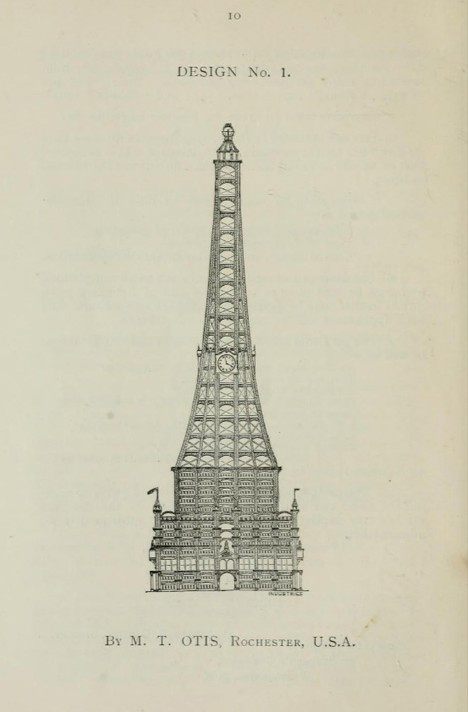
The Atlantic’s CityLab recently posted some late nineteenth-century designs for a Great Tower of London. The first one in the stack was a 1,355 foot sky scraping behemoth designed in Rochester USA…
Tags: architecture, Emily Morry, England, G.T. Otis, G.T. Otis and C.F. Crandall, General Elwell Stephen Otis, Great Tower in London, London, M.T. Otis, North Clinton Avenue, Otis Day, Otis Elevator Company, Rochester, Rochester NY, Rochester Public Library, Scientific American, Spanish-American War, YWCA, YWCA building
Posted in Architecture, Rochester History | 8 Comments »
Aldi Store Hailed as Model of 21st-Century Urban Planning
Thursday, March 5th, 2015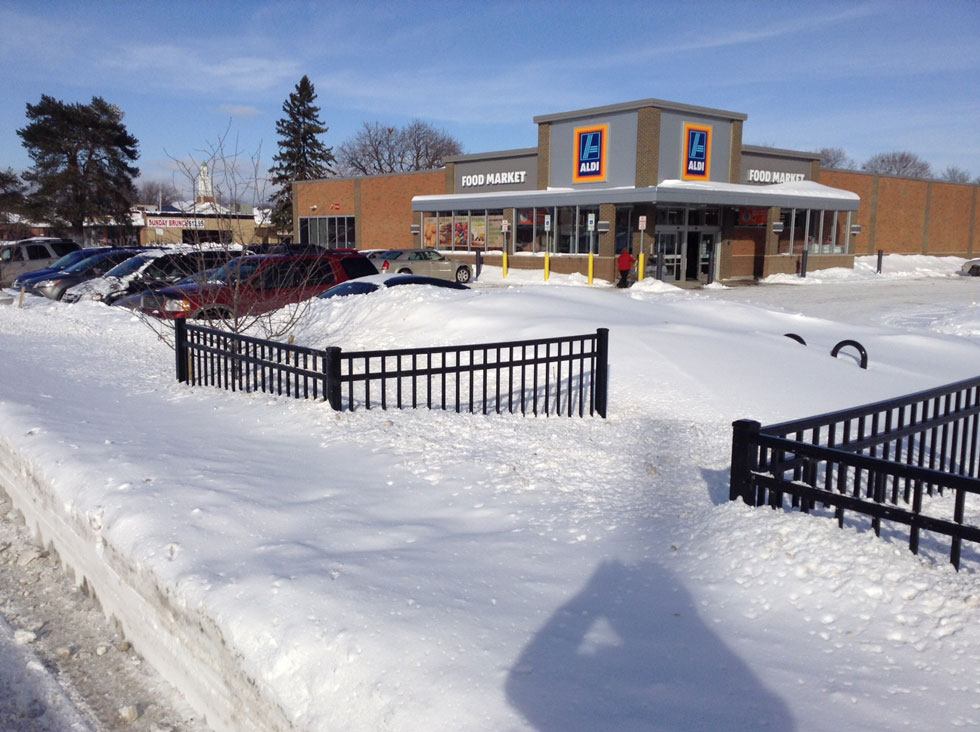
You may remember an article I posted more than a year about new plans for an Aldi store in Irondequoit on Hudson Ave. At that time I suggested the building should front the street/sidewalk, instead of being set back behind the parking lot. I thought the result would have been a development that would be more accessible to people who might choose to walk in off the street.
My suggestion was met with all kinds of wisdom from the project architect who has since set me straight. I now understand why it is better community planning to put your buildings in the middle of parking lots…
Tags: Aldi, Aldi's, APD Architects, APD Architects and Engineers, Blossom Road, development plans, Hudson Avenue, Irondequoit, North Winton Village, pedestrian safety, planning, Steve Cleason, urban development, urban planning, Winton Road
Posted in Architecture, Rochester News, Transit + Infrastructure, Urban Development | 37 Comments »
Protected Bike Lanes for the Full Length of Main St.
Wednesday, March 4th, 2015![Harvey Botzman, a local cycling advocate, is calling for protected bike lanes for the full length of Main Street in Rochester. [PHOTO: J. Stephen Conn, Flickr]](https://www.rochestersubway.com/images/photos/main-street-protected-bike-lanes-01.jpg)
The following is a guest post submitted by Harvey Botzman.
Submit your story today.
Protected bike lanes for the full length of Main Street. This was the request from local cycling advocate Harvey Botzman in an email late last week to City officials and other cycling advocates. The east end of Main Street in downtown Rochester is about to undergo a complete reconstruction, but bike lanes aren’t part of the plan. Additionally, the City is working on a plan to improve pedestrian connections and enhance the stretch of East Main Street between the Public Market and Neighborhood Of The Arts.
So with Main Street under the microscope, now is the time for all of us to demand, not ask, for a healthier mix of transportation options and amenities for Main Street. Harvey is leaving no gray area. He’s calling for “protected bike lanes for the full length of Main St. from Winton Rd. to Mt. Read Blvd.” and here’s why…
Tags: bike, bike lanes, cycling, East Main Street, Harvey Botzman, infrastructure, Main Street, protected bike lanes, Rochester, Rochester NY, transportation, urban planning
Posted in Opinion, Reader Submitted Stories, Transit + Infrastructure, Urban Development | 9 Comments »
Roadside to Bedside: The Real Impact of our Transportation Policies
Monday, February 23rd, 2015![Scott Wagner, a local cycling advocate, visited a fellow cyclist who was seriously injured last week by a drunk driver. [PHOTO: ✿Low✿, Flickr]](https://www.rochestersubway.com/images/photos/lonely-bike-in-snow.jpg)
The following is a guest post submitted by Scott Wagner.
Submit your story today.
I just returned from a trip to Strong Memorial Hospital to visit Debbie, a cyclist who was seriously injured and taken by Mercy Flight to Strong after being hit and left to die by a drunk driver near Palmyra last week.
Debbie is recovering satisfactorily, but is badly hurt and clearly in pain. Her nurse says she asks if she will be able to ride a bicycle again. The answer is “yes, but not tomorrow.” She was clearly touched and pleased to have a visitor and to know that we care…
Tags: Annie Londonderry, Around the World on Two Wheels, bicycle, bike, crash, cycling, DWI, DWI hit-and-run, hit and run, Marcia Roberts, NY State Route 21, Palmyra, Palmyra NY, Rochester, Scott Wagner, Strong Memorial Hospital, transportation, transportation alternatives, transportation policy, Wayne County
Posted in Opinion, Reader Submitted Stories, Rochester News, Transit + Infrastructure | 9 Comments »