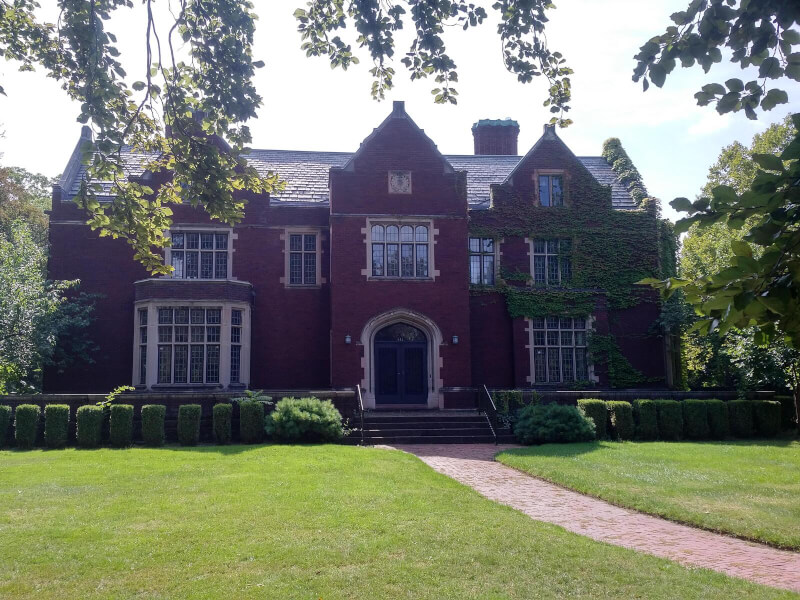
I have always had an affinity for the mansions on east avenue, which is why I jumped at the opportunity to tour, video tape and photograph the house at 935 East Ave. While it has been used as offices since the 1950’s, they maintained much of the original character of the house. Many of the mansions on East Avenue have been converted into apartments, condos or offices. While the outsides have mostly maintained their original appearances, the insides have been divided, and even in one building I have been in, they have covered or painted woodwork and used office ceiling tiles. Some have even had “additions” attached. There are still a few that remain single-family residences though.
In order to stay healthy, adults should try to achieve at least 150 minutes of physical activity each week. However, that hasn’t been easy to do over the last six months. Due to concerns pertaining to the coronavirus pandemic, gyms and health clubs throughout the New York State are staying closed. But while many of those facilities will eventually reopen, there are two community mainstays that have been forced to shut their doors for good.
February is Black History Month, and this year’s celebration is a special one for Rochester residents in particular. That’s because February 2019 is also the bicentennial anniversary of famed abolitionist and author Frederick Douglass, who later made his home in the Flower City. Not only is Douglass immortalized throughout Rochester in the form of statues for all to see throughout the year, but the University of Rochester’s Frederick Douglass Institute for African and African-American Studies will partner with the school’s Rare Books, Special Collections, and Preservation library facility to showcase Douglass’s work and life.
Many of you have noticed our extended hiatus and have begun asking if this is the end for RocSubway. I didn’t think it would be necessary to say anything about it. But for those of you who had followed this blog like religion for so long, you deserve some closure.
A little while ago I lost my job and decided to start my own web design business instead of going back to work for someone else. That was the best decision I ever made for myself. But it also means I now work pretty much nonstop with little time for anything else. What extra time I do have, I put into growing Reconnect Rochester . Reconnect is a nonprofit organization doing amazing work to change the way transportation is viewed in Monroe County. It’s something I’m very proud of. And it began with a seed planted right here.
So I’m not going away, really. I just won’t be posting much here for the foreseeable future. In the meantime you’re welcome to join me over at Reconnect . Or perhaps I’ll run into you somewhere else, helping to make our community better in your own way.
Before I sign off, I want to say thank you.
I’ve gained much more from every RocSubway reader I’ve met (virtually and in person) than what I’ve given on these pages. Always remember there are important lessons for the future buried deep within our past. Everywhere you look in this city—behind every wall and within every person—you will find a beautiful story. We’ve only scraped the surface.
On a recent trip to New York City (my previous home) I came across a poem in the subway by former U.S. Poet Laureate, Billy Collins. I cannot think of better words to close with…
As you fly swiftly underground
with a song in your ears
or lost in the maze of a book,
remember the ones who descended here
into the mire of bedrock
to bore a hole through this granite,
to clear a passage for you
where there was only darkness and stone.
Remember as you come up into the light.
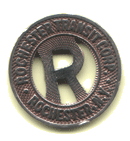
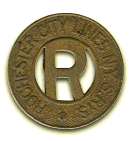
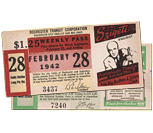
Gilbert Hunt was a trolley and bus operator for Rochester Transit Corporation (the predecessor organization of RTS) from 1907 to 1948. When Gilbert retired in 1948 the Democrat & Chronicle published a story about him and his impressive collection of Rochester transit passes which he amassed over his long career. That collection is now up for grabs…
While poking around the Rochester Image Database that the Monroe Public Library so lovingly maintains, I bumped into a series of 24 aerial photographs taken in 1982. That in and of itself wouldn’t be the most interesting thing ever, except the images portray Rochester in the middle of an incredible transition to be much closer to the city we know now than the one anyone might have recognized from before.
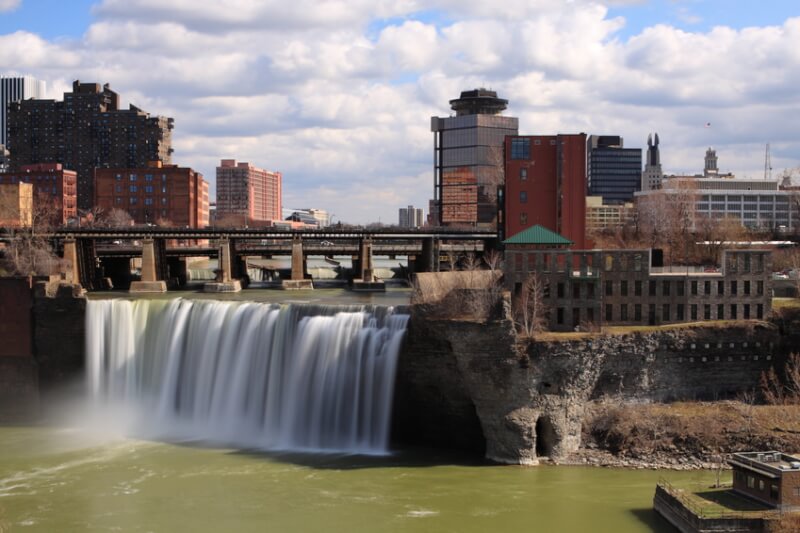
RG&E’s Beebee power plant was one of the most formidable structures in Rochester. For half a century, this cluster of buildings covered an 8 acre site along the floor of the High Falls gorge – climbing up the west rock wall and looming hundreds of feet in the air over Platt Street and the neighborhood below…
Every once in a while we like to share fun stuff from the Rochester Subway mailbag. Here’s an email from a Rochester expatriate now living in New England. John Zicari is keeping tabs on his old home town by following sites like ours, while longing for some of the finer things in life. John writes…
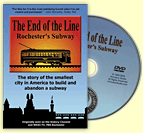
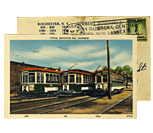
The Rochester Subway stopped passenger service on June 30, 1956. To mark the 60th anniversary of the subway’s closing the New York Museum of Transportation will host a two-day weekend event filled with talks, trolley rides, demonstrations of the Subway’s fully restored “Casey Jones” speeder, food, and vendors…
Since I’ve lived downtown I’ve had my eyes on this building. Not for much good reason except that it was there, and waiting. But despite being so close, it always stayed locked up and out of reach. In fact, over the years it seemed to defy everyone’s best efforts to occupy it – including those of its many owners…
This fully restored vintage Greyhound bus appeared in the movie Race, the recent film about Jesse Owens’ fight to compete in the 1936 Berlin Olympic Games where he won four gold medals. The bus will be open for visitors and tales from the restoration and filming of the bus will be told next Sunday at The New York Museum of Transportation…
Here’s a neat bit of Rochester sports history, even if we are forever on the losing end. 35 years ago this evening, the Pawtucket Red Sox and the Rochester Red Wings would begin the longest professional baseball game ever played to date; 33 innings spanning three calendar days…
There’s no real reason for this post. I was going through old family photos this weekend and stumbled upon these ones from a boat tour around Manhattan island my wife and I took in 2004. By complete coincidence we sailed directly in front of the infamous Spirit of Ontario I (a.k.a. Fast Ferry) on her maiden voyage to Rochester…
Letchworth Bridge in southern Letchworth State Park celebrates its 141st birthday this year (built 1875) and will be replaced by a new steel arch bridge about 75 feet to the south. The new bridge will take approximately 3 years to complete. During that time efforts will be made to turn the original bridge into a pedestrian walkway similar to the hugely successful Poughkeepsie NY bridge crossing the Hudson River and gorge—now a New York State Park…
Last week Medley Centre finally went up for auction. Angelo Ingrassia, former owner of Irondequoit Dodge, won the vacant building plus nine adjoining properties for the bargain basement price of $100,000.
The following images were taken last month (December 2015) inside Medley Centre…
The fate of the largest herd of white white-tailed deer in the world is at stake. But you can do something to help.
Although these deer are not albino, they are extremely rare. Their very presence is a small miracle. The Seneca white deer have thrived for decades within a 10,000-acre fenced former military munitions supply base called the Seneca Army Depot, about an hour-long drive from Rochester, which provided munitions for all U.S. wars between World War II and the first Gulf War…
Gallina Development , with the help of the Rochester Model Railroad Club , has restored a favorite old model railroad display for the holiday season. The model trains, which have sat in storage for a decade, will be in the lobby of The Metropolitan (formerly Chase Tower) at One Chase Square in Downtown Rochester through the holidays…
While doing research for a recent story on the Rochester Marshmallow Company, we came across another interesting story right around the corner. This one had nothing to do with marshmallows. Wulff’s Hotel (shown above) at the corner of State and Factory Streets, was the scene of a notorious murder case…
Last week Justin Schmidt sent us this incredible old illustration of Rochester Savings Bank. Justin writes, “I thought you would enjoy this; in my collection of Rochester ephemera, I came across this page in The American Architect (Sept. 20, 1928 issue) that shows the ‘complete’ design for the old Rochester Savings and Loan building. I never knew it was incomplete!”
Get Email Updates...
Stay up-to-date on Rochester-related stories, artifacts, and ideas that you won't find in the mainstream news.
Totally free, never spammy, and you can unsubscribe at any time.
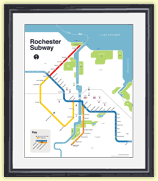
After the Erie Canal was rerouted south of downtown Rochester, the Rochester
Industrial & Rapid Transit Railway (the “subway”) was built in
its place as a link between the five different railroads and interurban trolley
lines that served the Rochester area. As the industrial landscape of Rochester
changed, and highways replaced the railroads, the Rochester subway gradually
became a relic of a bygone era. In 1956 the subway was abandoned and much of
its route was converted into Interstate 490 — built to connect Rochester
with the New York State Thruway (I-90). Read more about the history of the Rochester Subway.
RochesterSubway.com exists to help spark
public dialogue around how we can better connect the neighborhoods of Rochester
NY, surrounding communities, and their cultural offerings. Rochester’s
future is written in her past. Let's rediscover it.

















![Subway Poem [IMAGE: RochesterSubway.com]](https://www.rochestersubway.com/images/photos/subway-poem.jpg)

![Gilbert Hunt was a trolley and bus operator with Rochester Transit Corporation for 40 years. His collection of transit passes is up for grabs. [IMAGE: From the collection of Gilbert Hunt]](https://www.rochestersubway.com/images/photos/Gilbert-Hunt-1948-02-22_D&C.jpg)
![Downtown Rochester from the Cascade District [PHOTO: Rochester City Hall]](https://www.rochestersubway.com/topics/wp-content/uploads/Downtown_From_Cascade.jpg)
![RG&E Beebee power station prior to demolition. Rochester, NY. Summer 2016. [IMAGE: Anonymous]](https://www.rochestersubway.com/images/photos/rochester-rge-beebee-station-00.jpg)
![The Rochester subway station at Monroe Avenue (June 1956). The Rochester subway ended passenger service on June 30, 1956. [PHOTO: Rochester Municipal Archives]](https://www.rochestersubway.com/images/photos/rochester-subway-monroe-avenue-station.jpg)
![Old Richford hotel building at 65-67 S. Chestnut Street, Rochester. [IMAGE: Anonymous]](https://www.rochestersubway.com/images/photos/richford-building-65-67-chestnut-rochester-00.jpg)
![This 1948 Greyhound bus from the NY Museum of Transportation recently appeared in the movie 'Race' and is now open to museum visitors. [IMAGE: Provided]](https://www.rochestersubway.com/images/photos/nymt-greyhound-race-bus-01.jpg)
![Dave Koza ending baseball's longest game with a bases-loaded single in the 33rd inning of a game that began on April 18 and ended on June 23, 1981. [IMAGE: Pawtucket Red Sox]](https://www.rochestersubway.com/images/photos/rochester-vs-pawtucket-longest-baseball-game-01.jpg)
![Fast ferry on it's way to Rochester from New York Harbor, 2004. [IMAGE: RochesterSubway.com]](https://www.rochestersubway.com/images/photos/rochester-fast-ferry-in-new-york-harbor-07.jpg)
![Portageville rail bridge at Letchworth State Park, NY. [IMAGE: Richard H. Jordan III]](https://www.rochestersubway.com/images/photos/letchworth-portageville-bridge-07.jpg)
![Abandoned Medley Centre / Irondequoit Mall. Rochester, NY. [IMAGE: Random Retail, Flickr.com]](https://www.rochestersubway.com/images/photos/rochester-medley-center-irondequoit-mall-01.jpg)
![Fawn running through the First Baptist Cemetery, which is located within the Depot. At least three Colonial soldiers are buried there. [IMAGE: Dennis Money]](https://www.rochestersubway.com/images/photos/seneca-army-depot-08.jpg)
![An old model train display has been dusted off and restored at the former Chase Tower in downtown Rochester. [PHOTO: RochesterSubway.com]](https://www.rochestersubway.com/images/photos/rochester-chase-tower-metropolitan-tower-01.jpg)
![Wulff's Hotel, at the corner of State and Factory Streets in Rochester; the scene of a notorious murder on December 18, 1920. [IMAGE: From the Albert R. Stone Negative Collection, Rochester Museum & Science Center, Rochester, NY.]](https://www.rochestersubway.com/images/photos/wulffs-hotel-and-rochester-marshmallow-company.jpg)
![Rochester Savings and Loan building. 40 Franklin Street. [IMAGE: The American Architect]](https://www.rochestersubway.com/images/photos/rochester-savings-bank-drawing-01.jpg)