

















![Scene from the Rochester riots, July 24-26, 1964. [PHOTO: Rochester Municipal Archives]](https://www.rochestersubway.com/images/photos/rochester-riots-1964-02.jpg)
On July 24, 1964  a series of events took place which led to three of the darkest days in Rochester’s history. They had come to Rochester seeking a better life, yet African Americans in Rochester at that time still had to fight for jobs, fight for education, fight for housing… even for the simple right to stand on the sidewalk in their own neighborhood and not be questioned by police. By the 1960s the mistreatment of black people in this country—over the course of centuries—finally reached a boiling point. And Rochester was in the eye of the storm…
Posts Tagged ‘Rochester NY’...

‘Some Boy Causing Fuss’ First Warning Of Trouble in Rochester Riot Area
Thursday, July 24th, 2014Tags: 1964, Anthony Cerretto, Bernard Gayzer, Carrie Stevens, Dan Funk, Gene Stevens, Helen Myricks, race in Rochester NY, riot, Rochester, Rochester NY, Roger Bacon, Sal Arnone
Posted in Rochester History, Rochester Images | 3 Comments »
Abandoned Girl Scout Camp Beech-Wood
Monday, July 21st, 2014![Beechwood Park in Sodus, NY is a former Girl Scouts of America summer camp. The property has been left as it was abandoned in 1996. [PHOTO: Chris Clemens and Luke Myer]](https://www.rochestersubway.com/images/photos/rochester-abandoned-camp-beechwood-01.jpg)
My buddies Chris Clemens and Luke Myer (from the Burned Over District blog) recently shared these photos with me. Chris and Luke were on their way to Sodus on an unrelated exploration trip when they recalled stories of a nearby abandoned Girl Scout camp and decided to stop and check it out [map ].
Luke says his mother camped here when she was a little girl. In fact, many Girl Scouts earned a badge or two here over its 60+ year history. This was camp Beech-Wood and the following is an excerpt from NYfalls.com about its history…
Tags: abandoned, abandoned places, abandoned swimming pool, Beechwood State Park, camp site, Chris Clemens, Girl Scouts camp, Girl Scouts of America, Luke Myer, photography, Rochester, Rochester NY, rochester photos, Sodus, urban exploration
Posted in Rochester Destinations, Rochester History, Rochester Images, Urban Exploration | 30 Comments »
Double Jeopardy for Historic Rochester Church
Monday, July 14th, 2014![The Zoning Board will decide AGAIN whether or not to allow the former Westminster Presbyterian Church at 660 West Main Street to be demolished. [PHOTO: RochesterSubway.com]](https://www.rochestersubway.com/images/photos/rochester-westminster-church-660-west-main-01.jpg)
“Double Jeopardy” wasn’t invented by Alex Trebek. It’s actually a procedural defense in our system of justice that forbids a defendant from being tried more than once for the same (or similar) charges. Unfortunately this rule doesn’t seem to apply with historic preservation in Rochester. Because the very same owner of this historic church at 660 West Main Street will, for a second time, ask the Zoning Board for permission to demolish the structure to make way for a discount store.
Dawn Noto is president of the Susan B. Anthony Neighborhood Association. She was concerned about the demolition plans in March of 2013 when the Zoning Board blocked them the first time. This time Dawn says the conditions are no different and the City should be working with the owner on a plan to rehab the church building instead of entertaining his plan for a second time…
Tags: 660 W. Main Street, Dawn Noto, demolition, Designated Building of Historic Value, development, development plans, Marvin Maye, Rochester, Rochester NY, Susan B. Anthony Neighborhood, urban design, Westminster Presbyterian Church, zoning, Zoning Board of Appeals (ZBA), zoning code
Posted in Rochester History, Rochester News, Urban Development | 31 Comments »
Campaign to Restore Rochester Subway Car 60 Kicks Off Sunday
Saturday, June 28th, 2014![The last remaining Rochester subway car #60. [PHOTO: RochesterSubway.com]](https://www.rochestersubway.com/images/photos/rochester-subway-car-60-RGVRRM-04.jpg)
You may recall last year when Otto Vondrak told us the story of how the sole survivor of the Rochester subway fleet, Car 60, found its way home to Rochester. Since 1998 the car has been at the Rochester & Genesee Valley Railroad Museum awaiting restoration. To be perfectly honest, most of the volunteers who were involved in its return to Rochester passed on, putting restoration efforts on the back burner. But now, finally, this Sunday the museum will kick off a fundraising (and awareness building) campaign to restore Rochester Subway Car 60 for the public to enjoy once again…
Tags: donate, fundraiser, history of Rochester, Otto M. Vondrak, Rochester, Rochester & Genesee Valley Railroad Museum, Rochester history, Rochester NY, Rochester Subway, Rochester subway car 60, Rochester Subway photos
Posted in Events, Rochester Destinations, Rochester History, Rochester News, Rochester Subway | 1 Comment »
Juan & Maria Host a Garage Sale; Benefit for Daughter’s Cancer Fight
Thursday, June 26th, 2014
I have a soft spot in my heart for Juan & Maria Contreras. Their family has been serving up the tastiest (and friendliest) Spanish-American food at the Public Market for almost as long as I myself have been a Rochesterian. Their homemade empanadas have earned their place alongside the Garbage Plate and the Zwiegle’s white hot. Over 1,000 empanadas have been known to fly out of this little food stand on any given day at the market, but no matter how busy they are, Juan always has time to greet each customer with a warm, “How are YOU my friend?”
Now our friends need our help. Their daughter, Carolina (33) has been locked in a battle against a rare and deadly form of cancer known as Clear Cell Sarcoma. This Sunday at the Rochester Public Market the Contreras family will host a garage sale to help raise money for Carolina’s fight for life…
Tags: benefit, cancer, Carolina Contreras, event, garage sale, Juan & Maria's Empanada Stop, Juan Contreras, Maria Contreras, Rochester, Rochester NY, Rochester Public Market
Posted in Events, Rochester News | 1 Comment »
Guess What This Thursday is… ROC Transit Day!
Tuesday, June 17th, 2014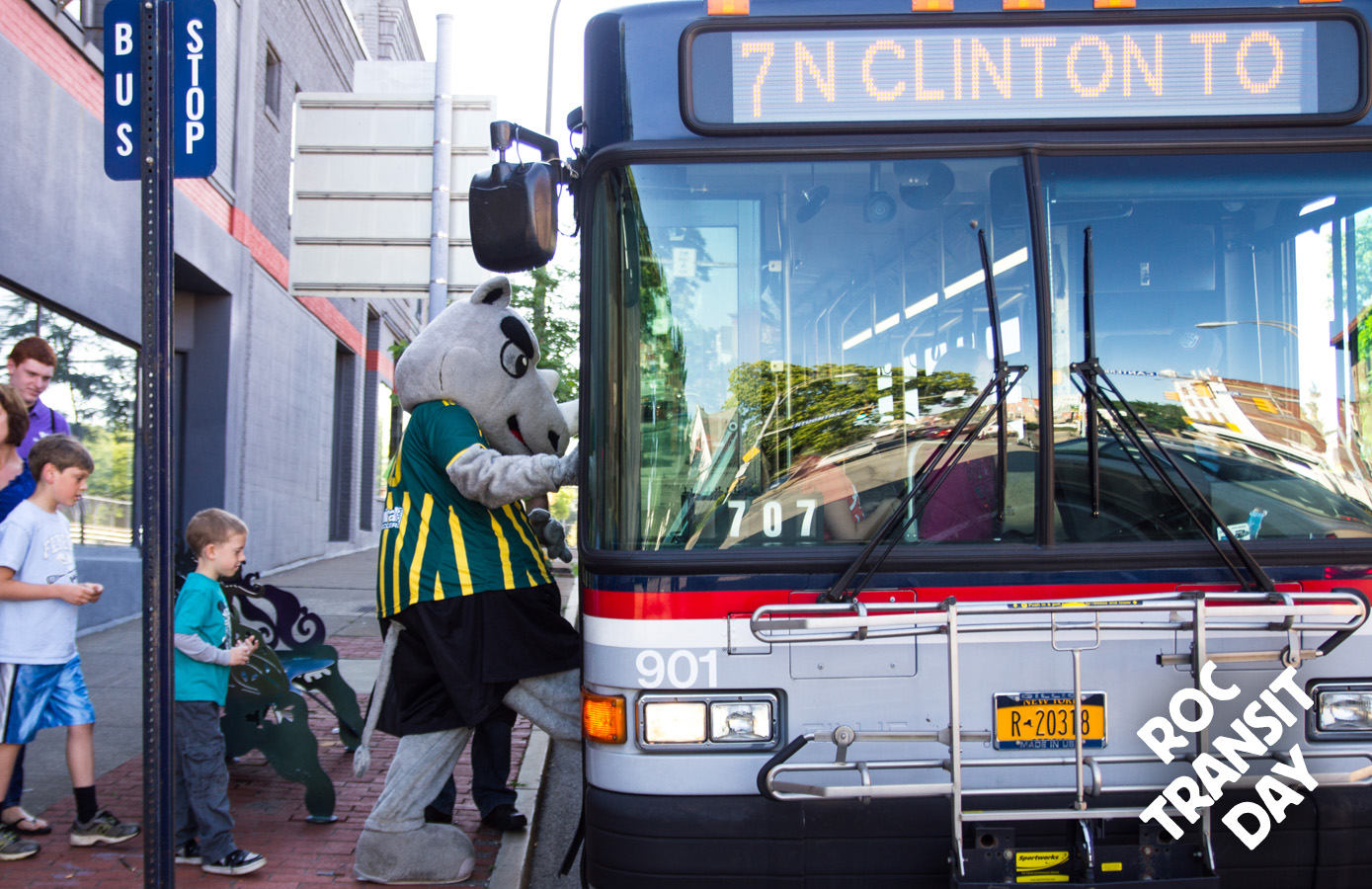
Reconnect Rochester is a non-profit organization I founded a few years ago to advocate for transportation alternatives in Rochester. We work for pedestrian-friendly streets, and we push for improved public transportation. These things are important to me because I’ve seen firsthand what happens to places that focus too much attention on providing spaces for automobiles, and not enough on spaces for people.
If you don’t quite get what I’m talking about, you can listen to me blabber on . But if you’re already with me, please make plans to leave your car at home this Thursday; a day we’re calling “ROC Transit Day”…
Tags: bus, event, mass transit, mass transportation, public transit, Reconnect Rochester, Regional Transit Service (RTS), ROC Transit Day, Rochester, Rochester Genesee Regional Transportation Authority (RGRTA), Rochester NY
Posted in Events, Opinion, Rochester News, Transit + Infrastructure | No Comments »
You Can Play the Bells of Rush Rhees Library
Thursday, June 12th, 2014![The carillon inside University of Rochester's Rush Rhees Library tower. [PHOTO: University of Rochester Carillon Society]](https://www.rochestersubway.com/images/photos/university-of-rochester-rush-rhees-carillon-01.jpg)
A year ago RochesterSubway.com took you UP inside Rush Rhees Library at the University of Rochester. The views from that tower are spectacular – but it’s the 6,668 pounds of bronze bells inside that are truly awe inspiring.
The bells are actually part of a massive musical instrument called a Carillon. And now, if you’ve got experience playing a keyboard, you may have a shot to go to the top of Rush Rhees and play the carillon yourself. Doris Aman of the University of Rochester Carillon Society sent in the following one-time offer…
Tags: carillon, Doris Aman, Rochester, Rochester NY, Rush Rhees Library, University of Rochester, University of Rochester Carillon Society, UofR, urban exploration
Posted in Art + Culture, Events, Reader Submitted Stories, Rochester News, Urban Exploration | 4 Comments »
$500 Treasure Hunt
Monday, June 9th, 2014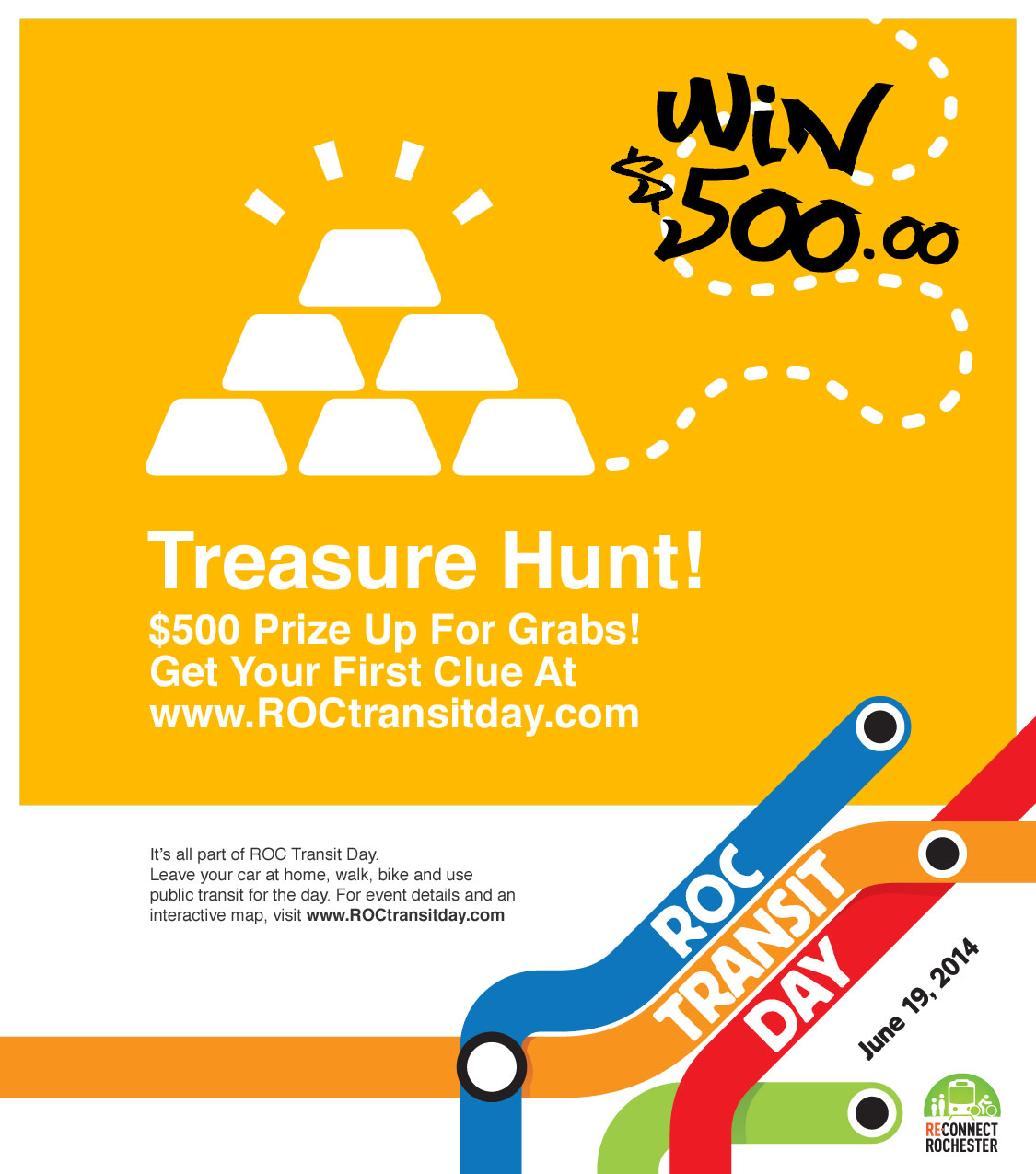
A $500 CASH prize is up for grabs in The Great ROC Transit Day Treasure Hunt!
On June 19, FIVE HUNDRED DOLLARS (U.S.) will be hiding somewhere in Rochester. The first person (or team of people) to find it will take all. There’s just one catch… no cars allowed. To claim this jackpot you’ll need to use the bus system, walk or bike. Get your first clue now at www.ROCtransitday.com .
Tags: Reconnect Rochester, ROC Transit Day, Rochester, Rochester NY, scavenger hunt, treasure hunt
Posted in Events, Rochester News, Transit + Infrastructure | No Comments »
Legality of Lyft and Other Ridesharing Operations in Rochester Seem Fuzzy – For Now
Monday, June 9th, 2014![Lyft is a San Francisco–based company whose mobile-phone app facilitates peer-to-peer ridesharing; enabling passengers who need a ride to request one from drivers in their area. [PHOTO: Lyft]](https://www.rochestersubway.com/images/photos/lyft-ridesharing-01.jpg)
Last week I shared an interview with a local Lyft driver. A debate in the comments—and on Facebook—about the legality of rideshare services (such as Lyft) immediately ensued. After hearing from both sides of the issue, I’m just as confused as I was before.
On one hand, Lyft has responded to these challenges by saying its service is absolutely not illegal, and that their insurance has drivers and passengers covered. On the other hand, a local insurance agent, Michael Montag has reached out to RochesterSubway.com. He believes Lyft drivers are operating illegally – even if Lyft itself may not be illegal. I’ll post both responses here, and if you’re thinking of driving for Lyft or similar services, do your homework first…
Tags: Carma Carpool, carpooling, John McBride, Lyft, MGM Associates of Rochester, Michael G. Montag, rideshare, ridesharing, Rochester, Rochester NY, Sidecar, transportation, transportation alternatives, Uber, Wingz, Zimride
Posted in Interviews, Rochester News, Transit + Infrastructure | 22 Comments »
The Slow Grind: the Story of Muler.
Thursday, June 5th, 2014![Muler. April 2012. [PHOTO: Facebook]](https://www.rochestersubway.com/images/photos/muler-band-2012-04.jpg)
The following is a guest post submitted by Brad Lewis.
Submit your story today.
Rochester has long been home to a vibrant and diverse music scene. Original music has always had room to find an audience here, a luxury most cities cannot claim, but we support our own. Even in the pre-punk days local bands like The Invictas , Soul Brothers Six and Duke Jupiter were able to make a name on a national level. But beyond those lucky few lie the stories of dozens of bands who achieved their own form of greatness. With an array of clubs and bars encouraging original voices there has never been a lack of up-and-comers (and should-have-made-its) hitting the stage on any given night.
A little over twenty years ago David Baumgartner, Sean Leahy, Will Veeder and Kris Durso joined those ranks as Muler . During their two decade career, Muler has embodied everything that makes this scene unique. They were just four guys who made loud tuneful rock and roll in the least pretentious way possible…
Tags: Brad Lewis, history of Rochester, Muler, Muler the band, Multi-use Community Cultural Center (MuCCC), music, Rochester, Rochester music history, Rochester NY, WAYO, WAYO radio
Posted in Art + Culture, Reader Submitted Stories, Rochester History | 3 Comments »
Need a Lyft?
Monday, June 2nd, 2014![Lyft is a San Francisco–based company whose mobile-phone app facilitates peer-to-peer ridesharing; enabling passengers who need a ride to request one from drivers in their area. [PHOTO: Flickr, Bootleggerson]](https://www.rochestersubway.com/images/photos/lyft-ridesharing-bootleggersson.jpg)
Have you seen one of these big pink mustaches tooling around town lately? This past April a ridesharing service called Lyft entered the Rochester market. Lyft connects people—via mobile app—who need a ride with drivers in their area. The pink facial hair is sort of the calling card of the Lyft brand.
Recently I got to talking with a local Lyft driver, Fred from Penfield, and he says from his point of view, the service has been a smashing success. “There are about 40 of us in Rochester,” says Fred. “We are similar to Uber and Sidecar, but we are much friendlier and have a much bigger focus on safety.”
Besides the pink moustaches, it’s also common for drivers and passengers to fist pump at the start of each ride. The following is a summary of our conversation about Lyft…
Tags: Carma Carpool, carpooling, Genesee Transportation Council (GTC), Lyft, rideshare, ridesharing, Rochester, Rochester NY, Sidecar, transportation, transportation alternatives, Uber, Wingz, Zimride
Posted in Interviews, Rochester News, Transit + Infrastructure | 10 Comments »
Rochester’s Mercury Statue, Up Close and Personal
Thursday, May 29th, 2014![Statue of Mercury. Rochester, NY. [PHOTO: Wes Plant]](https://www.rochestersubway.com/images/photos/rochester-mercury-statue-renovation-2011-40.jpg)
On Facebook last week I shared an old photo of Rochester’s iconic Mercury statue as it was being removed from its original perch atop the Kimball Tobacco Factory in 1951. The factory was demolished to make way for the War Memorial and the statue sat in storage until the Lawyers Cooperative (Aqueduct Building) became his new home in 1973.
Fast forward to June 2011; the 21 foot tall, 700 pound statue gets a thorough inspection for signs of wear and a good restoration. The following photos were taken by Wes Plant during that checkup. And they show Mercury in detail you’ve probably never seen before…
Tags: aerial photography, Aqueduct Building, Blue Cross Arena, Cluett-Peabody & Company, downtown Rochester, J. Guernsey Mitchell, John Siddons Co., Kimball Tobacco Factory, Lawyers Cooperative Publishing Company, Mercury statue, public art, Rochester, Rochester NY, rochester photos, Statue of Mercury, War Memorial, War Memorial Arena, William Kimball
Posted in Art + Culture, Reader Submitted Stories, Rochester Images, Urban Exploration | 22 Comments »
More Little Free Libraries
Tuesday, May 27th, 2014![A Little Free Libraries at 226 Hudson Avenue. Rochester, NY. [PHOTO: Deanna Varble]](https://www.rochestersubway.com/images/photos/rochester-free-library-10.jpg)
A while back, Chris Clemens called attention to Rochester’s growing collection of Little Free Libraries . Last week Deanna Varble and Ken Braley wrote in to RocSubway and asked me to share a few more they’ve been working on.
I love this grassroots effort to encourage reading. And I’m happy to share these newest additions to the greater Rochester neighborhood…
Tags: books, Caroline Street, Chris Clemens, Deanna Varble, free stuff, Freebies, Gregory Street, Hudson Avenue, Ken Braley, library, little free libraries, little free library, Rochester, Rochester NY, The Curious and Uncommon
Posted in Art + Culture, Reader Submitted Stories, Rochester Images, Rochester News | 2 Comments »
Filling In: Charlotte Part 3
Tuesday, May 20th, 2014
The following is a guest post submitted by Matthew Denker.
Submit your story today.
Welcome back to our three part series on Charlotte. We’ve arrived at part three. This is it, the omega. If you recall, all the way back in part one, we said this part would be broken up into three sections:
1. Residential and Commercial Development;
2. Transportation; and
3. Governance.
So without further adieu, let’s jump right in. Ok, one quick disclaimer, Charlotte as a whole is pretty big, too big for one little three part column. With that in mind, I’m cutting off Charlotte at Denise Road, similar to the other parts. Maybe someday I can write an addendum addressing the southern portion of the neighborhood. But enough of that – Onward!
Tags: Charlotte, development, Filling In, Matthew Denker, Port of Rochester/Charlotte, Rochester, Rochester NY, urban development
Posted in Opinion, Reader Submitted Stories, Rochester News, Urban Development | 44 Comments »
Rochester’s Great Flood(s)
Monday, May 19th, 2014![A large crowd is gathered on Front Street to look at the flood at the other end of the street. Varlan's Hotel, Rosenberg's Pawnshop, Charles Adam's Sons Grinding, J.G. Zweigle's Sons, W.T. Bridle Furniture, William Pigeon Shoes, Hyman Davis Shoes, Genesee Provision Company, Myers Department Store, and the F.H. Loeffler Company are visible in the photo. March, 1913. [IMAGE: Albert R. Stone]](https://www.rochestersubway.com/images/photos/rochester-ny-flood-march-1913-01.jpg)
With all of the recent flooding in our area, RocSubway reader Michael Delaney wrote in and suggested, “a great idea for an article would be about the history of flooding in Rochester and the civil engineering that has gone into solving the issue. Beyond the dams, I’ve heard that there are huge storm sewer tunnels underneath the city. It would be very interesting to know more about it.”
Situated at the intersection of the Genesee River and Erie Canal, Rochester’s geography has blessed—or cursed—us with a long long history of great floods. Before the construction of the Mount Morris Dam (1948-1952) records indicate the City of Rochester had experienced severe flooding about every seven years between 1865 and 1950. Talk about a pesky problem.
Digging into all of the engineering marvels that have spared modern Rochesterians from most of these high waters could easily span many pages. And I promise to dedicate future posts on the subject. But for now, I want to show just how bad this problem was by highlighting just one flooding disaster that occurred in late March, 1913…
Tags: Aqueduct Bridge, Atlantic Supply House, Bartholomay Beer, Black Creek, Brown Street, C.P. Ford & Company, Central Avenue, Charles Adam's Sons Grinding, Court Street, Dave Solomon, downtown Rochester, Erie Canal, Erie Canal Aqueduct, F.A. Sherwood Company, F.H. Loeffler Company, F.P. Van Hoesen Company, Fahy Market, Fifth Avenue Clothes Shop, flood, Front Street, Genesee Aqueduct, Genesee Provision Company, Genesee River, Gorsline Building, history of Rochester, Hotel Richmond, Hyman Davis Shoes, J.C. Vine's Columbia Hotel, J.C. Wilson Company, J.G. Zweigle's, J.G. Zweigle's Sons, Jacob Goldstein's Lodging House, John M. Forster Company, local history, Market Streets, Mill Street, Mount Morris Dam, Myer's Department Store, old photos, old photos of Rochester, old photos of Rochester NY, People's Rescue Mission, Plymouth Avenue, Postal Telegraph Cable Company, Powers Building, Rienzi, Rochester, Rochester history, Rochester NY, Rochester Poultry & Commission Company, Rochester Thread Company, Rosenberg's Pawnshop, Scottsville, South Avenue, Varlan's Hotel, W.T. Bridle Furniture, Weis & Fisher Company, West Shore railroad bridge, William H. Larkin Hotel, William Pigeon Shoes, Zweigle's
Posted in Rochester History, Rochester Images | 12 Comments »
Filling In: 34 King Street
Sunday, May 18th, 2014
The following is a guest post submitted by Matthew Denker.
Submit your story today.
Dear readers, we interrupt our three part Charlotte series to give you a small morsel of something different before the grand finale. Consider this a palette cleanser, an intermezzo, if you will.
I looked up tired in the dictionary, and found this picture of 34 King Street in the Susan B. Anthony neighborhood. Seeing as the Carriage Factory lofts are being built immediately behind, I think it’s time for a major upgrade here. Allow me to present the all-new 34 King Street…
Tags: 34 King Street, City of Rochester, Filling In, Matthew Denker, real-estate, Rochester, Rochester home for sale, Rochester house for sale, Rochester NY, Susan B. Anthony Neighborhood
Posted in Reader Submitted Stories, Rochester Homes for Sale, Rochester News, Urban Development | 3 Comments »
Get FREE ROC Transit Day Fare Cards for Your Organization
Wednesday, May 14th, 2014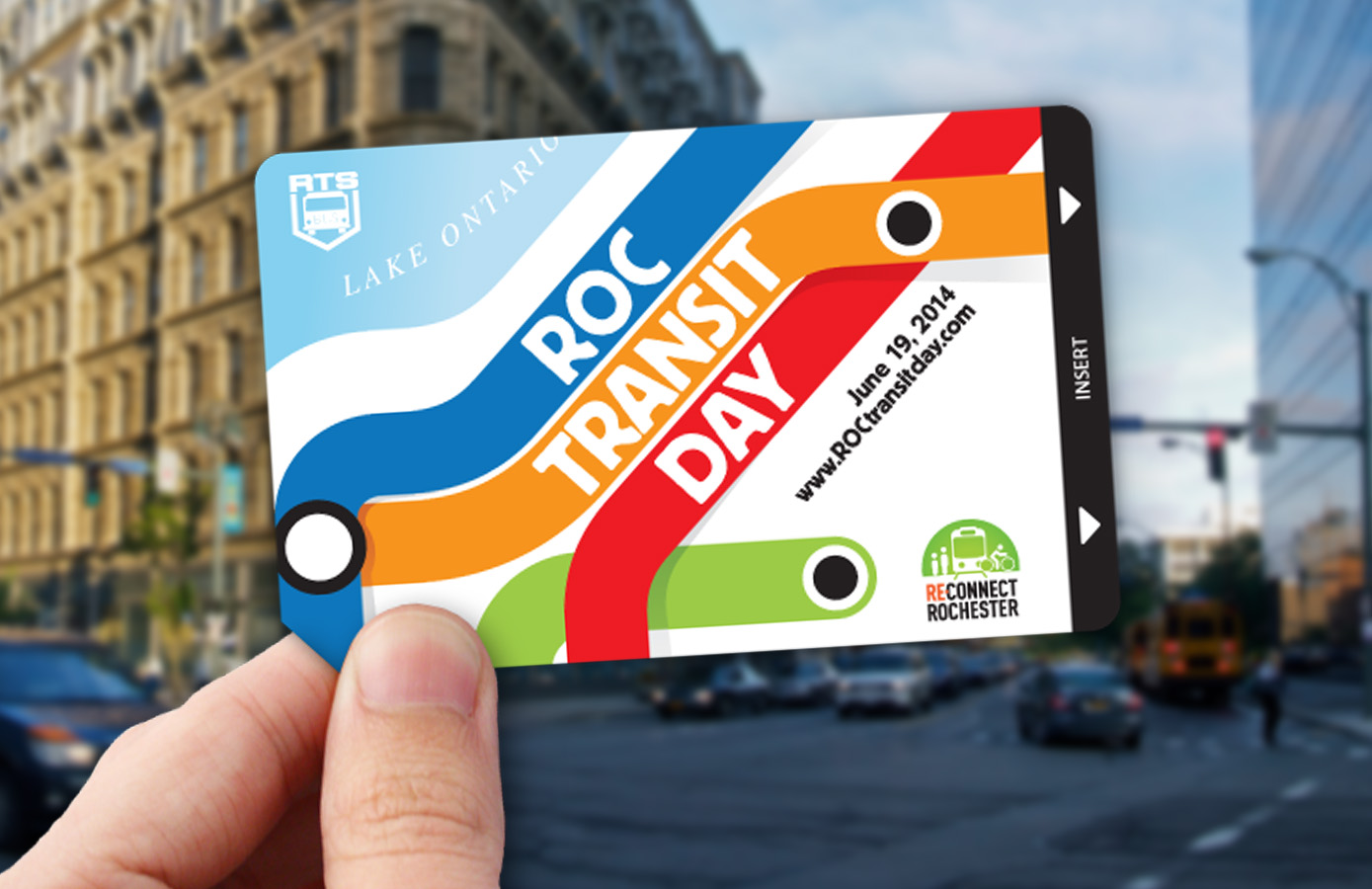
For ROC Transit Day 2013 we gave away nearly 1,000 transit fare cards and asked Rochesterians to ditch their cars for one day in support of a healthier community. 30 different forward-thinking organizations (and many intrepid individuals) pledged to ride public transit that day.
This year ROC Transit Day is Thursday, June 19, 2014. All kinds of free fun and great deals will be available for anyone who leaves their car at home and uses public transit for the day.
To request FREE all-day fare cards for your organization…
Simply use this form or contact [email protected] or
But hurry, we only have a limited supply and these babies go quickly. First come first serve.
And remember, public transit, walking and biking are healthy options for our bodies and the Rochester community. So get onboard!
Tags: bus, mass transit, mass transportation, public transit, Reconnect Rochester, Regional Transit Service (RTS), ROC Transit Day, Rochester, Rochester Genesee Regional Transportation Authority (RGRTA), Rochester NY
Posted in Events, Freebies, Rochester News, Transit + Infrastructure | No Comments »
Filling In: Charlotte Part 2
Thursday, May 8th, 2014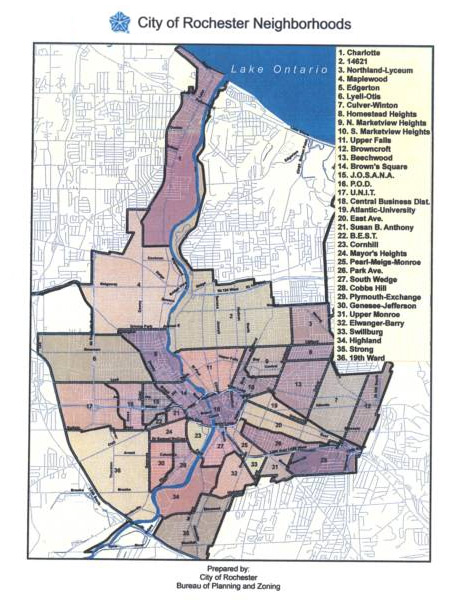
The following is a guest post submitted by Matthew Denker.
Submit your story today.
In part one of our three part Charlotte bonanza, we looked briefly at the history of Charlotte, from its formation in 1792, through its resort years and annexation in the early 20th century. In part two, we’ll look at Charlotte as it is today. Let’s start with the lay of the land. Shown above is the official definition of the city’s neighborhoods. As you know, Charlotte is the one at the top. Zooming in (and switching to Google maps) here’s what we see…
Tags: Charlotte, Filling In, Filling In Charlotte, Matthew Denker, Port of Rochester/Charlotte, Rochester, Rochester history, Rochester NY
Posted in Reader Submitted Stories, Rochester History, Urban Development | 7 Comments »
ROC Transit Day is important! But don’t take my word for it…
Monday, May 5th, 2014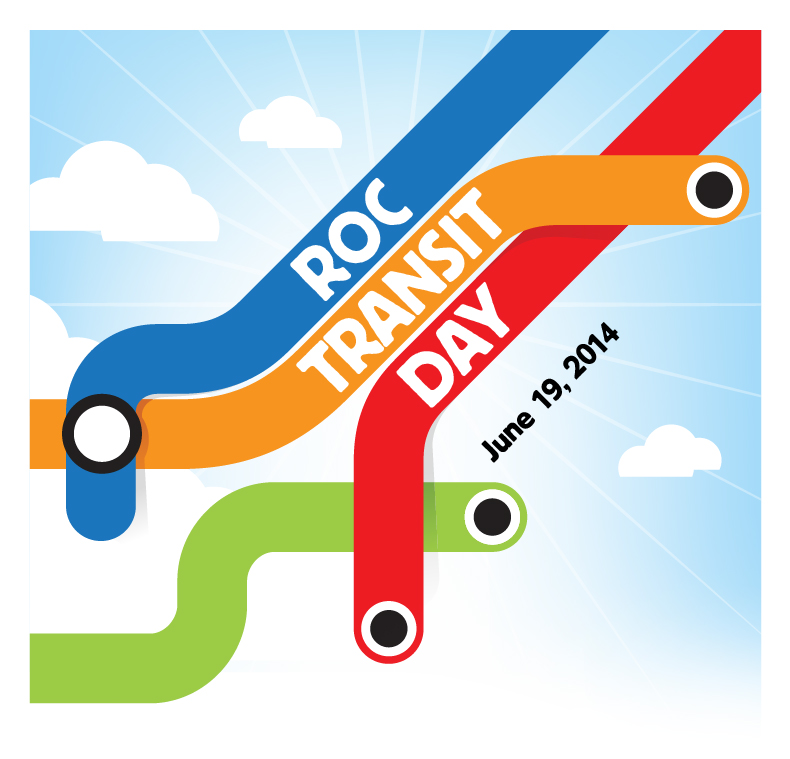
The days are getting longer, and (slowly) the air is getting warmer. Soon enough the sweet scent of Lilac will be in the air. This can only mean one thing… ROC Transit Day will soon be here!
If you drive in your car to work alone each day, you’re probably asking yourself, “Why would I want to ride public transit when I can just drive my Nissan Leaf (or whatever)?”
Well, I could list all the reasons why public transportation is healthier for our earth, healthier for our bodies, and healthier for our community. But that would be boring. Instead, watch this video and hear it straight from the mouths of your fellow Rochesterians…
Tags: Aaron Costa, bus, Cheesy Eddies, Full Moon Vista, Krudco, mass transit, mass transportation, public transit, Reconnect Rochester, Regional Transit Service (RTS), ROC Transit Day, Rochester, Rochester Genesee Regional Transportation Authority (RGRTA), Rochester NY, Scott Page, Taylor Ann Bogur
Posted in Events, Rochester News, Transit + Infrastructure | No Comments »
Settle Into the “GORGEous” Maplewood Neighborhood
Monday, May 5th, 2014![Fountain at Maplewood Park. [IMAGE: Doug Kerr]](https://www.rochestersubway.com/images/photos/rochester-homes-for-sale-maplewood-01.jpg)
The following is a guest post submitted by Rich Tyson.
Submit your story today.
First, a note from RochesterSubway.com…
A month or so ago, local realtor Rich Tyson submitted an article about Rochester’s active North Winton Village and showed a home-buying opportunity for anyone who might be looking for a great deal in a great city neighborhood.
Some people saw this as a cheap “knock-off” of what the Landmark Society does in the City Newspaper each week. To that I say, so what? This was not intended to be a knock-off. But if that’s how you feel, stop reading. On the other hand, if you’re interested in learning a bit about Rochester’s various neighborhoods and in seeing the full range of what Rochester’s real estate market has to offer, enjoy.
The homes featured by Landmark Society are fantastic architectural specimens. The homes featured by Rich Tyson are not perfect, but they are also great city homes that need good owners. And if you are a real estate agent or a homeowner looking to sell your city home, you are quite welcome to submit an article as well… [email protected]
Ok, enough of that. Let’s check out some other homes for sale. This time in the gorge-ous Maplewood neighborhood…
Tags: Avis Street, Bill Collins, Casey Jones, Dewey Ave Smoke Shop, Electric Avenue, Genesee River, Genesee Riverway Trail, Maplewood, Maplewood Neighborhood Association, Maplewood Park, real-estate, Rich Tyson, Rochester, Rochester home for sale, Rochester house for sale, Rochester neighborhoods, Rochester NY, Tim Brooks
Posted in Reader Submitted Stories, Rochester Homes for Sale | No Comments »