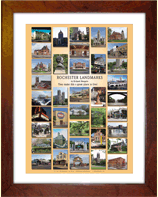
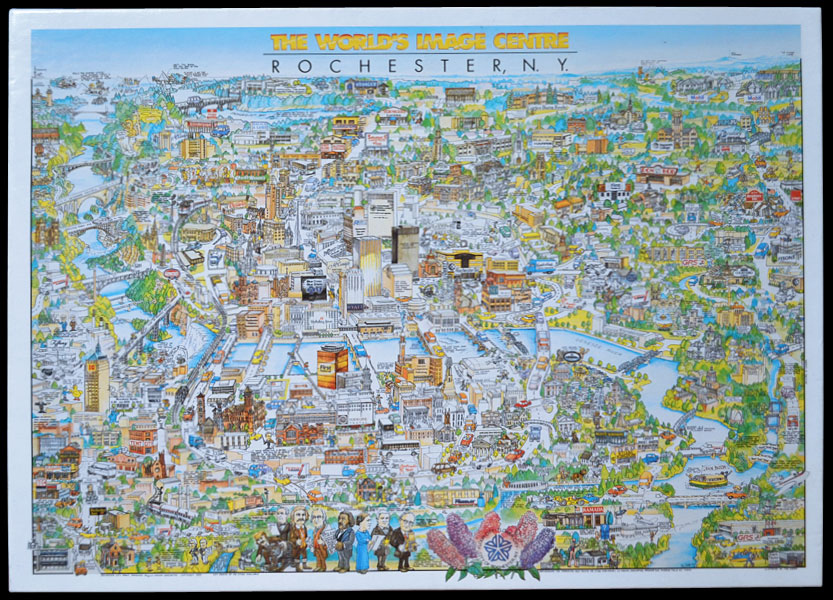
I love collecting fun little bits of Rochester history. So a few years ago I bought this Rochester jigsaw puzzle on eBay. Well somehow it slipped behind my sofa and I just recently found it again. It’s like Christmas in July!
Entirely hand drawn, this 513 piece puzzle is jammed with local landmarks, businesses, and fun historic facts. Now I realize I’m a total geek-dork, but I could stare at this thing for days picking stuff out—it’s THAT much fun…
All the controversy over whether or not to demolish the 120 year-old brewhouse at 13 Cataract Street got us thinking. Those in favor of demolishing the building say it’s an eyesore and a haven for drug dealers; even prostitutes. So, just remove the building and our problems go away.
Tonight the Preservation Board and Planning Commission will hear public comments and decide whether or not 13 Cataract will join the ranks of the reborn, or go the way of Rochester’s Bragdon Station and others.
All the controversy over whether or not to demolish the 120 year-old brewhouse at 13 Cataract Street got us thinking. Those in favor of demolishing the building say it’s an eyesore and a haven for drug dealers; even prostitutes. So, just remove the building and our problems go away.
Right?
But if we demolished every eyesore in Rochester, would we have solved all the City’s problems? Or might we end up tossing the proverbial “baby” out with the bath water? For the next two weeks we’ll take a look at some local eyesores …or rather, opportunities, nearly lost.
All the controversy over whether or not to demolish the 120 year-old brewhouse at 13 Cataract Street got us thinking. Those in favor of demolishing the building say it’s an eyesore and a haven for drug dealers; even prostitutes. So, just remove the building and our problems go away.
Right?
But if we demolished every eyesore in Rochester, would we have solved all the City’s problems? Or might we end up tossing the proverbial “baby” out with the bath water? For the next two weeks we’ll take a look at some local eyesores …or rather, opportunities, nearly lost.
All the controversy over whether or not to demolish the 120 year-old brewhouse at 13 Cataract Street got us thinking. Those in favor of demolishing the building say it’s an eyesore and a haven for drug dealers; even prostitutes. So, just remove the building and our problems go away.
Right?
But if we demolished every eyesore in Rochester, would we have solved all the City’s problems? Or might we end up tossing the proverbial “baby” out with the bath water? For the next two weeks we’ll take a look at some local eyesores …or rather, opportunities, nearly lost.
Cars parked in the High Falls neighborhood this week got notices slipped under their wiper blades. RG&E will be demolishing the last Beebee Station smokestack sometime within the next six months due to high levels of asbestos contained within the structure.
A new web site, SaveCataract.com , and a mountain of information on Rochester’s endangered Cataract Brewery building has surfaced this week… The accomplished life (and death) of its architect… Original architectural drawings… And new documents submitted by North American Breweries to the Zoning Board (see the section called Offers to Buy Cataract). Ready? Let’s dive right in… (more…)
The spate of recent articles in the D&C regarding local construction projects also means that there will be a great amount of demolition of older buildings and historic properties. Take, for example, the recent decision to demolish the Cataract Brewery buildings in High Falls. The cost to demolish the properties alone—estimated at $800,000 to $1 million—is more than twice the amount for which Genesee Brewery was recently selling the two Cataract Brewery buildings and a large parking lot. That same amount could be used to install a new roof and windows, “button up” the building, and abate the lead paint, within the older “gem” brewery building. Although the oldest Cataract building is currently a “liability” in the words of a developer who recently toured the property, it could actually act as the driver for redevelopment. Historic Preservation Tax Credits, coupled with city, county, state, and federal monies, could pay for at least 30-40% of construction costs, and potentially way more if the City took on the lead abatement costs and Genesee Brewery and its owner, KPS Capital, acted as an investor or partner in redevelopment.
Rendering of renovated buildings and GardenAerial trail
I realize that sometimes it’s a bit difficult to see the potential in something. Especially when that “potential” is hidden beneath layers of mustard yellow paint, rusty corrugated siding, and 25+ years of plain old tired…
The way things look now (click for larger views)
Why, just the other day Howard S. Decker, FAIA said, “” Mr. Decker is former Principal of DLK Architecture (Chicago) and former Chief Curator of the National Building Museum (Washington DC). He knows a thing or two about buildings, and places that are worth saving for future generations. His highly experienced eyes see the potential in 13 Cataract Street and the neighborhood it lives in.
But what about the rest of us? How can we be sure this building is worth the money and effort it will take to bring it back to life? What is the alternative to demolition? And will we lose our Brewery Visitor Center if we don’t tear this other building down??
Let’s start with an excerpt taken from a document filed by the Landmark Society in 1984 with the New York State Parks and Recreation Division for Historic Preservation…
On Friday officials at the Genesee Brewery unveiled plans they say will “create a destination for beer lovers that anchors development on downtown Rochester’s Northeast side.” Before we get too excited, let’s think.
Firstly, did you know Genesee Brewery is owned by a New York City investment firm called KPS Capital Partners? KPS Capital Partners established North American Breweries, Inc. in 2009 to manage its brewery acquisitions. One of those acquisitions was our beloved Genesee. They will tell you North American Breweries is headquartered in Rochester. But Genesee Brewery is no longer a locally owned company.
North American Breweries says their planned “Genesee Brew House…will celebrate the storied history and experience of the Genesee brand” and that they want to “tell the story of [this] resilient company with a rich history that dates back to 1878.” But to do this they will demolish this building; the centerpiece of Rochester’s historic brewing district, built 1899.
The following press release was issued today by North American Breweries, the NYC investment firm that owns Genesee Brewery.
In brief, they plan to renovate an old packaging building, turn it into a visitor center, and level two of the last remaining original buildings in the heart of Rochester’s historic brewing district. The press release claims that the new visitor center “hinges” on the demolition of these historic buildings – not because the new visitor center is being built on the land, but because the old buildings impede the view of High Falls.
What the press release doesn’t mention is that one local group, the people behind the Garden Aerial Project and the Greentopia Festival, expressed interest in these buildings three months ago. They want to renovate the old buildings and turn them into office space and a visitor center in partnership with the brewery. I was told North American Breweries turned them down because the money wasn’t right. So it looks like they will spend $600,000 to demolish the buildings instead. ??
This press release comes at the perfect time for North American Breweries. I learned today that they are planning to submit their application on Monday to demolish 13 Cataract St.
RocSubway has word from good sources this afternoon that Genesee Brewery will submit an application today to demolish this building at the eastern end of the High Falls pedestrian bridge at 13 Cataract Street. This will likely be going to the Zoning Board hearing on Dec 15. Obviously, if true, this would be a great architectural and historical loss for Rochester. If you know anyone with deep pockets, now is a great time to buy!
Have you seen this photo? It was posted yesterday on Reconnect Rochester’s site. The organizers of the Greentopia Festival turned Commercial Street (in High Falls) into “green” space and hosted a lunch picnic for workers in the neighborhood. As if that weren’t strange enough… Then I looked a little closer at the photo. WHAT THE HELL IS THAT IN THE SKY?!?
I took the liberty of digitally enhancing the area of the photo that caught my eye. Tell me this isn’t the least bit curious…
Lots of news has been brewing lately over the future of Rochester’s beat-up, 32-year-old Amtrak station on Central Avenue. Congresswoman Louise Slaughter recently announced that a $1.5 million federal stimulus grant has been awarded to New York state to plan for a new multi-modal station on the site. A $2.5 million appropriation to pay for the station design is expected to pass Congress next month. And Governor-elect Andrew Cuomo has just made it abundantly clear that New York will take whatever federal money is left on the table by newly elected GOP governors in Ohio and Wisconsin.
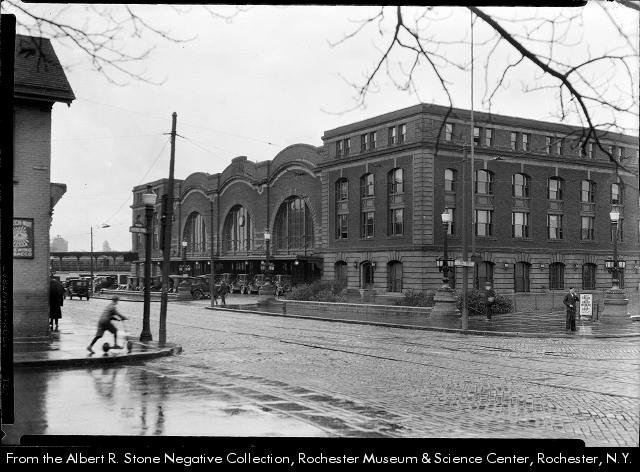
So for now, let’s just assume that something very interesting is in the works for our pitiful excuse for a train station. This is the perfect time to take a step back in time—to be inspired by Rochester’s grand old stations…
I’m a bit late on this but maybe this will be news to you. Some time last year, a notable infrastructure blog called The Infrastructurist, published a list of the top 10 greatest rail stations ever built. Standing shoulder to shoulder with some of the greatest examples of 20th Century American architecture is Rochester’s NY Central Station. What? You’ve never heard of it? That’s probably because it’s not with us anymore — may she rest in peace. The NY Central Station was demolished in 1965. In it’s place, the pretty little Amtrak Station you know and love today. In fact, all of the buildings on the Infrastructurist’s list are no longer.
On this day, December 21, 1887 in Rochester history… On the afternoon of December 21, 1887, the Vacuum Oil Works attempted to transfer 14,000 gallons of naphtha (petroleum ether) through a pipeline running underground to the Municipal Gas Company on Canal Street (one mile from the falls). Unfortunately, the companies were unaware that construction on the sewers at Atkinson street (a mile and half away from the falls area) had ruptured the pipeline.
The flammable gas filled the sewers and drifted down the line towards the High Falls/Browns Race district. (more…)
On September 15, 2009, there’ll be a gentleman on the Democratic primary ballot for Rochester City Council. Harry Davis is a big advocate for Rochester, sustainable urban planning, and rail transit …That’s all it took for us to take notice. Mr. Davis doesn’t have a long political resume or a lot of connections with big names. He’s a graduate of Brighton High School (1969), owned an antique store on Park Avenue, ran a small alternative Rochester newspaper called The Journal, and traveled around a bit while working as a video producer for Greenpeace. From my brief conversation with Mr. Davis, I’d say whatever he lacks in political experience he more than makes up for with heart and enthusiasm. Take this self-produced anti-RenSquare ad for instance…
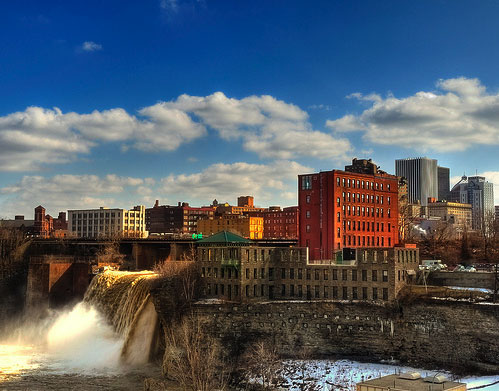
For a little more than 4 years I’ve worked in the High Falls district of Rochester. Last Thursday afternoon I took my lunch (which I usually eat over my computer keyboard) and I walked down Mill Street to Granite Mills Park. Of course you’ve never heard of it. It’s nothing more than a 50 foot square patch of concrete, a few trees, and 3 or 4 benches—not quite a full fledged “park” in the traditional sense. But on this sunny afternoon Granite Mills Park had transformed into a real urban plaza abuzz with music, laughter, people clapping, and even dancing.
A series of midday concerts presented by Hochstein Music School and WXXI called Hochstein at High Falls had kicked off with music provided by the Po Boy’s Brass Band. I don’t know if it was the glorious weather, the site of the surprisingly huge lunch-time crowd, or the sound of those trombones, but think I caught a glimpse of what the future might be like for that neighborhood by the falls…
Get Email Updates...
Stay up-to-date on Rochester-related stories, artifacts, and ideas that you won't find in the mainstream news.
Totally free, never spammy, and you can unsubscribe at any time.
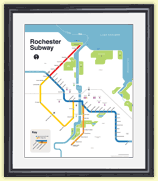
After the Erie Canal was rerouted south of downtown Rochester, the Rochester
Industrial & Rapid Transit Railway (the “subway”) was built in
its place as a link between the five different railroads and interurban trolley
lines that served the Rochester area. As the industrial landscape of Rochester
changed, and highways replaced the railroads, the Rochester subway gradually
became a relic of a bygone era. In 1956 the subway was abandoned and much of
its route was converted into Interstate 490 — built to connect Rochester
with the New York State Thruway (I-90). Read more about the history of the Rochester Subway.
RochesterSubway.com exists to help spark
public dialogue around how we can better connect the neighborhoods of Rochester
NY, surrounding communities, and their cultural offerings. Rochester’s
future is written in her past. Let's rediscover it.
















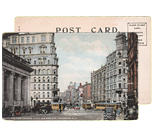
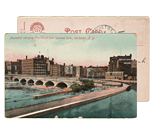

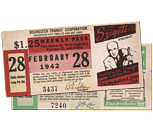




![This smokestack which belongs to the old RG&E Bee Bee Station power plant has towered over the High Falls neighborhood since the 1940's. [PHOTO: skyscraperpage.com user: xzmattzx]](https://www.rochestersubway.com/images/photos/high-falls-smokestack-xzmattzx.jpg)


![Genesee Brewery. [Flickr Photo: _Yoshi_]](https://www.rochestersubway.com/images/photos/genesee-brewery-sign-yoshi.jpg)
![A view of what could one day be Rochester's Historic Brewery Square and entrance to the GardenAerial trail (right). [RENDERING: RochesterSubway.com]](https://www.rochestersubway.com/images/photos/cataract-rendering-empty.jpg)
![The original panorama photo set used to create the rendering of Brewery Square. [PHOTO: RochesterSubway.com]](https://www.rochestersubway.com/images/photos/cataract-rendering-original.jpg)
![The building as it was in 1899. [PHOTO: Rochester Public Library]](https://www.rochestersubway.com/images/photos/genesee-brewery.jpg)

![Genesee Brewery getting set to demolish this building. That would be a great loss. [Flickr Photo: Zeus-the-Ferret]](https://www.rochestersubway.com/images/photos/genesee-brewery-Zeus-the-Ferret.jpg)
![Greentopia Festival gets ready to kick off this weekend. Workers in the High Falls neighborhood were invited to a picnic lunch today on the newly 'green' Commercial Street. But what the hell is that in the sky? [PHOTO: VJ Ortiz]](https://www.rochestersubway.com/images/photos/rochester-greentopia-ufo-sighting.jpg)