Welcome back! Last week we looked at a block that almost had it all. This week, let’s see what we can do on a much larger scale with a block that needs a little more work. A roughly 600’x600’ square mega block at the southern entrance to downtown. There are a few good things going on here; Geva Theater , Capron Lofts , Plan Architects . And, a few not so good; a sweeping highway off-ramp, a GIANT parking lot across the street from TWO garages, and random weedy surface lots…
Rochester’s Pulaski Library (originally the Hudson Avenue branch) was the second permanent library constructed by the City. As explained here , the library was closed in 1994, and has sat unused until last week when the City opened the doors to potential buyers. If you’re interested, the City wants your proposal by March 4. $1,000 to buy it, but you’ve got to show you’ve got a serious plan to rehab the property. Historic tax credits and grants could help take a bite out of the million dollars it could cost you when all is said and done. If you missed the open house, here’s a look inside…
Welcome to the first post in what will be an ongoing series called Filling In. One of the key elements of any great city is a tightly knit urban fabric. Whether you’re in New York City, San Francisco, or our own beloved Rochester, building an appealing city scape at a human, walkable scale promotes health, wealth, and wisdom. We’ve also learned that parks next to parks next to barren windswept plazas don’t put butts in seats, as they say. With that in mind, Filling In aims to explore vacant or underutilized pieces of Rochester in an effort to rebuild or strengthen our built environment. The aerial photo above was taken in 1929, when downtown was dense and energetic. And here is a reminder of what we’re up against…
Scientists have known of the existence of DNA for over fifty years. But until recently , no one had ever seen a photograph of that tricky little double-helix. For the preservation community in Rochester, the image above could be just as big of a breakthrough as photographing DNA for the first time. We had a fuzzy idea of their existence, but until today no one had ever seen a map of the city’s Designated Buildings of Historic Value (DBHV). And I mean NO ONE. Not even the people who put the list together…
Last November I had the ridiculously huge privilege to give a talk at TEDxRochester. The gravity of the honor may have been too much for my little brain to comprehend. In fact, when they initially asked me to do it I said “no thanks” – twice. Long story short, I gave in. And I’m glad I did, because the experience was one of those “once in a lifetime” things.
Since much of my talk was influenced by you, RocSubway readers and participants, I thought you’d like to watch (and share) the official video which has just been released. A word of caution: I’m not the most riveting public speaker, but there is lots of good stuff buried within this 12-minute presentation, so watch thru to the end if you can…
Last night the City of Rochester held the first of two informational/public input sessions for the new Center City Master Plan . This meeting was primarily intended for residents of downtown, although many people who work or live outside the inner loop also gave input.
I listened for about an hour as many great ideas were put on the table… “Plant trees down the middle of Main Street to make it nicer for pedestrians.” “Make people feel safer about walking downtown.” “Stop demolishing older and historic buildings.”
Then one resident announced, “Sometimes I go to the bathroom and I need toilet paper, but the only place to find toilet paper is Wegmans or Tops which are too far to walk to.” So, simply put, downtown could use more retailers and small grocers – for life’s little necessities (i.e. T.P.). Brilliant!
Sean Kirst began his career as a writer for City Newspaper (he’s now a columnist at Syracuse’s Post Standard ). He says he fell in love with the haunting feel of Rochester’s subway tunnels and was intrigued to learn the subway began taking off just after World War II. But at a critical moment, the system was basically dismantled by community leaders who were already thinking “interstates.” Sean dug into the story and wrote a fairly in-depth story entitled “Rochester’s Adventure in Optimism.” It was published in City Newspaper on June 2, 1983. Thirty years later, City Newspaper has graciously allowed RocSubway to share the story with you again, here…
I want to share with you an opinion piece from RustWire.com last week. The article was reposted on BuffaloRising.com and it’s now made its way down I-90 to RochesterSubway.com. Angie Schmitt begins by blasting attempts to market cities to young people. Angie cites an example from Columbus, Ohio where leaders spent a $30,000 grant to hire a so-called “Gen Y” expert to tell them how they could retain and attract the widely-coveted demographic. “Why didn’t they just ask the young people that live there what they want, and maybe put the $30,000 toward that?” she asks…
Ted Collins Tree & Landscape is proud to announce that it will be working with the Landmark Society of Western New York in the re-landscaping and re-opening of St. Joseph’s Park – a downtown park that has been closed for over ten years. Greg Frank, co-owner of the oldest landscaping firm in the Rochester area, became aware of this special site through a conversation with colleagues who shared their desire to see the park re-open. After visiting the area around the site, he realized that redevelopment was beginning to take place and so approached the Landmark Society about donating his company’s services – along with plant and landscape materials – to bring the park back as a special place for gathering and contemplation.
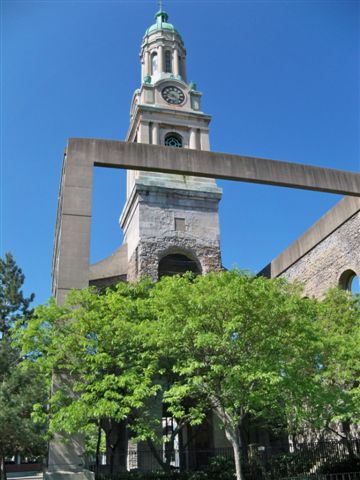
Last week Rochester’s Zoning Board heard public testimony, both in favor of, and in opposition to a developer’s plan to demolish a historic church at 660 W. Main St. in Rochester and replace it with a Dollar General store. Of all the comments made during that 2-3 hour hearing, the one drawing the most buzz was made by a member of the Zoning Board itself, Patrick Tobin . As an article in the D&C recounted, this board member expressed frustration that, “while preservationists and others urge them to protect these buildings, little is done to keep the structures from falling into severe disrepair.”
Mr. Tobin’s comment is similar to one I hear in the comments section of this blog quite frequently where preservation vs. demolition cases are discussed. Let me paraphrase… “If you loved the building so much then why didn’t you ‘preservationists’ do something about it until now? Why’d you wait until the property owner wants to tear it down?” There are so many things wrong with this line of thought there isn’t a comment box big enough for me to fit an answer in to.
Coincidentally (or should I say, as luck would have it), Wayne Goodman, Executive Director of the Landmark Society, stepped up to the podium immediately after Mr. Tobin’s comment was fired at the preservation community. And, as I expected, Goodman took great exception to the remarks.
So I reached out to Goodman and asked him to help us understand why preservationists don’t do a better job of keeping these “historic” buildings from falling into disrepair. Goodman sent me the following statement…
I’m probably going to take a lot of heat from people for the comparison I’m about to draw, but hear me out first. Then you can tell me that I’m being overly dramatic. Here it goes…
The photo above was taken last week in Xiazhangyang, China. This is the home of Luo Baogen and his wife. When the Chinese government offered them 260,000 yuan ($41,573 U.S.) to vacate their home so a new highway could be built, the elderly couple refused the offer…
I know I keep coming back to this over and over and over again. But I just can’t believe we intentionally reduced this once world-class rail station to rubble only so we could pay tens of millions 50 years later in an attempt to build a much smaller and less impressive imitation of what we once had.
I’m not going to say much more about it. I just wanted to share these recently found photos of Rochester’s half-demolished NY Central (Bragdon) Station. Like a decapitated, rotting corpse left to rot in public as a reminder of a brutal ‘auto’cracy. Most of the building was torn down in the 1960’s but one section stood like this for over a decade before it was finally removed altogether and replaced with the current Amtrak building in the mid to late 70’s. Oy, how painful…
The former Midtown Plaza site contained eight office buildings, an indoor shopping mall, Greyhound/Trailways bus station, and three levels of under-ground parking. Today, this nearly nine-acre, City-owned super-block is sloooowly being transformed…
About a month ago, someone set up a petition in opposition to a plan to demolish 660 West Main Street (formerly Westminster Presbyterian Church) and to prevent the building of a Dollar General in its place. The owner of the petition is using “Susan B. Anthony” as an alias. And this week “Susan B. Anthony” sent me a plea for help via email…
The I-Square project which was widely celebrated when it was announced last year has gotten tangled up in “negotiations” over local tax deals. Mike & Wendy Nolan want to invest $13 million to build a 7-building project including a new street, sidewalks and outdoor stage / “town square” area. They say they need a 25 PILOT agreement in order to be able to afford to build and maintain the project they’ve proposed. The Town of Irondequoit have offered a 10 year PILOT. Both sides seem to have dug in their heals. Today the Nolan’s posted a video on YouTube to explain (in detail) their 25 Year PILOT proposal “so that any questions can be answered and any misconceptions cleared up.” Watch the video…
In case you haven’t heard, plans for a transit center at University of Rochester’s College Town have been scrapped. The project is set to receive $20 Million in public loans but the D&C reported that plans for an enclosed transit center—which would have had 10 to 12 bus bays—no longer fits the developers’ needs.
The image above was printed in the Rochester Herald on October 10, 1908. This was Main Street looking east from the Four Corners on a busy day in October. The sidewalks are thronged with pedestrians. Several traffic police are standing at various spots in the intersection. A cluster of westbound trolleys, one labeled “Plymouth” and the other “Saratoga”, have stopped in their tracks. A few people are waiting to board, and others are crossing the street in front of the stopped cars. Several wagons, some covered, are traveling along the street. But then the trolley tracks were ripped up…
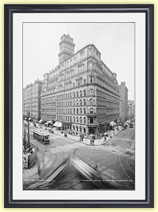
“Listed in the National Register of Historic Places and designated a city landmark, the old Federal Building is considered a fine example of Richardsonian Romanesque architecture. No one’s particularly interested in using it, however, because inside it’s dark, gloomy, usually uncomfortable and just plain ramshackle. Blow it up. It’s an ugly thing…and not particularly interesting inside or out…It should be demolished. A modern, tax-producing building would be a better use for the site and would give more new life to that section of downtown…”
RochesterSubway.com has learned that Marvin Maye, owner of 660 W. Main Street, is making a renewed push to demolish the historic church. And one local theatre group has expressed interest in saving the building…
Get Email Updates...
Stay up-to-date on Rochester-related stories, artifacts, and ideas that you won't find in the mainstream news.
Totally free, never spammy, and you can unsubscribe at any time.
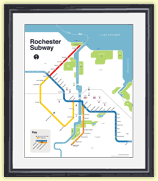
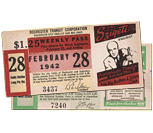
After the Erie Canal was rerouted south of downtown Rochester, the Rochester
Industrial & Rapid Transit Railway (the “subway”) was built in
its place as a link between the five different railroads and interurban trolley
lines that served the Rochester area. As the industrial landscape of Rochester
changed, and highways replaced the railroads, the Rochester subway gradually
became a relic of a bygone era. In 1956 the subway was abandoned and much of
its route was converted into Interstate 490 — built to connect Rochester
with the New York State Thruway (I-90). Read more about the history of the Rochester Subway.
RochesterSubway.com exists to help spark
public dialogue around how we can better connect the neighborhoods of Rochester
NY, surrounding communities, and their cultural offerings. Rochester’s
future is written in her past. Let's rediscover it.



















![Our second installment of 'Filling In' looks at developing the parking lots between Capron Lofts and Geva Theater. [IMAGE: Google Streetview]](https://www.rochestersubway.com/images/photos/filling-in-capron-street-01.jpg)
 , Capron Lofts
 ![Inside Rochester's Pulaski Library. [IMAGE: RochesterSubway.com]](https://www.rochestersubway.com/images/photos/rochester-pulaski-library-01b.jpg)
![Aerial view of the Main Street bridge. 1929. [IMAGE: Rochester Municipal Archives]](https://www.rochestersubway.com/images/photos/aerial-main-street-bridge-rochester-1929.jpg)
![A map of Rochester's Buildings of Historic Value [Thanks to: Jim Fraser and Joseph Becker]](https://www.rochestersubway.com/images/photos/rochester-designated-buildings-of-historic-value-map-01.jpg)
![Mike Governale at TEDxRochester. Mike is a designer, blogger, and founder of a local public transit advocacy group, Reconnect Rochester. [PHOTO: Jeffrey Hamson]](https://www.rochestersubway.com/images/photos/TEDx-Rochester-2.jpg)

![Cover of Rochester City Newspaper. June 2, 1983. [COURTESY: CITY Newspaper]](https://www.rochestersubway.com/images/photos/city-newspaper-rochester-subway-story.jpg)
![Rochester's RKO Palace Theater, September 1965. A sign is hung on the marquee proclaiming this the site of new $10 Million dollar twin towers. The theater was demolished and no towers were ever built on the site. [PHOTO: Courtesy of Rochester Theater Organ Society]](https://www.rochestersubway.com/images/photos/RKO-Palace-051-New10MillionDollarTwinTowers.jpg)
![Cyclist on the sidewalk across the street from the Midtown development, Rochester, NY. [PHOTO: Rick U, RocPX.com]](https://www.rochestersubway.com/images/photos/rochester-midtown-cyclist.jpg)

![A car stops beside a house in the middle of a newly built road in Wenling, Zhejiang province, November 22, 2012. [PHOTO: REUTERS/China Daily]](https://www.rochestersubway.com/images/photos/china-highway-built-around-house-1.jpg)
![Rochester's NY Central (Bragdon) Station half demolished, c.1970? [PHOTO VIA: John R. Stewart]](https://www.rochestersubway.com/images/photos/rochester-bragdon-station-demolition-1.jpg)


![University of Rochester president Joel Seligman showing off plans for College Town. Original plans included an enclosed public transit center. The latest plans include twice as much parking as originally called for and no transit center. [PHOTO: Democrat & Chronicle]](https://www.rochestersubway.com/images/photos/joel-seligman-college-town.jpg)
![Main Street Rochester. c.1908 [PHOTO: Albert R. Stone Collection]](https://www.rochestersubway.com/images/photos/rochester-main-street-then-and-now-1.jpg)
![Old Federal Building (now City Hall). [PHOTO: Richard Margolis]](https://www.rochestersubway.com/images/photos/rochester-city-hall-richard-margolis.jpg)