There’s really no comparison between this proposed $4 Billion transit station in San Francisco and Rochester’s Mortimer St. Bus Terminal. But watch the video anyway. It just might inspire you enough to come to the Hyatt Hotel tomorrow night…
Tomorrow (Wednesday) night RGRTA will host a 2-hour public workshop from 6-8pm to take ideas for the soon-to-be-built Mortimer St. Bus Terminal. You can protest and “Give ’em Hell”… Or you can give ’em your ideas… and help influence one of the most important public projects in Rochester’s history.
No signup is necessary, and no designs will be presented. Attendees will cycle through four workstations staffed by city and RGRTA officials, who will record people’s ideas for the center’s design. Those ideas will be posted on RGRTA website, www.rgrta.com .
UPDATE: Did you miss the RGRTA Transit Terminal design workshop? To submit your comments or ideas by mail use this form. New designs will be presented to the public on October 27.
Tonight was the City Council’s final public hearing and vote on whether or not to release a portion of Mortimer Street (in the heart of downtown Rochester) to the transit authority to build a 26-bay bus terminal. I used the opportunity not to denounce the bus terminal but more so to point out that the City of Rochester has no transportation plan. Also to sharpen my public speaking skills, which, after tonight I realize can only get better. I stumbled, I was shakey, I lost my place several times, and my mouth was so dry my tongue kept making this annoying clicking sound with every syllable. But, I delivered my message and that’s what counts. Anyway, here is the text of my statement:
According to an article in today’s Democrat & Chronicle, RGRTA has decided it does not need to produce an environmental study for it’s proposed bus garage on Mortimer Street. And the project that was despised by the public and the City when it was part of Renaissance Square looks like it will be embraced warmly at next week’s City Council meeting.
Let’s be honest, this is more than just a project…
If we’re being 100% honest with each other I have to tell you I used to pee myself with fear at the thought of having to ride Rochester’s bus system. Not because the buses are dirty—they’re actually some of the cleanest buses I’ve ever been in. And no, I’m not afraid of the “people” who ride the bus—some my best friends use RTS to get everywhere they go. I’m ashamed to say I used to avoid taking the bus because I couldn’t read those damn bus schedules. Pathetic I know.
Traveling to and from downtown wasn’t the problem. All I had to do was find a bus stop and hop on—it’s a straight shot. But if I had to get anywhere involving a transfer (which, in Rochester, is pretty much everywhere) then I was lost. How in the world would I know which bus to transfer to once I got downtown? And how long would I have to wait? Would it be quicker to walk? How do I know if this is the most direct route? How much time do I have to leave myself to catch the 7 o’clock show at the Little? AAAAAAH! Forget it! I’ll drive.
Last week members of City Council voted 8 to 1 in favor of a resolution supporting a new RGRTA bus station on Mortimer Street. The single vote against the plan came from Councilmember Carolee Conklin, who said the plan is “a 19th Century solution to a 21st Century problem.” RochesterSubway.com has obtained the following memo from Conklin to Mayor Duffy. In it she explains in detail why she is opposed to RGRTA’s proposal…
Howard Decker is new to Rochester. He moved here last Fall after spending much of his professional life designing transit systems from Chicago to Houston to Washington DC. He is a lifelong historic preservationist, an FAIA, architect, urban designer, and former Chief Curator of the National Building Museum. As a self-proclaimed “transit-geek” he is now spending time familiarizing himself with, and blogging about Rochester and working with groups such as the RRCDC and Reconnect Rochester . Last week Howard attended the public input meeting on RGRTA’s planned transit center on Mortimer Street. Today he posted his opinion on the whole thing. Read his article (below). And please attend the final public input meeting tomorrow night (May 5).
Buses and Subways and Trains, Oh My
A Town Square (May 4, 2010) — Our home place here is in the midst of considering a change to its transit system. As usual, Rochester is the perfect case study of how cities can screw themselves up with the greatest of ease. My newly adopted city, like so many of its sister places, has made a vast litany of urban gaffes over the last century, and we are about to see yet another. Let me explain.
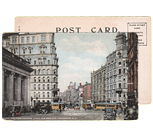
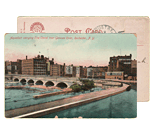
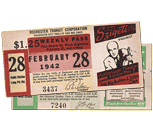
In the early 20th century, Rochester had a system of streetcars and interurbans and even a subway, all of which provided transit options to citizens. In those days, say the 1920s, the population of the city was quite a bit larger than today, though the region was much smaller – sprawl was only just getting started.
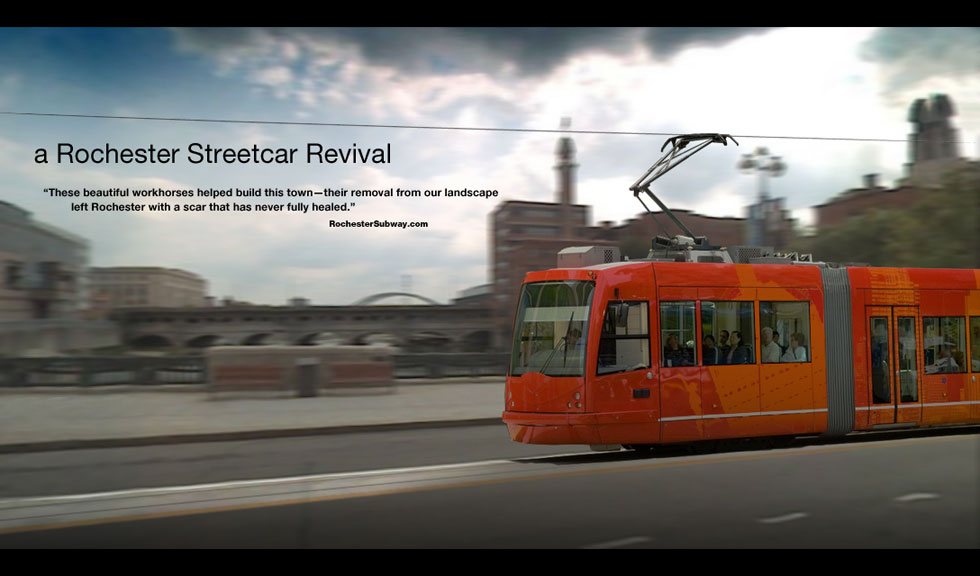
By the mid 1950s, everything was gone. Streetcars gone. Interurbans gone. Subway gone. Left on the roads? Cars, and buses. Retail was headed out of town, following all those who began to sprawl. Downtown’s fate was sealed…
America seems to have taken a renewed interest in mobility. Maybe due to President Obama’s recent commitment to high speed rail—or perhaps the positive results seen in towns like Portland and Denver have caught our collective attention. Whatever the reason, from the top down, people are rethinking our automobile-oriented culture—and getting excited about the possibilities.
There’s also good reason to focus on transportation as a way of jump-starting economic development. Industry requires access to people. And people need to have easy access to centers of employment. Continually improving access makes further development possible. Interrupting access will have the opposite effect. Likewise, doing nothing or simply maintaining existing infrastructure for an extended period of time will also hinder development.
For 30+ years Rochester has relied on the infrastructure choices it made in the 1950’s, 60’s, and 70’s. At that time we made development choices that encouraged our population to emigrate from the downtown core. We scrapped our extensive streetcar system, choked off downtown with the construction of the inner-loop, and paved super highways to take us from the city to the NY State Thruway and beyond. Since then that’s exactly where our money, our workforce, and our future have gone—down I-490 and out of state.
If I said Rochester may one day have a rapid transportation system linking RIT to downtown Rochester and beyond, you might automatically think ‘light rail’. Think again. RochesterSubway.com recently discussed the future of Rochester’s transportation infrastructure with Richard Perrin, Executive Director of the Genesee Transportation Council and an AICP certified city planner.
NOTE: If you’ve got a question that we didn’t ask in our interview, please leave a comment at the end of this post and we’ll pass it along to Mr. Perrin who will do his best to answer it as time permits.
Get Email Updates...
Stay up-to-date on Rochester-related stories, artifacts, and ideas that you won't find in the mainstream news.
Totally free, never spammy, and you can unsubscribe at any time.
After the Erie Canal was rerouted south of downtown Rochester, the Rochester
Industrial & Rapid Transit Railway (the “subway”) was built in
its place as a link between the five different railroads and interurban trolley
lines that served the Rochester area. As the industrial landscape of Rochester
changed, and highways replaced the railroads, the Rochester subway gradually
became a relic of a bygone era. In 1956 the subway was abandoned and much of
its route was converted into Interstate 490 — built to connect Rochester
with the New York State Thruway (I-90). Read more about the history of the Rochester Subway.
RochesterSubway.com exists to help spark
public dialogue around how we can better connect the neighborhoods of Rochester
NY, surrounding communities, and their cultural offerings. Rochester’s
future is written in her past. Let's rediscover it.