Welcome readers. I’m going on a slight deviation from my usual “Filling In” article to talk about the mean streets of Rochester. Let’s take a look at, eh, Main St. Yeah, Main St. What’s that looks like? Ok, well, there’s some tall(ish) buildings built to the street. There’s sidewalk, theoretically two driving lanes in each direction, and (supposedly) some street trees. If I were to give this street a grade, it would get an “in-complete.”
Oy, how I wish I could reconfigure things! Just pick stuff up and move it around. Maybe add a cycle track or a tree-lined median. Heh heh… can you say, STREET REMIX?!
One of the sites that the city has, let’s say aspirationally, earmarked for development is the site of the former Sherwood Shoe Company. The shoe company itself was incorporated in 1905 by Frederick A. Sherwood, and the factory for it was built on this site at roughly the same time. I’m less sure when it was torn down, but it is on the 1935 plat maps, so it was certainly there through the depression. (UPDATE: the photo above is from 1956)
As for what to do here, I think there are a million great ideas, and I am hoping that we are able to get a good conversation of the various uses: lofts where the factory used to be? More houses? All of these things and more? All great ideas, and I’m not one to come to the table empty handed, so let’s take a look at what I think should go here.
Welcome back dear readers. Today we’re going to try something a little different at Filling In. Let’s actually walk through a lightweight proposal in response to the city’s RFP for 19 and 21-23 Berlin St (due by 4pm this Friday, 7/19). Just as a disclaimer; I do not intend to submit this proposal. Additionally, you are welcome to take it and submit it, but I am not to be held liable for any damages should you do so.
Wow it’s been a while! This week, Let us take a look at Rochester’s best shot at an iconic piece of post-modern architecture downtown. No, not Midtown Tower. I’m talking about Midtown Plaza’s undeveloped “site 6”. As a quick refresher, here are the current plans:
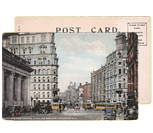
Oh 1926, it seems like you were only 87 years ago. Oh wait, what, it was only 87 years ago? Ok then. Well, since the Neighborhood of the Arts is receiving so much press these days, let’s take a look at a piece of the neighborhood from then and see what was happening.
A great deal has already been written about the development planned at 933 University Ave. (see: here , here , and here ). Even so, it is important that we take a step back and really think about the kinds of arguments that are being made. Further, let us consider how the neighborhood could benefit from this development, how George Eastman House can meet its needs going forward (and better integrate with Neighborhood of the Arts, as they express a desire to do), and how to move the entire neighborhood towards the increased success it deserves…
The Landmark Society is partnering with the Park-Meigs Neighborhood Association to hold a public forum on the evening of Tuesday, May 21 at 597 East Avenue . Up for discussion: the timely and controversial topic of new development in preservation districts. This is a community conversation you will NOT want to miss.
A panel of speakers, representing developers, homeowners, business owners, urban planners, and The Landmark Society, will offer their perspective, followed by an open question and answer session. Speakers include Wayne Goodman, Executive Director of The Landmark Society; Glenn Kellogg, Urban Advisors; Joe Hanna, Hanna Properties; Steve Vogt, Rochester Young Professionals. RocSubway contributor, Matthew Denker will also weigh in. Can new development benefit preservation districts? How can the new co-exist with the old? What is “good” development? These are some of the questions this forum will attempt to address.
Dear readers, let’s take a short break from redeveloping Rochester. Instead, can we take a moment to consider that which we’ve lost? That which we can still repair?
This week, let’s talk about parks. Specifically, let’s talk about Lomb Memorial Park, and Schiller Park. But first, take a look at Columbus Circle in New York City (above). Oh man! Look at poor Christopher Columbus hanging out there all alone in the middle of traffic. At least he has a convenient parking spot for his car. Wait, what? You say that Columbus Circle doesn’t look anything like that? Well, I guess it doesn’t, now…
As some of you may or may not know, the city has finally released a Request for Proposals (RFP) on 88 Elm Street . Up front, here’s a link to the RFP , in case you run a development company, or if you’re Larry Glazer and you’re looking for another project to work on.
In any event, here’s some background on 88 Elm St. Somehow, despite being built sometime in the 60s, no one is exactly sure when 88 Elm St. was constructed, or where, exactly, it came from. You’d think that’d be impossible in this day and age, but it’s not. In 1998, the city decided it had enough of the owners of the property not paying their taxes and they took it. All well and good, except now it’s been empty for 15 years. It’s emptier than you might think. The city spent more than a million dollars on an asbestos abatement and a new roof. The building has no electrical system, no sprinkler system, no HVAC, no plumbing. It is a completely bare 13 story tower. That’s a bit of a rarity, and it could be yours for only $360,000. Apparently that’s the market rate for the 13-story husk of a building…
One of the best places to put additional density is near public parks. Why you ask? Well, that’s an excellent question. Not only do parks double as excellent backyards that homeowners don’t need to mow, but they provide excellent views (that will never go away), and density around parks makes the parks themselves more attractive to passers-by.
All of this translates to adding housing around pre-existing parks. This should be a priority for the city. While I am hoping to tackle a master plan for Brown Square Park (by Frederick Law Olmsted, no less!), let’s start out with something a little smaller…
Well, dear readers, I must admit that this is not exactly what I had planned when I left you the last time. That said, please bear with me while we look at something a little bit different.
John Baker, Steve Gullace, Chris Gullace have proposed to construct a new gym and a 48 unit apartment building at 759 Park Ave . The gym would be for the Talmudic Institute next door, while the apartments would be for rent. This has, not surprisingly, drawn a raft of criticism from the residents of the Park Ave neighborhood…
Last week RocSubway learned that developer Thomas Masaschi is converting the old Ted Cohen’s Office Furniture store into three upscale penthouses, lofts and retail space on the first floor. You know the place ; behind the Hess gas station on Monroe Ave. So we thought, for this week’s edition of “Filling In,” why not look at Monroe Ave, and how we could make one of Rochester’s most walkable strips even better! We’ll focus on a few small changes that could be implemented quickly, and then a few bigger ideas for the corridor going forward…
Welcome back! Last week we looked at a block that almost had it all. This week, let’s see what we can do on a much larger scale with a block that needs a little more work. A roughly 600’x600’ square mega block at the southern entrance to downtown. There are a few good things going on here; Geva Theater , Capron Lofts , Plan Architects . And, a few not so good; a sweeping highway off-ramp, a GIANT parking lot across the street from TWO garages, and random weedy surface lots…
Welcome to the first post in what will be an ongoing series called Filling In. One of the key elements of any great city is a tightly knit urban fabric. Whether you’re in New York City, San Francisco, or our own beloved Rochester, building an appealing city scape at a human, walkable scale promotes health, wealth, and wisdom. We’ve also learned that parks next to parks next to barren windswept plazas don’t put butts in seats, as they say. With that in mind, Filling In aims to explore vacant or underutilized pieces of Rochester in an effort to rebuild or strengthen our built environment. The aerial photo above was taken in 1929, when downtown was dense and energetic. And here is a reminder of what we’re up against…
RochesterSubway.com has been digging up stories from Rochester’s past and uncovering new ideas that will undoubtedly shape our community’s future. The following individuals are active contributors to the site but ANYONE—including YOU—may contribute a story (or a rant) at any time as long as it has something to do with Rochester, NY. Submit your story by emailing [email protected].
Get Email Updates...
Stay up-to-date on Rochester-related stories, artifacts, and ideas that you won't find in the mainstream news.
Totally free, never spammy, and you can unsubscribe at any time.
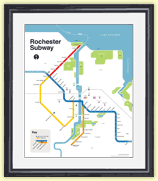
After the Erie Canal was rerouted south of downtown Rochester, the Rochester
Industrial & Rapid Transit Railway (the “subway”) was built in
its place as a link between the five different railroads and interurban trolley
lines that served the Rochester area. As the industrial landscape of Rochester
changed, and highways replaced the railroads, the Rochester subway gradually
became a relic of a bygone era. In 1956 the subway was abandoned and much of
its route was converted into Interstate 490 — built to connect Rochester
with the New York State Thruway (I-90). Read more about the history of the Rochester Subway.
RochesterSubway.com exists to help spark
public dialogue around how we can better connect the neighborhoods of Rochester
NY, surrounding communities, and their cultural offerings. Rochester’s
future is written in her past. Let's rediscover it.

















![The current view looking west down Main Street, Rochester. Blah. If only we could rearrange things. [IMAGE: Google Streetview]](https://www.rochestersubway.com/images/photos/remix-your-street-01b.jpg)
![A view of the Rochester Subway looking east from the Meigs Street bridge. A westbound car is shown approaching the Goodman-Meigs station. The Sherwood Shoe Company building on Goodman Street and Uhlen Place is seen in the right background. [PHOTO: Rochester Municipal Archives]](https://www.rochestersubway.com/images/photos/rochester-subway-and-sherwood-shoe-company-1956.jpg)

![19-23 Berlin Street [IMAGE: Google Maps]](https://www.rochestersubway.com/images/photos/19-23-berlin-street-rochester.jpg)

![The corner of Atlantic and Anderson in the Holmes Tract. Gleason doesn't want this lot anymore. Maybe we can put it to good use? [PHOTO: Google Streetview]](https://www.rochestersubway.com/images/photos/filling-in-holmes-tract-01.jpg)
![Proposed new development at 933 University Ave. [IMAGE: Morgan Management]](https://www.rochestersubway.com/images/photos/933-university-ave-06.jpg)

![Columbs Circle, maybe early 1970's? [PHOTO: andrewcusack.com]](https://www.rochestersubway.com/images/photos/filling-in-reparations-01.jpg)
![88 Elm Street. 13 floors of empty waiting for you to do something with it. [PHOTO: City of Rochester]](https://www.rochestersubway.com/images/photos/filling-in-88-elm-01.jpg)

![John Baker, Steve Gullace, Chris Gullace have proposed to construct a new gym and a 48 unit apartment building here at 759 Park Ave. [IMAGE: Bing Maps]](https://www.rochestersubway.com/images/photos/filling-in-park-avenue-02.jpg)
![This week's edition of 'Filling In' looks at some small changes that could make Monroe Avenue even better. [PHOTO: RocPX.com]](https://www.rochestersubway.com/images/photos/monroe-avenue.jpg)
![Our second installment of 'Filling In' looks at developing the parking lots between Capron Lofts and Geva Theater. [IMAGE: Google Streetview]](https://www.rochestersubway.com/images/photos/filling-in-capron-street-01.jpg)
![Aerial view of the Main Street bridge. 1929. [IMAGE: Rochester Municipal Archives]](https://www.rochestersubway.com/images/photos/aerial-main-street-bridge-rochester-1929.jpg)