Accidents are an unfortunate yet prevalent part of everyday life, with significant risks that can often be minimized through proper awareness and preventive measures. In Rochester, as in many places, understanding the gaps in safety practices and the common causes of accidents can help in creating a safer community. By examining statistics and facts, we aim to shed light on preventable risks and explore pathways to reduce them significantly.
Bicycling Risks and Road Safety
Bicycling, although a popular mode of transport and recreation, harbors significant risks due to road accidents. Reports show that annually, approximately 1,000 bicyclists meet fatal ends on U.S. roads, with over 130,000 affected by collisions. This startling figure highlights the urgency for improved cycling infrastructure and stringent enforcement of traffic rules. In Rochester, initiatives for enhancing bike lanes and public awareness campaigns can drastically lower accident occurrences. Emphasis on wearing helmets and obeying road signals should be an integral part of these safety measures.
The concept of shared road space between cyclists and motorists is often fraught with challenges, leading to tragic incidents. It is crucial to acknowledge the vulnerabilities cyclists face while navigating through city traffic. Adopting a collaborative approach involving city planners, law enforcement, and the local community can contribute towards safer roads. For instance, the city’s role in deploying more bike-friendly pathways plays a crucial role in accident prevention. Residents of Rochester can also contribute by staying informed and respectful towards one another on the road.
Public safety campaigns focus heavily on education, ensuring that both cyclists and motorists understand their responsibilities. Enhanced visibility measures, like reflective clothing or improved street lighting, can be cornerstone strategies to prevent nighttime accidents. With the right combination of policy and public action, Rochester can set a benchmark in urban cycling safety. Continual data analysis and feedback loops will further refine prevention strategies, reducing the risk for cyclists effectively.
Automotive Accidents: A Predominant Risk
Across the country, automotive accidents present a grave concern, making up a substantial portion of injury cases. Reports indicate that 61% of personal injury claims stem from car accidents, emphasizing the need for improved vehicular safety measures. In Rochester, like many urban centers, traffic congestion amplifies the risk of collisions, underscoring the importance of defensive driving practices. Regular updating, routine check-ups, and following traffic guidelines are vital for every road user’s safety. Rochester’s municipal authorities must also invest in better traffic control systems to mitigate accident risks.
Human error is often a significant contributor to car crashes, highlighting the importance of continuous driver education. Defensive driving classes can be essential in equipping residents with the skills needed to anticipate and react appropriately in hazardous situations. The city can also leverage technology, using apps and online platforms to disseminate information quickly and efficiently to all drivers. By integrating current technologies, such as real-time traffic alerts, Rochester can take a significant step towards reducing the number and severity of road incidents. Predictive analytics can further forecast high-risk areas and times, allowing for preemptive safety measures.
Rochester’s road safety can also improve through collaboration with car manufacturers and insurers. Encouraging the adoption of new safety technologies in vehicles, such as automatic braking systems, can drastically reduce accidents. Additionally, insurance incentives for drivers who demonstrate safe practices can motivate a culture focused on accident prevention. With concerted efforts from all stakeholders, the number of road-related injuries can significantly decline, ensuring safer streets for all residents.
Workplace Safety: Addressing Lift Accidents
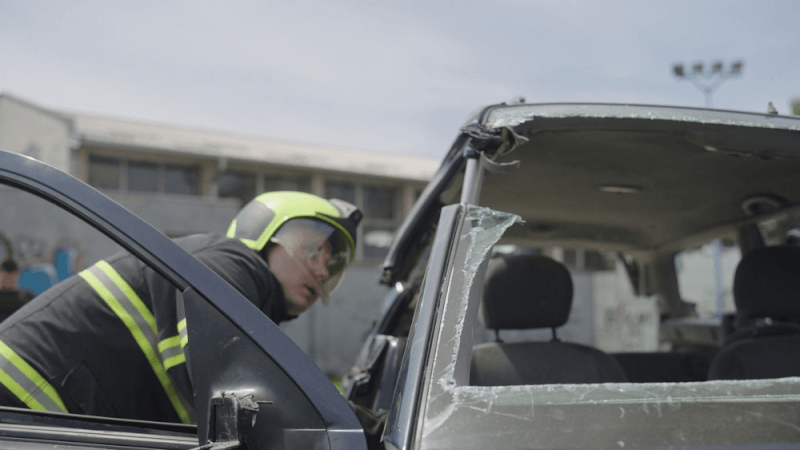
In industries where automotive lifts are frequently used, such as automotive repair, safety standards are essential to prevent avoidable accidents. Reports highlight that more than 50% of lift-related accidents occur due to inadequate maintenance and insufficient inspections. As a precaution, employers and workers in Rochester are urged to adhere strictly to safety standards and schedules for regular lift certifications. Negligence in workplace safety protocols can lead to both human and material costs, which are largely preventable through proper diligence. Creating a culture focused on proactive safety measures could significantly diminish workplace hazards.
Training programs and compliance checklists play a critical role in minimizing lift-related mishaps. Employers in Rochester should prioritize regular staff training sessions on equipment handling best practices. Implementing periodic safety audits can also ensure adherence to industry standards, thus reducing the likelihood of accidents. Additionally, providing quick access to emergency procedures can further heighten workplace safety. A culture of transparency, where workers feel comfortable reporting potential hazards without fear of retaliation, can foster a safer working environment.
Modernizing existing infrastructure in automotive repair shops by investing in state-of-the-art equipment is another prevention strategy. By continuously assessing and updating mechanical lifts and related machinery, risks can be managed effectively. Communication between safety equipment manufacturers and users is key to staying abreast of the latest safety protocols. Rochester can become a leader in workplace safety through innovation and shared responsibility. Ultimately, proactive efforts in maintaining safe workplaces will contribute to reducing overall accident statistics.
In conclusion, preventing accidents in Rochester requires a multi-faceted approach involving the cooperation of the entire community. By addressing the specific risks associated with bicycling, driving, and workplace safety, significant strides can be made. Adopting new technologies, educational campaigns, and enforcing strict safety standards can collectively bridge the safety gap, ensuring the well-being of residents and setting a precedent for other cities to follow.
For those who want to take advantage of walking, there are some good eco-conscious decisions you can make in the city of Rochester and surrounding areas. There are great benefits that impact your wallet, your health, and others in your environment. If you want to know how walking can truly be economical and environmental, keep reading for more information.
Are you planning to move to another state with your family? Statistics show one-third of people who are renters will move each year. If you’re not already considering Rochester, NY, there are many reasons you should do so. Here are some of the reasons why you should make Rochester your next home:
Preventing drunk driving in Rochester, or any community for that matter, is an essential safety measure. According to the Department of Transportation, there are around 1.4 billion cars in the United States. Drunk driving is blamed for over 37 deaths every day in the United States. Prevention programs to stop drunk driving save lives. Here are some of the ways Rochester can get the problem under control.
Rochester is a beautiful and charming city based in Upstate New York. It’s a destination steeped in culture featuring museums, art galleries, performance arts, jazz music, and education, and is known as the “birthplace of amateur photography.” Rochester is also fondly known as the city of flowers because it’s home to magnificently beautiful lilac flowers, with the first bush planted in the 1890s. Today, Rochester also celebrates the much-anticipated annual Lilac Festival.
If you’re looking to move, today’s article discusses some things to know before relocating to Rochester, New York.
Rochester is one of the most beautiful cities in New York, offering views of stunning natural scenery and a thriving downtown. However, it is also one of the most congested cities in the US, making driving a headache for residents and visitors alike. Fortunately, there are plenty of reasons to leave your car behind and start walking instead. From mental health benefits to reduced carbon footprint, Rochester’s sidewalks offer many advantages that cars don’t.
Snowsports in Rochester are meant to be exciting and memorable. Ice hockey is filled with intensity and speed, while cross-country skiing will leave you feeling breathless, exhilarated, and eager for more fun. When you come to Rochester, be sure to visit these five locations. These are the best places to participate in snow sports while you’re in Rochester.
Crafting has taken on a whole new life. People are finding that they can make desired goods that will make them a little money along the way. Plenty of crafting groups have sprung up on social media that specifically look at helping people in the Rochester area find ways to sell their lovely products, but it goes beyond that as well. There are many great places in the physical space of Rochester that are also great for selling products and making some extra money.
There is some unfortunate news regarding driving in Rochester, New York. The police and media have reported an increase in carjackings, and if you’re a driver you know that’s trouble. Carjackers are often armed, violent, and desperate to get away from the scene of a crime, making the situation very volatile if you’re unprepared or choose to fight back. Even though carjackings are on the rise, there is evidence that suggests that it’s still safe to drive in Rochester, so long as you know what you’re doing.
If you were one of the many people looking forward to the Rochester Auto Show this year, you’re unfortunately out of luck. COVID-19 and its spread have canceled this event for the year, leaving many people with few options for fun. Thankfully, there are still many things that you can do to keep yourself entertained and avoid pandemic boredom concerns. These ideas might just help you get through this tough time.
Welcome back, readers! In this edition of Filling In, let’s take another look at Parcel 5. Before we get started, quickly refresh by scouting the last time we discussed this site. I apologize in advance that this article probably isn’t going to cover much more about what I think should be done with the site, rather, what should probably not be done, and why…
It will actually be warm soon—and stay warm. But, when you live in upstate NY you don’t necessarily wait for the ground to thaw to start your housing search. Smart shoppers know the best spots don’t last long on the market, whether it’s a new build, a fixer upper or a historic landmark. Now there’s another tool you can add to your home buying tool box.
The City of Rochester, City Council, and the Rochester Coalition for Neighborhood Living have launched Celebrate City Living , a new program to help homebuyers and renters learn about the benefits of living in the city and find the resources to make it easier to buy or rent a home in Rochester…
When we last spoke, it was Halloween, and we were on the eve of our first zoning board of appeals and preservation board hearings. It’s now March and we’ve been to two hearings for each board, and spoiler alert, we’ve received approval(s) from each. Yay! But now that we’re here, let’s take a look at the process and all the fun we had…
And now for the final chapter of our little zoning adventure. This is the part where you, the gentle reader, are given the opportunity to read a final few hundred words about the kinds of zoning changes that would really make a difference in Rochester. If that sounds terrible (it might be), don’t click on.
You may have noticed the City of Rochester went red last night. February is American Heart Month and buildings including Xerox Tower, Kodak Tower, One East Avenue, Rundell Library, and City Hall were lit up to show support for National Wear Red Day and raise awareness about heart health…
Well, it had to come to this – a whirlwind article about everything else in Rochester. We’re going to run the gamut from Industrial, to all the Center City District (CCD) zones to Open Space, and everything inbetween. Buckle Up…
Here’s a quick update on a story we brought attention to exactly five years ago. On this empty lot (shown above) once stood 72 Conkey Avenue. The old 19th century Victorian storefront had been the subject of a demolition-vs-rehabilitation debate—one between the City of Rochester and neighborhood resident, Jim Fraser, who has restored a handful of neglected homes in the area. Jim saw 72 Conkey as a diamond in the rough…
Hope your heart is still racing from our introduction to Zoning last week, because this week we’re talking about residential zoning in Rochester!
Contrary to common knowledge, residential zoning isn’t exclusively for residences (nor is commercial zoning exclusively for commercial – it’s a good place to build apartments, in fact). That said, Rochester has 3 specific residential zones that we’re discussing here. Grab your bow tie and let’s go…
Get Email Updates...
Stay up-to-date on Rochester-related stories, artifacts, and ideas that you won't find in the mainstream news.
Totally free, never spammy, and you can unsubscribe at any time.
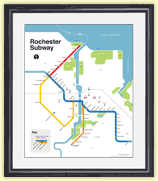
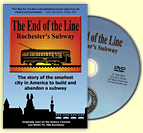
After the Erie Canal was rerouted south of downtown Rochester, the Rochester
Industrial & Rapid Transit Railway (the “subway”) was built in
its place as a link between the five different railroads and interurban trolley
lines that served the Rochester area. As the industrial landscape of Rochester
changed, and highways replaced the railroads, the Rochester subway gradually
became a relic of a bygone era. In 1956 the subway was abandoned and much of
its route was converted into Interstate 490 — built to connect Rochester
with the New York State Thruway (I-90). Read more about the history of the Rochester Subway.
RochesterSubway.com exists to help spark
public dialogue around how we can better connect the neighborhoods of Rochester
NY, surrounding communities, and their cultural offerings. Rochester’s
future is written in her past. Let's rediscover it.


















![2008 Conceptual plan for Midtown by the City of Rochester [PHOTO: City Hall Photo Lab Contemporary Collection]](https://www.rochestersubway.com/topics/wp-content/uploads/Original_Conceptual_Plan.jpg)
![Xerox Plaza [PHOTO: Author]](https://www.rochestersubway.com/images/photos/denker/links/Xerox_Plaza.jpg)
![Celebrate City Living is a new program aiming to help homebuyers and renters learn about the benefits of living in the city. [Image: Provided]](https://www.rochestersubway.com/images/photos/celebrate-city-living-01.jpg)


![Cleaning at Rochester's Lower Falls [PHOTO: The Lower Falls Foundation]](https://www.rochestersubway.com/images/photos/denker/links/Cleaning_Rochester_Lower_Falls.jpg)

![Rochester buildings were illuminated in red yesterday for National Wear Red Day, an event to raise awareness about heart disease & stroke for the American Heart Association. [Image: Kathy Oehling Photography]](https://www.rochestersubway.com/images/photos/rochester-buildings-go-red-for-heart-disease-01.jpg)

![72 Conkey Avenue has been demolished. [IMAGE: RochesterSubway.com]](https://www.rochestersubway.com/images/photos/clifford-and-conkey.jpg)
![34 Atkinson Street - An utterly illegal house to build today. [IMAGE: Google]](https://www.rochestersubway.com/images/photos/denker/zoning/34_Atkinson_St.jpg)