I live in America’s first boom town—Rochester, New York—on Linden Street. Linden trees, unsurprisingly, line much of my street. Down the street is the Genesee River, once one of America’s most polluted—and possibly still. My street is a historic district that was once part of the world’s largest nursery. The Ellwanger and Barry Company supplied the first fruit trees to California…
This little tree caught my attention yesterday on State Street downtown. First of all, it’s wearing a totally rad sweater. But also, this tree has been buttoned up for a good cause. I totally dig stuff like this…
One evening sometime during the fall of 2011, my friend Chris and I were sitting around complaining about the ways of the world. The conversation eventually turned towards discussing how despite both of us having been born and raised in Rochester, NY, how neither one of us had ever bothered to visit any of the “cool looking” spiritual places of worship in the area, like St. Michael’s Church or St. Stanislaus Church…
Historic buildings are under attack, especially in Western New York. Indeed, the month of May is potentially the saddest month locally for historic structures in recent memory. Within a short time, the Otisca Brewery building in Syracuse, the Cataract Brewery buildings in Rochester, and the Bethlehem Steel North Office Building in Lackawanna will be gone—ashes on the dust heap that is our shoddy collective memory. All of these buildings were once useful—integral, in fact—pieces of our industrial past. Soon, these structures will be removed, thus helping three communities to ponder if they were ever part of the “rust belt.”
The spate of recent articles in the D&C regarding local construction projects also means that there will be a great amount of demolition of older buildings and historic properties. Take, for example, the recent decision to demolish the Cataract Brewery buildings in High Falls. The cost to demolish the properties alone—estimated at $800,000 to $1 million—is more than twice the amount for which Genesee Brewery was recently selling the two Cataract Brewery buildings and a large parking lot. That same amount could be used to install a new roof and windows, “button up” the building, and abate the lead paint, within the older “gem” brewery building. Although the oldest Cataract building is currently a “liability” in the words of a developer who recently toured the property, it could actually act as the driver for redevelopment. Historic Preservation Tax Credits, coupled with city, county, state, and federal monies, could pay for at least 30-40% of construction costs, and potentially way more if the City took on the lead abatement costs and Genesee Brewery and its owner, KPS Capital, acted as an investor or partner in redevelopment.
RochesterSubway.com has been digging up stories from Rochester’s past and uncovering new ideas that will undoubtedly shape our community’s future. The following individuals are active contributors to the site but ANYONE—including YOU—may contribute a story (or a rant) at any time as long as it has something to do with Rochester, NY. Submit your story by emailing [email protected].
Get Email Updates...
Stay up-to-date on Rochester-related stories, artifacts, and ideas that you won't find in the mainstream news.
Totally free, never spammy, and you can unsubscribe at any time.
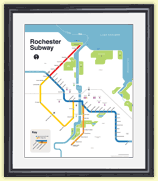
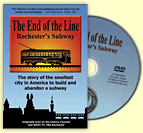
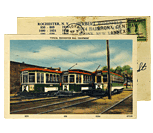
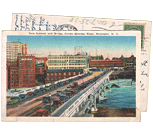
After the Erie Canal was rerouted south of downtown Rochester, the Rochester
Industrial & Rapid Transit Railway (the “subway”) was built in
its place as a link between the five different railroads and interurban trolley
lines that served the Rochester area. As the industrial landscape of Rochester
changed, and highways replaced the railroads, the Rochester subway gradually
became a relic of a bygone era. In 1956 the subway was abandoned and much of
its route was converted into Interstate 490 — built to connect Rochester
with the New York State Thruway (I-90). Read more about the history of the Rochester Subway.
RochesterSubway.com exists to help spark
public dialogue around how we can better connect the neighborhoods of Rochester
NY, surrounding communities, and their cultural offerings. Rochester’s
future is written in her past. Let's rediscover it.




















![Lilacs in Highland Park, Rochester, NY. [PHOTO: Rich Engelbrecht, via Flickr]](https://www.rochestersubway.com/images/photos/lilacs-highland-park-rochester.jpg)

![A stained glass window in Rochester's Saint Michael's Church, Rochester NY. [IMAGE: www.exploringtheburnedoverdistrict.wordpress.com]](https://www.rochestersubway.com/images/photos/saint-michaels-church-stained-glass-rochester.jpg)

![This is the former Bethlehem Steel North Office Building in Lackawanna, NY. Designed by noted New York City architect Lansing C. Holden, this magnificent Beaux Arts building was originally designed for the Lackawanna Steel Company in 1902. It will likely be demolished within weeks. [Photo: Derek Gee, Buffalo News]](https://www.rochestersubway.com/images/photos/buffalo-bethlehem-steel-headline.jpg)

![Genesee Brewery. [Flickr Photo: _Yoshi_]](https://www.rochestersubway.com/images/photos/genesee-brewery-sign-yoshi.jpg)