Last summer Rochester developer and restauranteur, John Tachin called up RocSubway with a history mystery for us to solve. After four months of digging, we came up empty. But here’s hoping maybe YOU can help us solve the case of the stone lions.
Welcome to Part 2 of Filling In: 37 Eagle Street. It’s been a while, so to catch you up, in Part 1 my wife and I bought an empty lot at 37 Eagle Street in Corn Hill. But the fun doesn’t stop there. We decided to build ourselves a house on it, and we’re going to take you along for the ride!
Today I want to talk about architects. Just for starters, we decided we did not want off-the-shelf plans and would instead pay (about 10% of the overall project budget) for a house to be designed from scratch…
You do not have to be a designer to see that Rochester has a problem—well, a number of problems, actually. That we continue to make the same mistakes, however, regarding design of our built environment, is perhaps one of the most egregious. This column highlights some of the worst offenders in Rochester—some of which are still being built…
All the controversy over whether or not to demolish the 120 year-old brewhouse at 13 Cataract Street got us thinking. Those in favor of demolishing the building say it’s an eyesore and a haven for drug dealers; even prostitutes. So, just remove the building and our problems go away.
Right?
But if we demolished every eyesore in Rochester, would we have solved all the City’s problems? Or might we end up tossing the proverbial “baby” out with the bath water? For the next two weeks we’ll take a look at some local eyesores …or rather, opportunities, nearly lost.
Get Email Updates...
Stay up-to-date on Rochester-related stories, artifacts, and ideas that you won't find in the mainstream news.
Totally free, never spammy, and you can unsubscribe at any time.
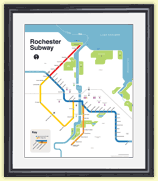
After the Erie Canal was rerouted south of downtown Rochester, the Rochester
Industrial & Rapid Transit Railway (the “subway”) was built in
its place as a link between the five different railroads and interurban trolley
lines that served the Rochester area. As the industrial landscape of Rochester
changed, and highways replaced the railroads, the Rochester subway gradually
became a relic of a bygone era. In 1956 the subway was abandoned and much of
its route was converted into Interstate 490 — built to connect Rochester
with the New York State Thruway (I-90). Read more about the history of the Rochester Subway.
RochesterSubway.com exists to help spark
public dialogue around how we can better connect the neighborhoods of Rochester
NY, surrounding communities, and their cultural offerings. Rochester’s
future is written in her past. Let's rediscover it.

















![Here's hoping maybe YOU can help us solve the case of the stone lions. [PHOTO: RochesterSubway.com]](https://www.rochestersubway.com/images/photos/benvenuto-stone-lions-rochester-ny-01.jpg)
 , this one’s a doozy…
![Dehumanizing architecture like this has been popping up all over Rochester for decades. [IMAGE: RochesterSubway.com]](https://www.rochestersubway.com/images/photos/fortified-rochester.jpg)