Have you seen one of these big pink mustaches tooling around town lately? This past April a ridesharing service called Lyft entered the Rochester market. Lyft connects people—via mobile app—who need a ride with drivers in their area. The pink facial hair is sort of the calling card of the Lyft brand.
Recently I got to talking with a local Lyft driver, Fred from Penfield, and he says from his point of view, the service has been a smashing success. “There are about 40 of us in Rochester,” says Fred. “We are similar to Uber and Sidecar, but we are much friendlier and have a much bigger focus on safety.”
Besides the pink moustaches, it’s also common for drivers and passengers to fist pump at the start of each ride. The following is a summary of our conversation about Lyft…
The City of Rochester has contracted with Laberge Group of Albany, New York to determine the feasibility of converting the one-way street couplets of St. Paul Street/South Avenue and North/South Clinton Avenue between Byron Street and Cumberland Street to two-way traffic to improve neighborhood accessibility and walkability. Key considerations are expected to include impacts to traffic congestion, safety, parking, bicyclists, pedestrians, transit, and service provision.
I just read an article in Sunday’s Albany Times Union that has me scratching my head. Mark Aesch, CEO of the Rochester Genesee Regional Transportation Authority, wants to consolidate the four big transit authorities of upstate New York—Albany, Syracuse, Rochester, and Buffalo. On the surface it seems to make sense. They each do the same thing in relatively similar cities in a single state. But does Aesch really believe consolidating operations across a 250 mile wide region will lead to better public transit service for all four regions? Or are we witnessing the beginning of a power grab?
Get Email Updates...
Stay up-to-date on Rochester-related stories, artifacts, and ideas that you won't find in the mainstream news.
Totally free, never spammy, and you can unsubscribe at any time.
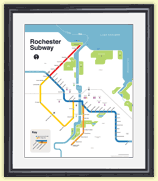
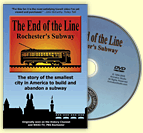
After the Erie Canal was rerouted south of downtown Rochester, the Rochester
Industrial & Rapid Transit Railway (the “subway”) was built in
its place as a link between the five different railroads and interurban trolley
lines that served the Rochester area. As the industrial landscape of Rochester
changed, and highways replaced the railroads, the Rochester subway gradually
became a relic of a bygone era. In 1956 the subway was abandoned and much of
its route was converted into Interstate 490 — built to connect Rochester
with the New York State Thruway (I-90). Read more about the history of the Rochester Subway.
RochesterSubway.com exists to help spark
public dialogue around how we can better connect the neighborhoods of Rochester
NY, surrounding communities, and their cultural offerings. Rochester’s
future is written in her past. Let's rediscover it.










![Lyft is a San Francisco–based company whose mobile-phone app facilitates peer-to-peer ridesharing; enabling passengers who need a ride to request one from drivers in their area. [PHOTO: Flickr, Bootleggerson]](https://www.rochestersubway.com/images/photos/lyft-ridesharing-bootleggersson.jpg)
 entered the Rochester market. Lyft connects people—via mobile app—who need a ride with drivers in their area. The pink facial hair is sort of the calling card of the Lyft brand.